





Question: Prove that for every integer n where n is greater than or equal to 2, P (n, n) = P (n, n 1). For full
Prove that for every integer n where n is greater
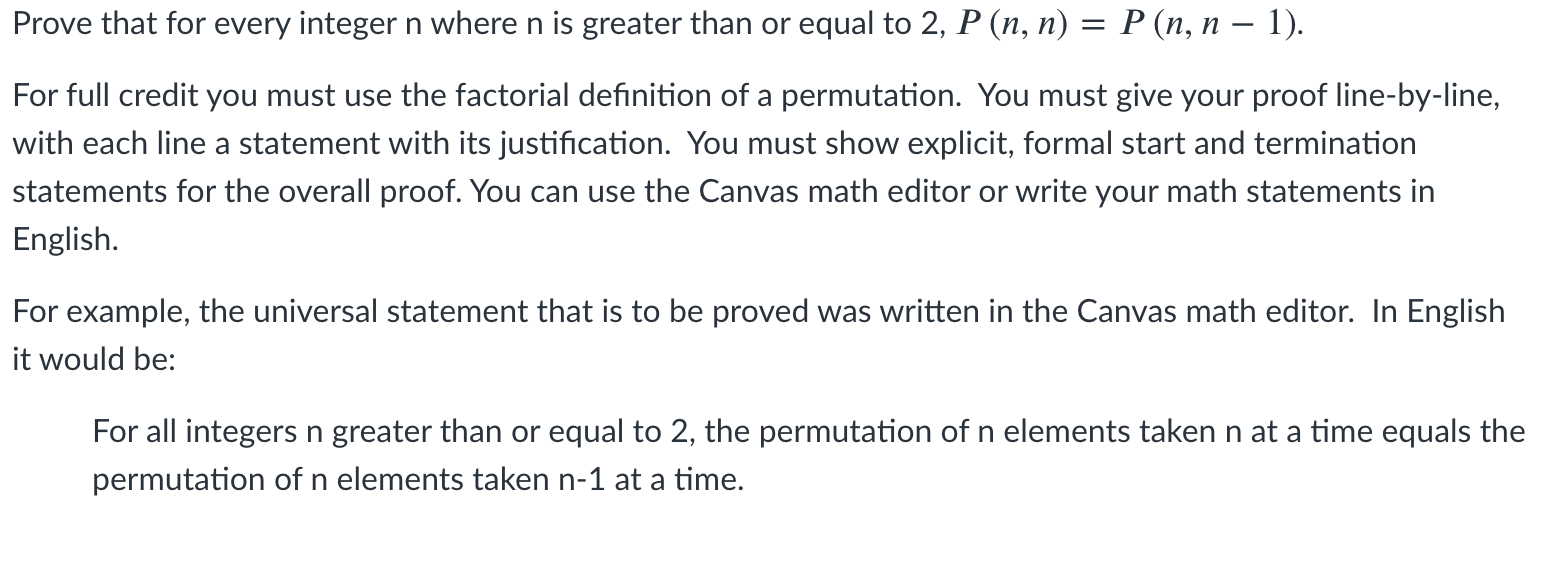
Prove that for every integer n where n is greater than or equal to 2, P (n, n) = P (n, n 1). For full credit you must use the factorial denition of a permutation. You must give your proof line-by-line, with each line a statement with its justication. You must show explicit, formal start and termination statements for the overall proof. You can use the Canvas math editor or write your math statements in English. For example, the universal statement that is to be proved was written in the Canvas math editor. In English it would be: For all integers n greater than or equal to 2, the permutation of n elements taken n at a time equals the permutation of n elements taken n-1 at a time

Step by Step Solution

There are 3 Steps involved in it

1 Expert Approved Answer
Step: 1 Unlock blur-text-image
Question Has Been Solved by an Expert!

Get step-by-step solutions from verified subject matter experts

Step: 2 Unlock
Step: 3 Unlock

Students Have Also Explored These Related Mathematics Questions!