



Question: Prove that the following are true: a. For a normalizable solution, the separation constant E must be real. Do this by writing E in Eqn.
Prove that the following are true:\ a. For a normalizable solution, the separation constant
Emust be real. Do this by writing
Ein Eqn. 2.7 as
E_(0)+i\\\\Gamma where
E_(0)and
\\\\Gamma are real and show that if Eqn. 1.20 is to hold for all
t,\\\\Gamma must vanish.\ b. The time-independent wave function
u(x)can always be taken to be real unlike
\\\\Psi (x,t)which is necessarily complex. If
u(x)satisfies Eqn. 2.5, for a given
E, so too does its complex conjugate, and hence also the real linear combinations
(u+u^(**))and
i(u-u^(**)).\ c. If
V(x)is an even function, i.e.,
V(-x)=V(x), then
u(x)can always be taken to be either even or odd. Note that if
u(x)satisfies Eqn. 2.5, for a given
E, so does
u(-x), and thus also the even and odd linear cominations
u(x)+-u(-x).
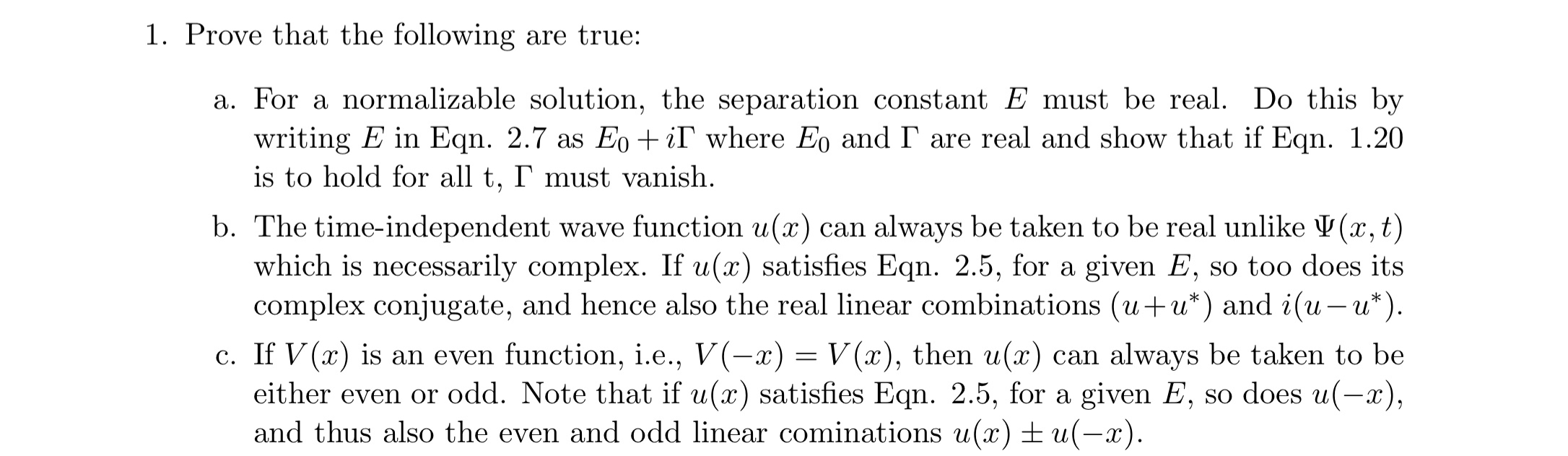
Prove that the following are true: a. For a normalizable solution, the separation constant E must be real. Do this by writing E in Eqn. 2.7 as E0+i where E0 and are real and show that if Eqn. 1.20 is to hold for all t, must vanish. b. The time-independent wave function u(x) can always be taken to be real unlike (x,t) which is necessarily complex. If u(x) satisfies Eqn. 2.5, for a given E, so too does its complex conjugate, and hence also the real linear combinations (u+u) and i(uu). c. If V(x) is an even function, i.e., V(x)=V(x), then u(x) can always be taken to be either even or odd. Note that if u(x) satisfies Eqn. 2.5, for a given E, so does u(x), and thus also the even and odd linear cominations u(x)u(x)
Step by Step Solution
There are 3 Steps involved in it

Get step-by-step solutions from verified subject matter experts