







Question: provid the answer with details Design and build a sequential circuit in logisim-evolution to count in the following manner: Q(t+1)=(Q(t)+5) MOD 9. That is, your
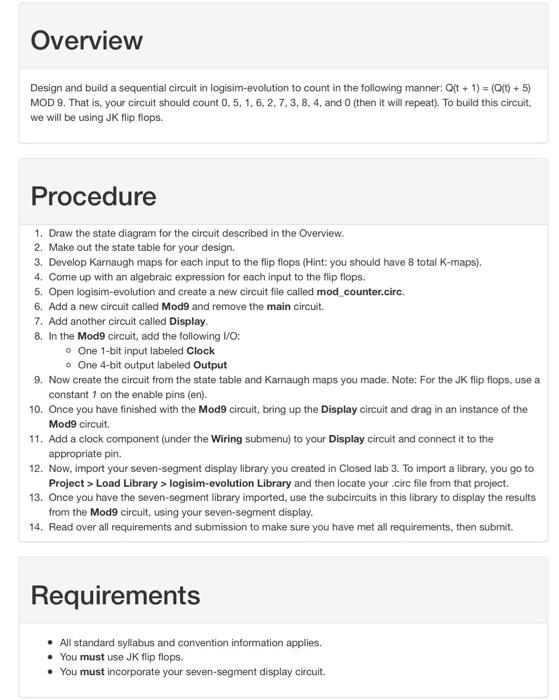
Design and build a sequential circuit in logisim-evolution to count in the following manner: Q(t+1)=(Q(t)+5) MOD 9. That is, your circuit should count 0,5,1,6,2,7,3,8,4, and 0 (then it will repeat). To build this circuit, we will be using JK flip flops. Procedure 1. Draw the state diagram for the circuit described in the Overview. 2. Make out the state table for your design. 3. Develop Karnaugh maps for each input to the flip flops (Hint: you should have 8 total K-maps). 4. Come up with an algebraic expression for each input to the flip flops. 5. Open logisim-evolution and create a new circuit file called mod counter.circ. 6. Add a new circuit called Mod9 and remove the main circuit. 7. Add another circuit called Display. 8. In the Mod9 circuit, add the following W/O: - One 1-bit input labeled Clock - One 4-bit output labeled Output 9. Now create the circuit from the state table and Karnaugh maps you made. Note: For the JK flip flops, use a constant 1 on the enable pins (en). 10. Once you have finished with the Mod9 circuit, bring up the Display circuit and drag in an instance of the Mod9 circuit. 11. Add a clock component (under the Wiring submenu) to your Display circuit and connect it to the appropriate pin. 12. Now, import your seven-segment display library you created in Closed lab 3. To import a library, you go to Project > Load Library > logisim-evolution Library and then locate your .circ file from that project. 13. Once you have the seven-segment library imported, use the subcircuits in this library to display the results from the Mod9 circuit, using your seven-segment display. 14. Read over all requirements and submission to make sure you have met all requirements, then submit. Requirements - All standard syllabus and convention information applies. - You must use JK flip flops. - You must incorporate your seven-segment display circuit
Step by Step Solution
There are 3 Steps involved in it

Get step-by-step solutions from verified subject matter experts
 Study Help