







Question: - Provide a full justification and recommendation for each finding of fact (minimum of 1 page each, not including the Finding of Fact) Introduction In

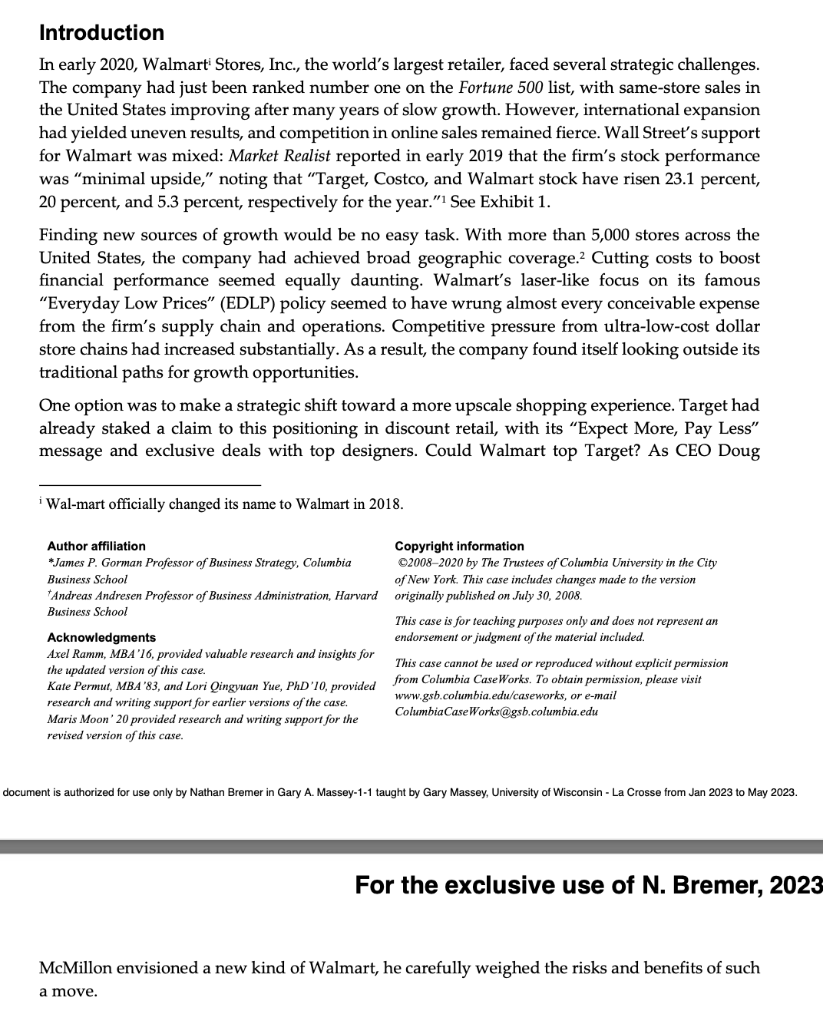
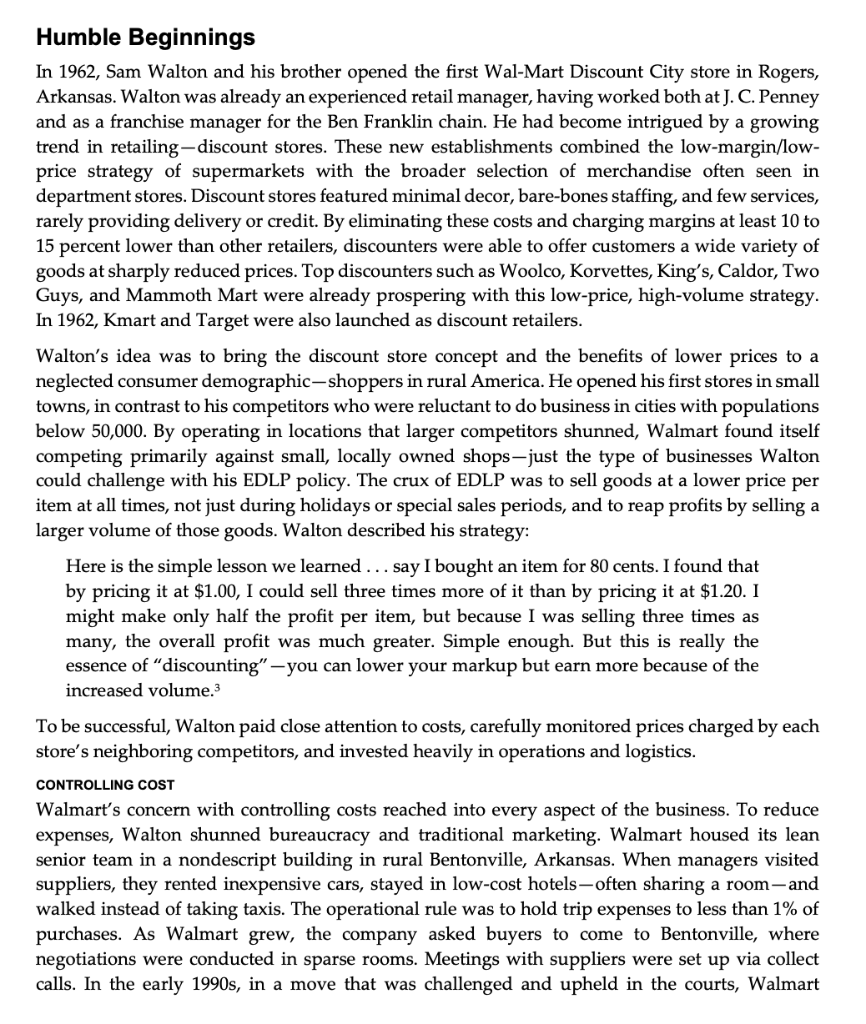
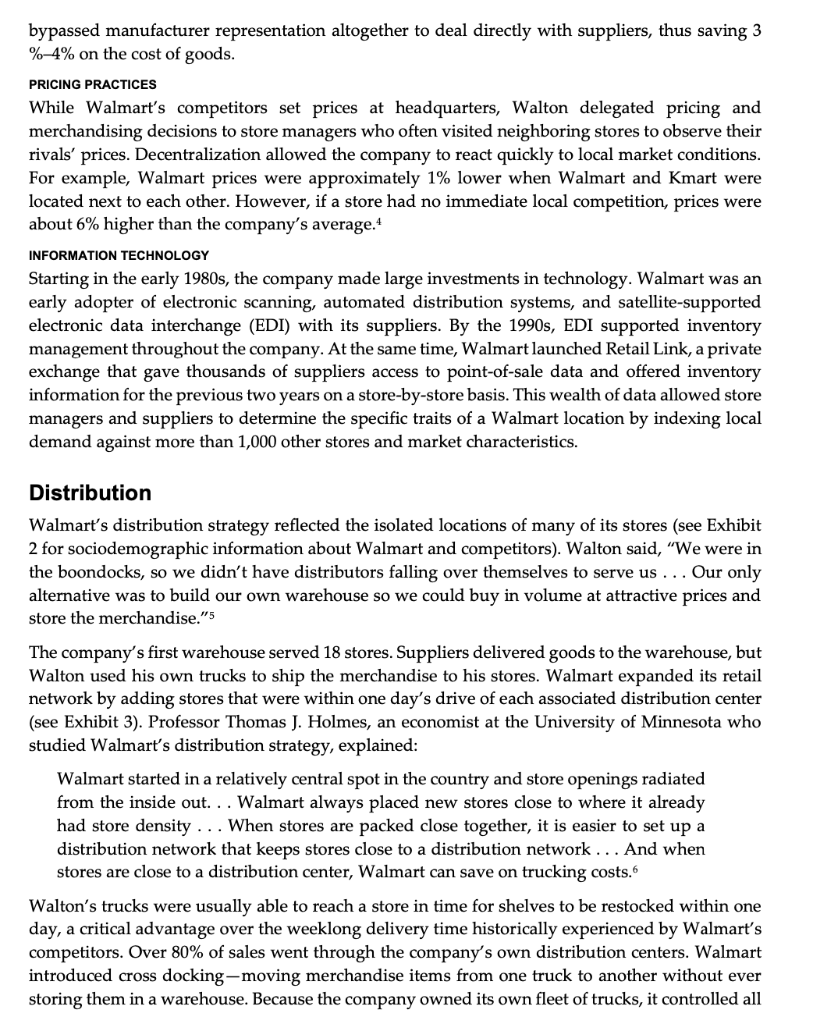
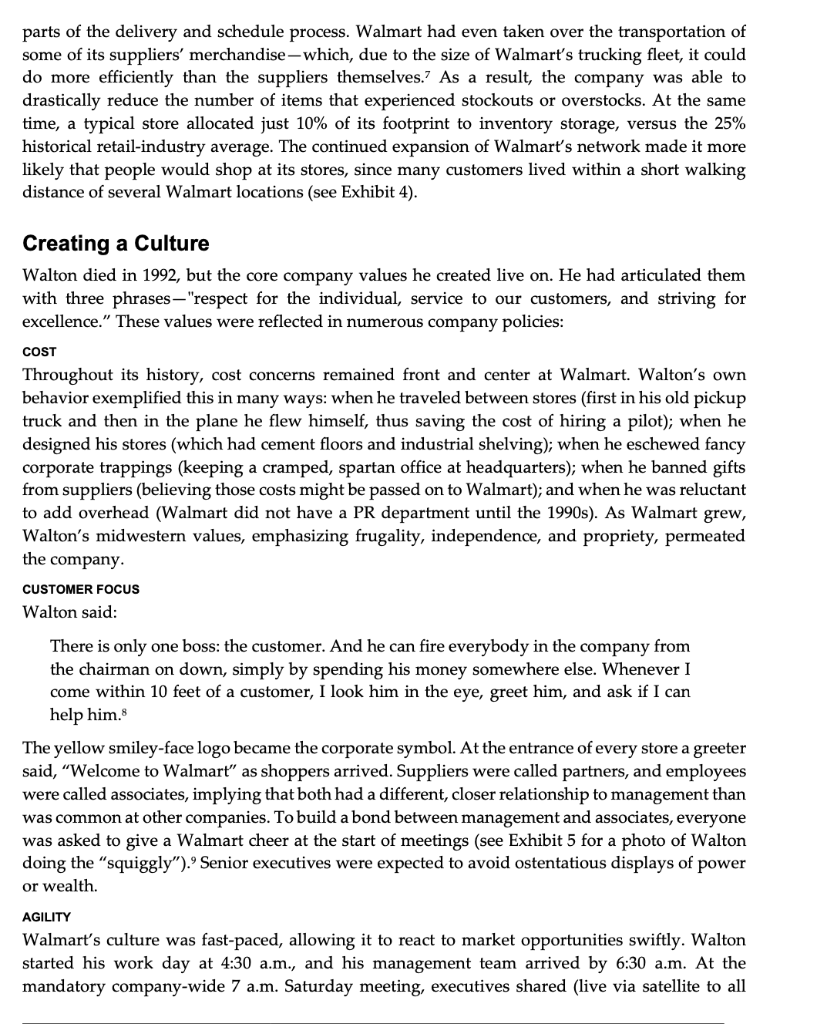
- Provide a full justification and recommendation for each finding of fact (minimum of 1 page each, not including the Finding of Fact) Introduction In early 2020, Walmarti Stores, Inc., the world's largest retailer, faced several strategic challenges. The company had just been ranked number one on the Fortune 500 list, with same-store sales in the United States improving after many years of slow growth. However, international expansion had yielded uneven results, and competition in online sales remained fierce. Wall Street's support for Walmart was mixed: Market Realist reported in early 2019 that the firm's stock performance was "minimal upside," noting that "Target, Costco, and Walmart stock have risen 23.1 percent, 20 percent, and 5.3 percent, respectively for the year."1 See Exhibit 1. Finding new sources of growth would be no easy task. With more than 5,000 stores across the United States, the company had achieved broad geographic coverage. 2 Cutting costs to boost financial performance seemed equally daunting. Walmart's laser-like focus on its famous "Everyday Low Prices" (EDLP) policy seemed to have wrung almost every conceivable expense from the firm's supply chain and operations. Competitive pressure from ultra-low-cost dollar store chains had increased substantially. As a result, the company found itself looking outside its traditional paths for growth opportunities. One option was to make a strategic shift toward a more upscale shopping experience. Target had already staked a claim to this positioning in discount retail, with its "Expect More, Pay Less" message and exclusive deals with top designers. Could Walmart top Target? As CEO Doug zument is authorized for use only by Nathan Bremer in Gary A. Massey-1-1 taught by Gary Massey, University of Wisconsin - La Crosse from Jan 2023 to May 2023. For the exclusive use of N. Bremer, 2023 McMillon envisioned a new kind of Walmart, he carefully weighed the risks and benefits of such a move. Humble Beginnings In 1962, Sam Walton and his brother opened the first Wal-Mart Discount City store in Rogers, Arkansas. Walton was already an experienced retail manager, having worked both at J. C. Penney and as a franchise manager for the Ben Franklin chain. He had become intrigued by a growing trend in retailing-discount stores. These new establishments combined the low-margin/lowprice strategy of supermarkets with the broader selection of merchandise often seen in department stores. Discount stores featured minimal decor, bare-bones staffing, and few services, rarely providing delivery or credit. By eliminating these costs and charging margins at least 10 to 15 percent lower than other retailers, discounters were able to offer customers a wide variety of goods at sharply reduced prices. Top discounters such as Woolco, Korvettes, King's, Caldor, Two Guys, and Mammoth Mart were already prospering with this low-price, high-volume strategy. In 1962, Kmart and Target were also launched as discount retailers. Walton's idea was to bring the discount store concept and the benefits of lower prices to a neglected consumer demographic-shoppers in rural America. He opened his first stores in small towns, in contrast to his competitors who were reluctant to do business in cities with populations below 50,000. By operating in locations that larger competitors shunned, Walmart found itself competing primarily against small, locally owned shops-just the type of businesses Walton could challenge with his EDLP policy. The crux of EDLP was to sell goods at a lower price per item at all times, not just during holidays or special sales periods, and to reap profits by selling a larger volume of those goods. Walton described his strategy: Here is the simple lesson we learned ... say I bought an item for 80 cents. I found that by pricing it at $1.00, I could sell three times more of it than by pricing it at $1.20. I might make only half the profit per item, but because I was selling three times as many, the overall profit was much greater. Simple enough. But this is really the essence of "discounting" - you can lower your markup but earn more because of the increased volume. 3 To be successful, Walton paid close attention to costs, carefully monitored prices charged by each store's neighboring competitors, and invested heavily in operations and logistics. CONTROLLING COST Walmart's concern with controlling costs reached into every aspect of the business. To reduce expenses, Walton shunned bureaucracy and traditional marketing. Walmart housed its lean senior team in a nondescript building in rural Bentonville, Arkansas. When managers visited suppliers, they rented inexpensive cars, stayed in low-cost hotels-often sharing a room-and walked instead of taking taxis. The operational rule was to hold trip expenses to less than 1% of purchases. As Walmart grew, the company asked buyers to come to Bentonville, where negotiations were conducted in sparse rooms. Meetings with suppliers were set up via collect calls. In the early 1990s, in a move that was challenged and upheld in the courts, Walmart bypassed manufacturer representation altogether to deal directly with suppliers, thus saving 3 %4% on the cost of goods. PRICING PRACTICES While Walmart's competitors set prices at headquarters, Walton delegated pricing and merchandising decisions to store managers who often visited neighboring stores to observe their rivals' prices. Decentralization allowed the company to react quickly to local market conditions. For example, Walmart prices were approximately 1% lower when Walmart and Kmart were located next to each other. However, if a store had no immediate local competition, prices were about 6% higher than the company's average. 4 INFORMATION TECHNOLOGY Starting in the early 1980s, the company made large investments in technology. Walmart was an early adopter of electronic scanning, automated distribution systems, and satellite-supported electronic data interchange (EDI) with its suppliers. By the 1990s, EDI supported inventory management throughout the company. At the same time, Walmart launched Retail Link, a private exchange that gave thousands of suppliers access to point-of-sale data and offered inventory information for the previous two years on a store-by-store basis. This wealth of data allowed store managers and suppliers to determine the specific traits of a Walmart location by indexing local demand against more than 1,000 other stores and market characteristics. Distribution Walmart's distribution strategy reflected the isolated locations of many of its stores (see Exhibit 2 for sociodemographic information about Walmart and competitors). Walton said, "We were in the boondocks, so we didn't have distributors falling over themselves to serve us ... Our only alternative was to build our own warehouse so we could buy in volume at attractive prices and store the merchandise." The company's first warehouse served 18 stores. Suppliers delivered goods to the warehouse, but Walton used his own trucks to ship the merchandise to his stores. Walmart expanded its retail network by adding stores that were within one day's drive of each associated distribution center (see Exhibit 3). Professor Thomas J. Holmes, an economist at the University of Minnesota who studied Walmart's distribution strategy, explained: Walmart started in a relatively central spot in the country and store openings radiated from the inside out. . Walmart always placed new stores close to where it already had store density ... When stores are packed close together, it is easier to set up a distribution network that keeps stores close to a distribution network ... And when stores are close to a distribution center, Walmart can save on trucking costs. 6 Walton's trucks were usually able to reach a store in time for shelves to be restocked within one day, a critical advantage over the weeklong delivery time historically experienced by Walmart's competitors. Over 80% of sales went through the company's own distribution centers. Walmart introduced cross docking - moving merchandise items from one truck to another without ever storing them in a warehouse. Because the company owned its own fleet of trucks, it controlled all parts of the delivery and schedule process. Walmart had even taken over the transportation of some of its suppliers' merchandise - which, due to the size of Walmart's trucking fleet, it could do more efficiently than the suppliers themselves. 7 As a result, the company was able to drastically reduce the number of items that experienced stockouts or overstocks. At the same time, a typical store allocated just 10% of its footprint to inventory storage, versus the 25% historical retail-industry average. The continued expansion of Walmart's network made it more likely that people would shop at its stores, since many customers lived within a short walking distance of several Walmart locations (see Exhibit 4). Creating a Culture Walton died in 1992, but the core company values he created live on. He had articulated them with three phrases-"respect for the individual, service to our customers, and striving for excellence." These values were reflected in numerous company policies: cost Throughout its history, cost concerns remained front and center at Walmart. Walton's own behavior exemplified this in many ways: when he traveled between stores (first in his old pickup truck and then in the plane he flew himself, thus saving the cost of hiring a pilot); when he designed his stores (which had cement floors and industrial shelving); when he eschewed fancy corporate trappings (keeping a cramped, spartan office at headquarters); when he banned gifts from suppliers (believing those costs might be passed on to Walmart); and when he was reluctant to add overhead (Walmart did not have a PR department until the 1990s). As Walmart grew, Walton's midwestern values, emphasizing frugality, independence, and propriety, permeated the company. CUSTOMER FOCUS Walton said: There is only one boss: the customer. And he can fire everybody in the company from the chairman on down, simply by spending his money somewhere else. Whenever I come within 10 feet of a customer, I look him in the eye, greet him, and ask if I can help him. 8 The yellow smiley-face logo became the corporate symbol. At the entrance of every store a greeter said, "Welcome to Walmart" as shoppers arrived. Suppliers were called partners, and employees were called associates, implying that both had a different, closer relationship to management than was common at other companies. To build a bond between management and associates, everyone was asked to give a Walmart cheer at the start of meetings (see Exhibit 5 for a photo of Walton doing the "squiggly"). 9 Senior executives were expected to avoid ostentatious displays of power or wealth. AGILITY Walmart's culture was fast-paced, allowing it to react to market opportunities swiftly. Walton started his work day at 4:30 a.m., and his management team arrived by 6:30 a.m. At the mandatory company-wide 7 a.m. Saturday meeting, executives shared (live via satellite to all store locations) the week's priorities, including up-to-the-minute sales trends, new products, and competitive developments. Saturday meetings were "equal parts talk show, financial update, merchandising workshop, town-hall forum, talent revue, gripe session and pep rally." 10 Actions called for on Saturday morning were implemented by the end of that day. COMPETITION Walmart's culture was characterized by a fierce sense of competition and a keen focus on business improvement. After managers visited the stores of local rivals, they had to come up with ways to undercut their prices. Every associate was asked to make suggestions about ways to improve sales for his or her area. Buyers aggressively negotiated the best prices from their suppliers and then went back each year to demand another 5% savings. The company was not shy about asking suppliers to modify their products or packaging. Despite such pressures, many manufacturers continued to view Walmart as the best retailer to do business with. Walmart had taken the top spot in Kantar Retail's annual ranking of about 350 retailers every year since the first survey was published in 1997. Out of nine categories in the 2019 survey, 11 Walmart scored first in seven, with key competitor Kroger topping the remaining two. 12 New Store Formats To grow its business, Walmart experimented with a variety of new store formats (see Exhibit 6). SAM's CLUBS Modeled after San Diego's Price Club, Walmart's warehouse club offered a limited selection of merchandise (3,500 SKUs, compared to 70,000 at a regular store) at near-wholesale prices exclusively for Sam's Club members. The company delineated the differences between these ventures and Walmart stores clearly. Sam's Clubs' inventory was purchased separately from Walmart's, seasonal merchandise played a much bigger role, and inventory turnover was much faster. As was typical for stores of this format, Sam's Clubs sold merchandise in industrial quantities. Although the division's gross margin was 13% significantly lower than Walmart stores' average of 23%-each Sam's Club had sales-per-square-foot averaging $401, versus $150 at a Walmart. 13 SUPERCENTERS In the late 1980s, Walmart adapted the European hypermarket store format, pioneered by the French retailer Carrefour, to create supercenters. Supercenters added a grocery market to an existing Walmart store. Despite the thin margins in the grocery business 3%4% was considered typical, compared to 20% in the general merchandise segment-supercenters came to fuel Walmart's growth and profitability (see Exhibit 7). The company expanded into supercenters at a blistering pace; by 1999 it had opened 683. By the mid-2000s, this figure had grown to 1,980. In 2020, groceries accounted for 56% of the company's annual revenues. 14 NEIGHBORHOOD MARKETS As Walmart's grocery business grew, the company seized on closely related opportunities, as reported in the company's 1999 Annual Report: Supercenters effectively serve a large trade area, but we think there may be some business that we are not getting purely because they may not be as close to the customer or convenient for small shopping trips. That's where we think there may be an opportunity for the small grocery/drug store format where we are testing the Neighborhood Market. 15 Neighborhood Markets signaled Walmart's entry into the small-scale grocery business, and by 2015, growth in that format had intensified. A Neighborhood Market store was one-quarter the size of a supercenter and carried one-fifth the number of items available there. The smaller size also gave Walmart a useful format for trying out new merchandise and service concepts. For example, the company first tested pharmacies in Neighborhood Markets and found them to be an attractive new revenue stream. Walmart also experimented with private-label grocery and household product brands in its Neighborhood Markets. While the number of Neighborhood Markets had increased dramatically, in 2015 there were still none in New York, New Jersey, Pennsylvania, Massachusetts, Ohio, Michigan, and many other states. International Expansion In the early 1990s, Walmart's executives turned to global markets for growth opportunities. The company's initial move outside the United States was to the south, where it entered into a joint venture with Cifra, Mexico's largest retailer. Walmart purchased Cifra outright in 1998. In similar moves, Walmart acquired 122 Canadian Woolco discount stores in 1994, and 21 hypermarkets in Germany in 1998. One year later, Walmart completed the purchase of ASDA, a 232-store supermarket chain in the United Kingdom with $14 billion in sales. In 1996, Walmart entered China. By 2020, Walmart International operated in 26 countries, producing 28% of the company's revenue in 6,146 locations. 16 While international sales grew quickly, Walmart often faced savvy competitors who matched the company's management skills and sophisticated consumers who were not impressed by its midwestern frugality. The company was forced to exit Germany and South Korea in 2006, ceding these markets to better-positioned rivals. 17 Competition was especially strong in Germany, where labor laws were very different than in the United States, and zoning regulations were extremely strict and unfavorable to megastores. 18 Mexico was an encouraging growth story, and Walmart's sales there were by far the largest of any country outside the United States; however, the Mexican market had slowed in recent years. In June 2012, Walmart's senior executives in Mexico were charged by the US Justice Department for allegedly bribing local officials to sidestep zoning laws in order to fast-track new store permits. In 2019 after years of investigation, Walmart agreed to pay $282 million to the SEC for allowing a third-party to bribe foreign officials in Mexico, Brazil, China, and India. 19 In view of these setbacks, Walmart started to take a more measured approach to international expansion. For example, the company scaled back its ambitions in China, setting more modest growth targets. 20 Continuing Challenges In 2013, Doug McMillon became Walmart's new CEO, the youngest CEO since Walton first took the helm and only the fourth since Walton's death in 1992. McMillon had started out in a Walmart distribution center as a summer intern and had spent almost his entire career at the company. A tough-minded buyer for many years, McMillon assumed responsibility for Walmart's international business in 2009. When McMillon was appointed CEO, he led the largest retailer in the world an international behemoth with 2.2 million associates (1.4 million employees in the United States alone) and $482 billion in annual sales (see Exhibits 8A and 8B). 21 Walmart revenues surpassed those of its top five competitors combined. 22 As McMillon soon learned, the company's scale invited scrutiny, posing management challenges in two distinct areas: labor relations and community impact. LABOR RELATIONS Walmart had a long history of staunch opposition to labor unions. Rather than allowing its workforce to organize, the company preferred to restructure its operations to eliminate positions that could potentially be unionized. Although Walton had emphasized maintaining good relations between employees and management, the company's reputation as an employer grew increasingly negative. Many saw Walmart's culture as bullying and mean-spirited and believed the firm exploited its market power. 23 Critics alleged that Walmart's wage policies kept employees below the poverty line. According to these estimates, a typical sales clerk earned $8.50 an hour, or about $14,000 a year, which was $1,000 below the poverty line for a family of three in 2003 (see Exhibit 9 for information on labor costs). 24 Low wages, these critics argued, also prevented Walmart employees from participating in the company's health plan. 25 Gender discrimination was another matter of contention. In a 2001 lawsuit, six Walmart employees claimed that women earned 5%15% less than men in similar positions. 26 Women also seemed less likely to be promoted. While two-thirds of Walmart's hourly employees were women, only one-third of salaried managers and 14% of the company's top managers were female. The company's competitors had about 20% more women in managerial positions. Walmart challenged the plaintiffs' statistical studies, arguing that female associates were less likely to apply for management positions. 27 Reviewing the evidence, a federal judge certified the class in June 2004 and Walmart's stock fell by 1.6 percent on the day of the announcement. 28 The Supreme Court ultimately sided with Walmart. But the suit-and similar allegations in subsequent years -indicated how costly the antagonistic labor relations had become. Poor labor relations also impacted operating costs; the turnover rate among Walmart associates was close to 50% each year, historically more than double that experienced at Costco and other retailers. 29 COMMUNITY IMPACTS As the retail industry in the United States grew more concentrated (the average US county had 3.86 small retail stores in 1988 , but this number fell by more than 10% in the following decade), Walmart's critics linked the rise of the discount retailer to deserted city centers and main streets. One independent academic study attributed at least 50% of the decline in the number of small stores to the rise of Walmart.30 When Walmart opened a new store, it created 100 new jobs, but as small rivals unable to compete with the discounter were forced to shut their businesses, 70% of the initial increase in local jobs was eventually lost. 31 Everyday low prices, some argued, came at a significant social cost. As a result, the company found it increasingly difficult to develop new sites. Supported by unions and grassroots groups, towns used zoning laws and referenda to stymie the company's expansion plans. When citizens kept Walmart from opening stores in Inglewood, California, and Littleton, Colorado, the company's defeat was widely publicized, further encouraging Walmart's detractors. Strained community relations impeded not only store growth; when Walmart applied for a banking license so it could take deposits and make loans, there was massive public outcry. There were "thousands of public comments and a letter from nearly 100 lawmakers" against approving Walmart's application. 32 In 2007, the firm had to withdraw its bid. As the cost of sour community relations became more visible, Walmart began to soften its stance. Former CEO Lee Scott explained the evolution: No question, it has been a hard transition for us going from being the darling to being under attack. At first, we threw the sandbags up and got the machine guns out and believed anybody who criticized us was our enemy. But I think we're taking down those sandbags one at a time. 33 The company's attempts to put on a friendlier face seemed to have paid off. Rather than trying to embarrass the retailer, unions started to work with the company on proposals for improved healthcare, for instance. David Nassar, executive director of Walmart Watch, a largely unionfinanced group that sought to shame the company with stinging newspaper advertisements and public pronouncements, noted "It is fair to say we have been less in-your-face." 134 Reflecting the better relations, the company shut down the campaign-style war room created to battle the unions and disbanded "Working Families for Walmart," a company-supported advocacy group. Seeking Fresh Opportunities for Growth Walmart's expansion began to falter in the mid-2000s, and its stock price flattened. At the company's 2015 shareholders meeting, McMillon acknowledged that same-store sales had been negative in some quarters. 35 The rate of increase in comparable store sales had slowed to virtually zero in 2014 and 2015 and had only grown 2.6\% overall since 2009 (see Exhibit 10). Later in the decade, Walmart was able to increase its comparable store sales to 4.0 percent and 2.7 percent in 2019 and 2020, respectively. 36 By comparison, Walmart's key competitor, Costco, posted gains of approximately 5% annually from 2015 to 2019.37 McMillon and his team faced a number of challenges as they sought further growth. One issue was sales cannibalization (see Exhibit 12). By 2006, 60\% of the US population lived within five miles of a Walmart, and 96% lived within 20 miles of one. There were still some potential areas for expansion, such as California and New York, but the company acknowledged that "additional stores may take sales away from existing units." 18 McMillon estimated that comparable store sales in fiscal years 2014 and 2015 were negatively impacted by the opening of new stores by approximately 1% each year (see Exhibit 13). Grocery margins were a second area of concern. The company remained the price leader in the food business, but supermarkets such as Kroger and Publix were beginning to close the gap. The innovations that Walmart had created in merchandising, logistics, and transportation had been well studied by its competitors and were being duplicated. 39 Even more importantly, dollar stores and "deep discount" grocers created enormous price pressure; during the Great Recession of 2009, even wealthier customers patronized such venues. Even though they were no-frills stores, people enjoyed shopping at them, especially for fill-in trips, because they were more centrally located and smaller than supercenters. 40 In 2014, Dollar Tree announced it was taking over Family Dollar to create a chain with more than 13,000 stores and $18 billion in annual sales; competitor Dollar General had around 12,000 stores. 41 Germany's Aldi and Lidl stood out among the discount grocers-both companies offered mainly private-label products, a far smaller number of SKUs, and a reduced store format of about 5,000 square feet filled with cut boxes and rudimentary shelf displays. As a result, Aldi's and Lidl's prices compared favorably to Walmart's. In some studies, consumers saved more than 20% by shopping at Aldi. 42 Third, online sales were another headache. With a market share of 1.6% of US online sales, Walmart was lagging behind Amazon (12.1\%), the largest e-retailer in the world. 43 Amazon didn't have brick-and-mortar stores and optimized its distribution to the particular needs of e-tailing. In contrast, Neil Ashe, CEO of Global eCommerce for Walmart, admitted at the company's 2015 shareholder meeting "we're rebuilding the business from scratch." "4 Walmart was investing heavily in online sales by improving its platform and opening new e-commerce distribution centers. To compete with Amazon's Prime, a popular service that offered customers free shipping and entertainment for an annual membership fee of $99, Walmart introduced unlimited free shipping for a $50 annual fee. .45 In 2016, Walmart acquired Jet.com for $3.3 billion in order to compete more effectively with other online retailers. 46Jet was an e-commerce startup that offered a broad selection of merchandise. It operated on a unique pricing scheme that found the true marginal cost of getting the product to the customer. Prices dropped when the customer purchased multiple items from the same distribution center, when the customer purchased multiple units of the same item, and when the customer waived their right to return the item. Despite continued efforts, however, Jet was never profitable and Walmart finally closed it down in 2020.47 Jet's demise was gradual. Walmart took several intermediate steps before closing it down. Walmart shifted much of its budget from Jet to Walmart.com starting in 2018. Jet's team was transferred to Walmart.com, including Jet cofounder Marc Lore who became the CEO of Walmart.com. Marc Lore introduced free two-day shipping for orders over $35 without a membership fee, a move that was a direct threat to Amazon Prime. Walmart's physical stores were a key advantage against Amazon, and it utilized the power of its store base to introduce two-hour express delivery. From 2016 to 2019, Walmart.com sales tripled and the company became the second biggest player in e-commerce but still lagged far behind Amazon (see Exhibit 14). Fourth, customer preferences appeared to have evolved in ways that hurt Walmart. Shoppers seemed to have become increasingly sensitive to the appearance, cleanliness, and convenience of the store environment. The allure of EDLP did not always overcome the minimal customer service, disheveled aisles, and aging physical spaces that could make a trip to Walmart exhausting and depressing. In the 2019 American Consumer Satisfaction Index, Walmart scored at the bottom, far behind competitors like Target, Sears, and Costco. 48 Upscaling the Walmart Experience Walmart's competitors had long emphasized their superior products and a more pleasant shopping experience to compete with the company's low-price value proposition. Former Target President Bob Ulrich said, "If Walmart was striving to be the king of logistics with enough muscle to force vendors to deliver on price, Target could deliver on a great store experience and a product that was exciting and unique." 49 Ulrich made innovation, design, and quality the hallmarks of Target's offerings. He set up a trend-tracking department, founded a user-experience research center, and aggressively pursued design leaders to create unique products for Target stores. He launched fashion trendsetter Isaac Mizrahi's line of value-priced women's clothing. Target's eye-catching TV and print ads suggested that shoppers could find joy in buying a broom or a toothbrush. Target's motto, "Expect More, Pay Less," embodied its offerings-upscale products including Michael Graves's line of housewares, Todd Oldham's home decor and furniture, and Philippe Starck's kitchenware at discount prices. This positioning appeared to be a success; for a similar mix of merchandise, Target's prices exceeded those of Walmart by about 10%, but Target's same-store sales still grew more quickly. 50 Lured by the attractive margins of products with a stylish design-fashion clothing, for instance, had a 31 percent profit margin, compared to 20% for general merchandise and 4% for food 51-Walmart introduced branded clothing at higher price points beginning in 2000. To support these efforts, the company installed simulated wood floors and more dressing rooms in its stores, moved its office from Bentonville to a 40,000-square-foot space in New York City's Fashion District, and added more than 300 fashion merchandisers to the company's payroll. Walmart inked a series of deals to bring brand-name designer goods to its shoppers: surfer brand OP (Ocean Pacific) signed on to develop a line of casual clothing, footwear, and accessories; junior jeans brand l.e.i. agreed to partner with Walmart; and designer Norma Kamali was tapped to create a new line of women's wear. 52 These forays into the world of fashion had limited success, however, and the executive in charge resigned in 2010 due to "slow growth in sales." 53 One analyst commented: "Without imagery, apparel just becomes a commodity business. Without the nuances of making a brand have an essence, as opposed to just a product, there is no additional sale." 4 Upscaling 2.0 Under McMillon's leadership, Walmart renewed its efforts to reposition the company. An important goal was to improve customers' in-store experience. To increase the engagement of its associates, McMillon raised the hourly wage of 500,000 employees to $9 in early 2015 , and to $12 in early 2020.55 The company also adjusted the pay bands for many full- and part-time workers
Step by Step Solution
There are 3 Steps involved in it

Get step-by-step solutions from verified subject matter experts
 Study Help