







Question: Provide brief summary which discuss analysis presented in this article. Influence of Indoor Environmental Quality on Work Productivity in Green Office Buildings: A Review Indoor
Provide brief summary which discuss analysis presented in this article.
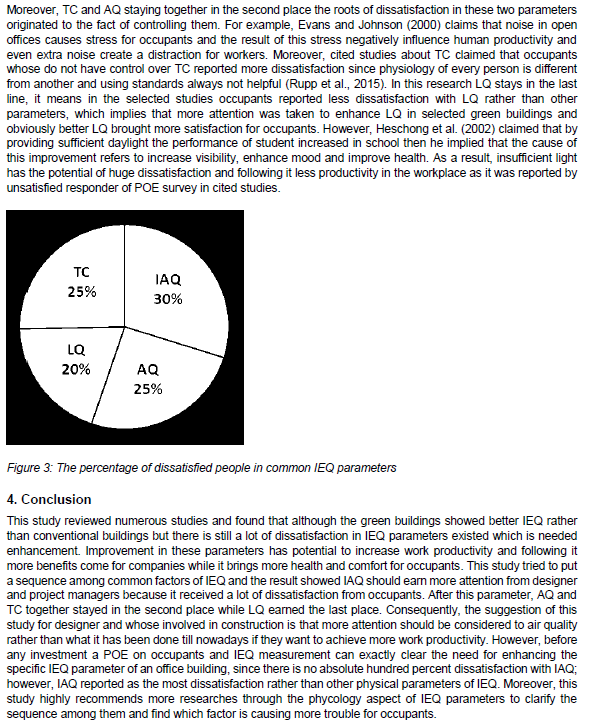
Influence of Indoor Environmental Quality on Work Productivity in Green Office Buildings: A Review Indoor Environment Quality (IEQ) of green offices is able to change occupants' behaviour by representing various conditions. The IEQ depends on factors such as lighting, noise, thermal quality, and air quality which directly or indirectly influence the occupants' behaviour and work productivity. To improve and support the work productivity of occupants, it is significant to consider occupants' physical condition, well-being and psychological facets which are affected by IEQ. Consequently, it is essential to understand initially the most effective IEQ factors that impact on occupants' behaviour and the overall satisfaction. Occupant's satisfaction can be improved by elimination or minimization factors that cause any discomfort, illness or dissatisfaction. However, most research on IEQ and occupant satisfaction are focused on conventional commercial and office buildings. There is a lack of research evaluating the performance and IEQ levels of new "green" buildings, in relation to work productivity. Thus, the current study reviews peer-reviewed journal articles and dissertations to find crucial factor influences on IEQ and work productivity in "green" offices. The results showed that increasing the quality of IEQ factors will most likely enhance occupant's productivity, which directly brings benefits for companies. Through a critical literature review, the study found that Indoor Air Quality (IAQ) is the most influential, which is vital for enhancing work productivity and it can boost occupants' satisfaction. Moreover, occupants' personal control over thermal condition shows the huge effect on enhancing work productivity. The results showed that there is a lack of a comprehensive study to rank the IEQ factors which effect on work productivity. 1. Introduction Thousands of year have been passed since the day human lived in the wild environment and caves, now in the twenty-first-century human life's have evolved into modem civilizations and they are spending much of their life in the buildings with a controlled environment to escape the harsh outdoor environment. One of these places which take at least a quarter of human lifetime is a workspace, with the potential of influencing users' behaviour, health, morality and even their productivity (Loftness et al., 2003). Numerous strategies and theories have been proposed and used in building construction to preserve human desires in workspace while it considers sustainability and saves energy. In this regard, the Green construction has earned a lot of value for architecture, building managers and companies. Advanced technology has helped human beings to reach more efficiency, and moving forward to reach new targets for the future is essential for better living. Work productivity, is a new target in building construction for commercial buildings with regards to enhancing the productivity of workers, which sets a new direction of building environment to create a suitable workspace for users to achieve the goal of high productivity (Fassoulis and Alexopoulos, 2015). As green construction method becomes more popular, reaching high energy efficiency is one of its goals to reduce environmental impact and saving energy. Exactly in this point, numerous Post Occupancy Evaluation (POE) studies were done to evaluate characters of Indoor Environment Quality (IEQ) for further improvements, and more recently the Building Performance Evaluation (BPE) method has earned a lot of attention. Consequently, after a decade POE studies and data collection, it is found that the most important characters of IEQ can be divided in two parameters, one related to energy that normally affects human physiology, and one influencing human psychology This study through critical literature review found that there is a gap in the sequence of IEQ parameters, therefore, it is not clear which parameter has the most effect on occupants' behaviour. It is also critical to evaluate IEQ parameters to put a sequence among them, and also categorize which energy-related parameter are the most influential on occupants, hence project managers and designers can prioritize the parameters in their projects. The importance of this finding becomes clear when the investment budget for improving IEQ is limited and only can be spent on improving one or two parameters, in this case having the idea of which parameter is the most worth spending is crucial for the designer. Consequently, the main focus of this study is that to compare and analyse the result of energy-related IEQ parameters among various studies in the field of POE and BPE to put a sequence among them. In this relation in the first place, an understanding of workplace needed to clarify the importance of IEQ for it. 1.1 Workplace performance The process of identifying and attracting appropriate talent in companies required recruitment of many consultants and even psychometrics to reach a high level of productivity and gaining more lucrative for employees (Calder, 2007). However, choosing appropriate talent is not the only factor of reaching high work productivity. Hamid and Hassan (2015) claimed that preparing a proper workplace to support, assist and motivate workers is a crucial factor that cannot be omitted. As a result, it is time to put the focus on an aspect of workplace space, in another word it is time to pay attention to people feeling good about their workplace. One of the inexpensive ways to motivate and retain workers is to make them feel included to the organization this can be achieved from advantages of the workplace itself. In the first place to make people feel included companies need to satisfy their worker. To give an example of this fact, Fassoulis and Alexopoulos (2015) in their research about relation between workplace satisfaction and productivity in University of Athen's (UOA) found that the administrative staff is not satisfied with their workplace and all related aspect of it, therefore this dissatisfaction directly affected their work productivity in a negative way. They also addressed staffs dissatisfaction roots to practical management approach since they were failed to encourage and support a new form of office work for administrative staff (Fassoulis and Alexopoulos, 2015). On the contrary, Wyon (2004) claimed that by improving indoor environment quality in a different lab experiment and comparing them with other cases with normal indoor environment quality, the productivity of workers in the improved indoor environment was raised and also it brought more satisfaction for workers. Accordingly, it can be achieved that two important factor as human priorities and indoor environment quality are interrupting workplace performance, which each of them has its own sub factors. As a result, to reach high- performance workplace and better productivity, indeed it is significant to have scrutiny research in both and clear the variable which finally influences human productivity. 1.2 Indoor Environmental Quality (IEC) The quality of environment encompasses any particular building is called Indoor Environment Quality (IEQ). In this regard, Abbaszadeh et al. (2006) have indicated that user's satisfaction is in direct relation to the quality level of the indoor environment. For instance, Seppanen et al. (2006) showed that indoor temperature is able to change task performance of workers in an office environment. Significant analyses and discussion on health issue related to the indoor environment were presented by Fisk (2002) indicate that better IEQ resulted in potential reduction of sick leaving, therefore worker's productivity increment shown its benefit in annual gain in United State. One of the interesting findings of this research explaining that personnel salaries and costs especially those in related to health issues normally surpasses the cost of operating offices, thus investing in strategies to improve employees' productivity and health has a significant return over the long run (Fisk, 2002). However, the improvement of health by better IEQ is only one of the achievements to reach the goal of high productivity, therefore it is striking to understand what are the IEQ factors and how these factors affect users. To clarify what are the characteristics of IEQ, it is critical to refer to numerous studies in this area and find consensus among them. In this relation, Ravindu et al. (2015) claimed that significant parameters of IEQ includes thermal condition quality, Indoor Air Quality (IAQ), lighting quality, and acoustic quality. As shown in Figure 1 a model can be suggested pertain to human behaviour. Workspace environment effects two different aspects of being human as physical and psychological condition, in relation to how they influence human behaviour (Vischer, 2008). Physical criterion includes energy related parameters of IEQ (Fisk et al., 2002), while the psychology criterion is related to non-energy one (Vischer, 2008). In this regard, putting IEQ characteristics in a sequence base of their importance for occupants' satisfaction is crucial to achieving maximum productivity with least enhancing of IEQ parameters. Various standards and guidelines for human comfort in non-industrial, commercial building indicate that specific period exists for human condition to feel comfort like ASHRAE Standard 62 (1989) and World Health Organization (WHO) (2000). As a result, as shown in Figure 2 developing suitable and the optimal condition is crucial for occupants' comfort and satisfaction. For instance, too much light has potential to make very bright workspace and low light causes a dim workspace which either of them has potential to negatively affect IEQ of occupied workspace and following it the productivity of users (Loftness et al., 2005). This follows other characters of IEQ as an unavoidable circumstance for the human condition, as a result a balance and optimize environment is an essential requirement for high performing workspace pertain to human productivity. Below Above Occupants wellbeing and satisfaction Optimal Condition Thermal Too Cold Too Hot Psychological comfort . Air quality Too Polluted Physical comfort Too Dim Light Too Bright Discomfort Acoustic Too Noisy Work Environment Figure 1: Model of achieving environmental comfort Figure 2: The effect of not optimising condition on for occupant occupants in the indoor environment of buildings. 1.3 Indoor Air Quality (IAQ) The state of the air inside a building is known as Indoor Air Quality (IAQ) (Stanton et al., 2004). IAQ is directly related to a health issue and sick leaves are one of its outcomes besides the fact that improving air quality will cause a reduction in company's budget for health care facilities. For instance, Wyon (2004) declared that there is a correlation between reduction of offices performance and percentage of occupants' dissatisfied with indoor air quality existed. Materials used in the building structure such as wall and roof covering, paint material, etc., or office furniture can have chemical properties that can be toxic and harmful for occupants' health (Evans, 2003). 1.4 Thermal condition Another fundamental factor of IEQ is indoor temperature. It has a huge effect on human psychology and physical condition as a result, it can affect workers' behaviour and productivity (Stanton et al., 2004). For example, a meta-analysis of studies of temperature and productivity found that temperature between 21-22 C will increase productivity, and as the temperature goes up between 23-24 C productivity starts to relatively decrease. When the temperature reaches 30 C only 91.1 % of relative productivity is observed. Hence, It would suggest that the optimal temperature for relative productivity is achieved between 21 - 24 C (Seppanen et al., 2006). 1.5 Light quality Various research like Naharuddin and Sadegi (2013) proved that natural light and light with good quality is able to enhance offices performance, and other suggested it can improve health, productivity, well-being and satisfaction. One study declared that improvement in school achievement was correlated to good lighting quality. One significant rule with the lighting system is that it has to save energy and brings comfort for occupants, and subsequently both productivity and sustainability will preserve together (Loftness et al., 2003). 1.6 Acoustic control Extra noise or noise pollution in offices can also cause a reduction in productivity in a certain type of work and also it has a direct effect on occupants' health and psychology as a result it can bring stress for workers especially in open offices (Evans and Johnson, 2000). The extra noise is produced by different sources as outside noise, the mechanical system in building, occupants, and customers (Noweir, 1984). 2. Research methodology The current manuscript provides practical information according to peer-reviewed journal articles and dissertations and analysis of published scientific literature which related to IEQ, POE and BFE pertain to occupants' health, comfort, satisfaction, and work productivity. Some of the original manuscripts contain field study and cross-sectional multi-building surveys of IEQ condition with the regard of using POE. These studies collected data on health, absence, or work productivity. Other studies used a reliable collection of databases to achieve the goal of the study. For example, Abbaszadeh et al. (2006) used the databases of Centre for Built Environment (CBE) to collect data and analyse information to reach the target of study. It can be expected that these studies used statistical models to analyse data and quantify IEQ parameters like temperature or air quality on and their effect on outcomes as illness or absence rate. IEQ parameters as IAQ, Acoustic Quality (AQ), Light Quality (LQ), and Thermal Condition (TC) have been chosen throughout the critical review of review papers to find the most common variable of IEQ for this research; hence, these criteria are the crucial factors for critical analysis. The details and number of reviewed studies can be found in. However, as shown in Table 2 among all of those studies nine specific studies with the special context related to this research are selected. The reason for selection of these studies is that they had the high number of samples, case studies and POE questionnaire survey, while they contain the analysis of four selected IEQ parameters for this study. Hence, they can cover numerous occupants and green building, however, some studies in the conventional building are also added to the table to make sure that the result can be expanded to a wider range of commercial buildings. In this regard, to achieve the target of this study each parameter is considered as its effect on occupants' dissatisfaction since, the most dissatisfy item is the one which treated occupants in a negative way. Consequently, the parameters are ranked among 1 to 4 to create a sequence of parameters according to more dissatisfaction to less dissatisfaction. In another word a higher rank describes less dissatisfaction in selected study. To put it differently, it is crucial for this study to find the most dissatisfaction parameter among all since, as cited in the research more dissatisfaction brings less productivity, so it can be achieved that improvement of most dissatisfy parameter of IEQ stays in the first priority. To create a sequence for IEQ factors it is essential to have a critical analyse over the result of Table 2. Statistical package for social science (SPSS) has been used to analyse collected data. Frequency analysis as main critical data analysis has been taken into account to present maximum frequency among dissatisfaction features of IEQ. Table 1: Number of reviewed study to choose proper ones for this study ISI Web of knowledge Google Scholar Reports Dissertations 6 43 14 8 Table 2: Studies in the field of POE or BPE which analysed IEQ factor (higher number means less dissatisfaction responded by occupants as 1=Extremely dissatisfied, 2=Highly dissatisfied 3=Slightly dissatisfied 4=Dissatisfied) IEQ parameters' rank No Researcher LAQ AQ LQ TC Description 1234 1234 12 34 1234 1 Kim and Dear (2012) CBE occupants' database 2 Wong et al. (2008) 293 occupants - Hong Kong 3 Pei et al. (2015) 10 Green building -10 conventional building - over 1000 occupants Amasyali and El-Gohary Over 600 valid respond of questionaries of (2016) Green building 5 Ravindu et al. (2015) Case study of a LEED platinum certified factory 6 Woo (2014) POE in Green-rated high-rise office buildings 7 Liang et al. (2014) Certified Green office buildings in Taiwan 8 Frontczak et al. (2012) 351 office building - 52980 occupants 9 Abbaszadeh et al. (2006) LEED rated green building (CBE Database) 4 IL 2 3. Result and discussion Table 2 implies that IAQ was caused the most dissatisfaction among all common parameters. As shown in Figure 3, IAQ showed more dissatisfaction frequency among other parameters which implies that in selected green offices less attention was taken for considering the quality of indoor air. Hence, it caused more trouble for occupants' so, according to the literature it is obviously predictable that dissatisfaction has consequences like reduction in work productivity in the workplace. The result of dissatisfaction refers to sub parameters of IAQ which cause a lot of issues for occupants' health, comfort, and satisfaction (Ha, 1998). Moreover, TC and AQ staying together in the second place the roots of dissatisfaction in these two parameters originated to the fact of controlling them. For example, Evans and Johnson (2000) claims that noise in open offices causes stress for occupants and the result of this stress negatively influence human productivity and even extra noise create a distraction for workers. Moreover, cited studies about TC claimed that occupants whose do not have control over TC reported more dissatisfaction since physiology of every person is different from another and using standards always not helpful (Rupp et al., 2015). In this research LQ stays in the last line, it means in the selected studies occupants reported less dissatisfaction with LQ rather than other parameters, which implies that more attention was taken to enhance LQ in selected green buildings and obviously better LQ brought more satisfaction for occupants. However, Heschong et al. (2002) claimed that by providing sufficient daylight the performance of student increased in school then he implied that the cause of this improvement refers to increase visibility, enhance mood and improve health. As a result , insufficient light has the potential of huge dissatisfaction and following it less productivity in the workplace as it was reported by unsatisfied responder of POE survey in cited studies. TC 25% IAQ 30% LO 20% AQ 25% Figure 3: The percentage of dissatisfied people in common IEQ parameters 4. Conclusion This study reviewed numerous studies and found that although the green buildings showed better IEQ rather than conventional buildings but there is still a lot of dissatisfaction in IEQ parameters existed which is needed enhancement. Improvement in these parameters has potential to increase work productivity and following it more benefits come for companies while it brings more health and comfort for occupants. This study tried to put a sequence among common factors of IEQ and the result showed IAQ should earn more attention from designer and project managers because it received a lot of dissatisfaction from occupants. After this parameter, AQ and TC together stayed in the second place while LQ earned the last place. Consequently, the suggestion of this study for designer and whose involved in construction is that more attention should be considered to air quality rather than what it has been done till nowadays if they want to achieve more work productivity. However, before any investment a POE on occupants and IEQ measurement can exactly clear the need for enhancing the specific IEQ parameter of an office building, since there is no absolute hundred percent dissatisfaction with IAQ; however, IAQ reported as the most dissatisfaction rather than other physical parameters of IEQ. Moreover, this study highly recommends more researches through the phycology aspect of IEQ parameters to clarify the sequence among them and find which factor is causing more trouble for occupants
Step by Step Solution
There are 3 Steps involved in it
1 Expert Approved Answer
Step: 1 Unlock

Question Has Been Solved by an Expert!
Get step-by-step solutions from verified subject matter experts
Step: 2 Unlock
Step: 3 Unlock
 Study Help