







Question: Provide numerical results for the performance measures in question. As the manager, which system would you prefer? Problem 3 Consider a single-server queueing system that
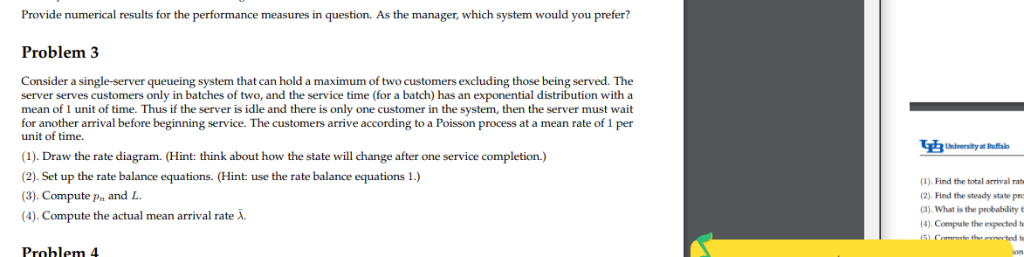
Provide numerical results for the performance measures in question. As the manager, which system would you prefer? Problem 3 Consider a single-server queueing system that can hold a maximum of two customers excluding those being served. The server serves customers only in batches of two, and the service time (for a batch) has an exponential distribution with a mean of 1 unit of time. Thus if the server is idle and there is only one customer in the system, then the server must wait for another arrival before beginning service. The customers arrive according to a Poisson process at a mean rate of 1 per unit of time. ya ab (1). Draw the rate diagram. (Hint: think about how the state will change after one service completion.) (2). Set up the rate balance equations. (Hint: use the rate balance equations 1.) (3). Compute pa and L (4). Compute the actual mean arrival rate A (1). Find the total arrival rat (2) Find the steady state pro (3). What is the probability 4) Compute the expected Prohlem 4 Provide numerical results for the performance measures in question. As the manager, which system would you prefer? Problem 3 Consider a single-server queueing system that can hold a maximum of two customers excluding those being served. The server serves customers only in batches of two, and the service time (for a batch) has an exponential distribution with a mean of 1 unit of time. Thus if the server is idle and there is only one customer in the system, then the server must wait for another arrival before beginning service. The customers arrive according to a Poisson process at a mean rate of 1 per unit of time. ya ab (1). Draw the rate diagram. (Hint: think about how the state will change after one service completion.) (2). Set up the rate balance equations. (Hint: use the rate balance equations 1.) (3). Compute pa and L (4). Compute the actual mean arrival rate A (1). Find the total arrival rat (2) Find the steady state pro (3). What is the probability 4) Compute the expected Prohlem 4
Step by Step Solution
There are 3 Steps involved in it

Get step-by-step solutions from verified subject matter experts
 Study Help