







Question: provide python coding 3 Part 3: Extra Credit Question 5) (20 points) In the literature people have used STDP for image processing applications. In this
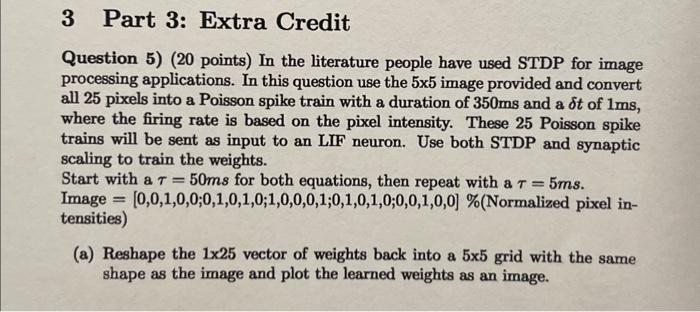
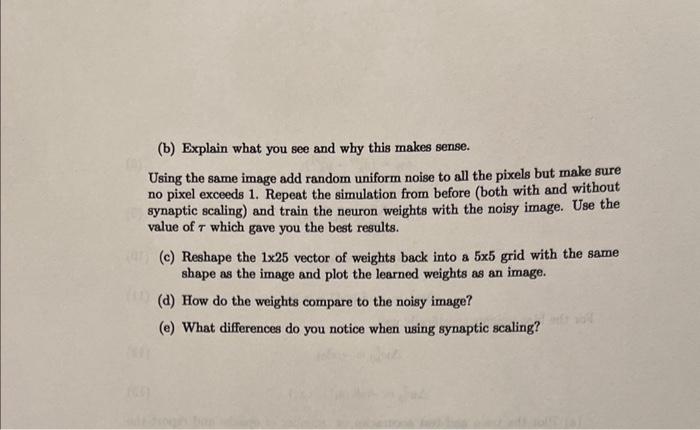
3 Part 3: Extra Credit Question 5) (20 points) In the literature people have used STDP for image processing applications. In this question use the 55 image provided and convert all 25 pixels into a Poisson spike train with a duration of 350ms and a t of 1ms, where the firing rate is based on the pixel intensity. These 25 Poisson spike trains will be sent as input to an LIF neuron. Use both STDP and synaptic scaling to train the weights. Start with a =50ms for both equations, then repeat with a =5ms. Image =[0,0,1,0,0;0,1,0,1,0;1,0,0,0,1;0,1,0,1,0;0,0,1,0,0]%( Normalized pixel intensities) (a) Reshape the 125 vector of weights back into a 55 grid with the same shape as the image and plot the learned weights as an image. (b) Explain what you see and why this makes sense. Using the same image add random uniform noise to all the pixels but make sure no pixel exceeds 1. Repeat the simulation from before (both with and without synaptic scaling) and train the neuron weights with the noisy image. Use the value of which gave you the best results. (c) Reshape the 125 vector of weights back into a 55 grid with the same shape as the image and plot the learned weights as an image. (d) How do the weights compare to the noisy image? (e) What differences do you notice when using synaptic scaling
Step by Step Solution
There are 3 Steps involved in it

Get step-by-step solutions from verified subject matter experts
 Study Help