



Question: Provide short answers to each question below. (a) (8 points) Which of the three hypotheses culture, geography, or institutions- would be most likely to
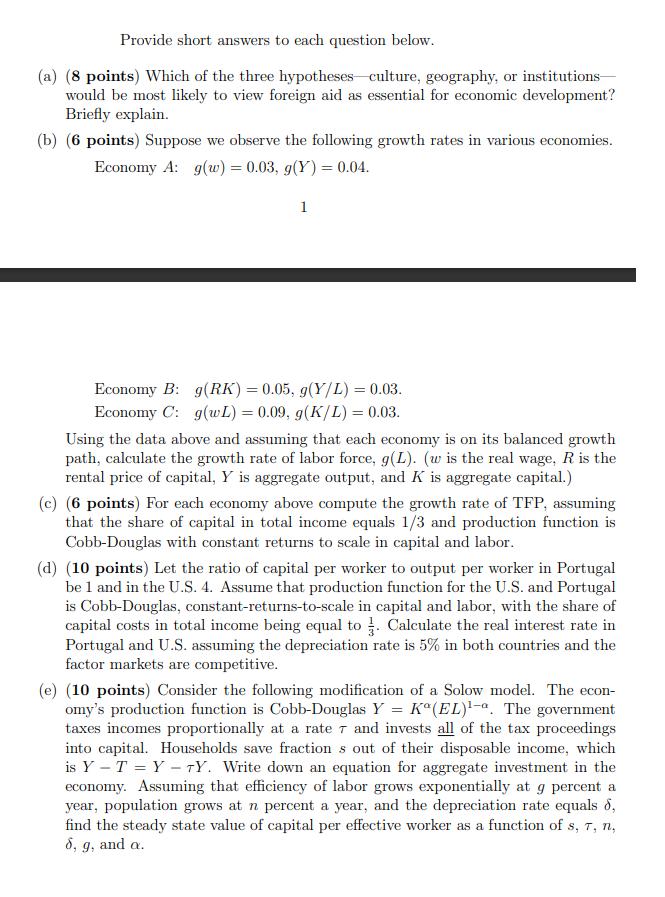
Provide short answers to each question below. (a) (8 points) Which of the three hypotheses culture, geography, or institutions- would be most likely to view foreign aid as essential for economic development? Briefly explain. (b) (6 points) Suppose we observe the following growth rates in various economies. Economy A: g(w) = 0.03, g(Y) = 0.04. 1 Economy B: g(RK) = 0.05, g(Y/L) = 0.03. Economy C: g(wL) = 0.09, g(K/L) = 0.03. Using the data above and assuming that each economy is on its balanced growth path, calculate the growth rate of labor force, g(L). (w is the real wage, R is the rental price of capital, Y is aggregate output, and K is aggregate capital.) (c) (6 points) For each economy above compute the growth rate of TFP, assuming that the share of capital in total income equals 1/3 and production function is Cobb-Douglas with constant returns to scale in capital and labor. (d) (10 points) Let the ratio of capital per worker to output per worker in Portugal be 1 and in the U.S. 4. Assume that production function for the U.S. and Portugal is Cobb-Douglas, constant-returns-to-scale in capital and labor, with the share of capital costs in total income being equal to . Calculate the real interest rate in Portugal and U.S. assuming the depreciation rate is 5% in both countries and the factor markets are competitive. (e) (10 points) Consider the following modification of a Solow model. The econ- omy's production function is Cobb-Douglas Y = K(EL)-a. The government taxes incomes proportionally at a rate 7 and invests all of the tax proceedings into capital. Households save fraction s out of their disposable income, which is YTYTY. Write down an equation for aggregate investment in the economy. Assuming that efficiency of labor grows exponentially at 9 percent a year, population grows at n percent a year, and the depreciation rate equals d, find the steady state value of capital per effective worker as a function of S, T, n, 8, g, and a.
Step by Step Solution
There are 3 Steps involved in it

Get step-by-step solutions from verified subject matter experts