







Question: Provide steo-by-step solutions 2 Exercise (10 pts) Consider a world with only two countries, Home and Foreign (Foreign is indexed by *), and two goods,
Provide steo-by-step solutions
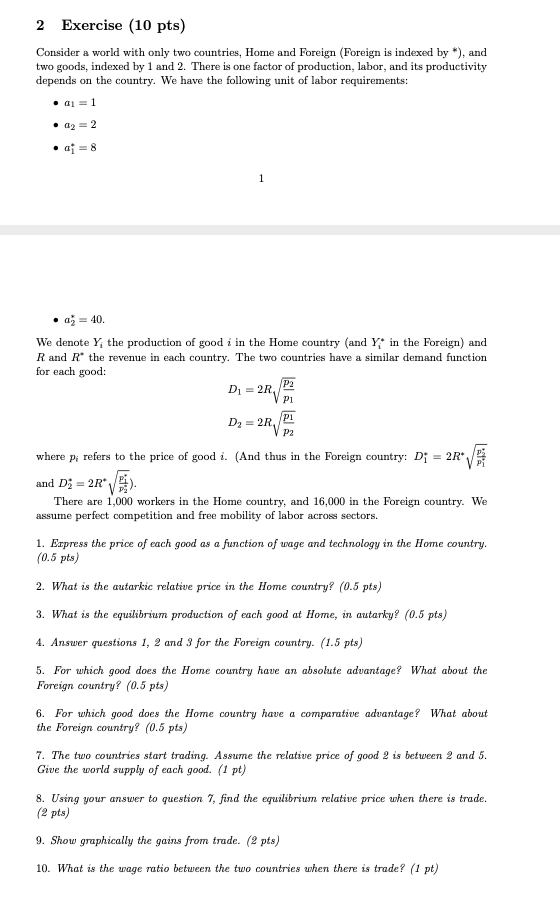
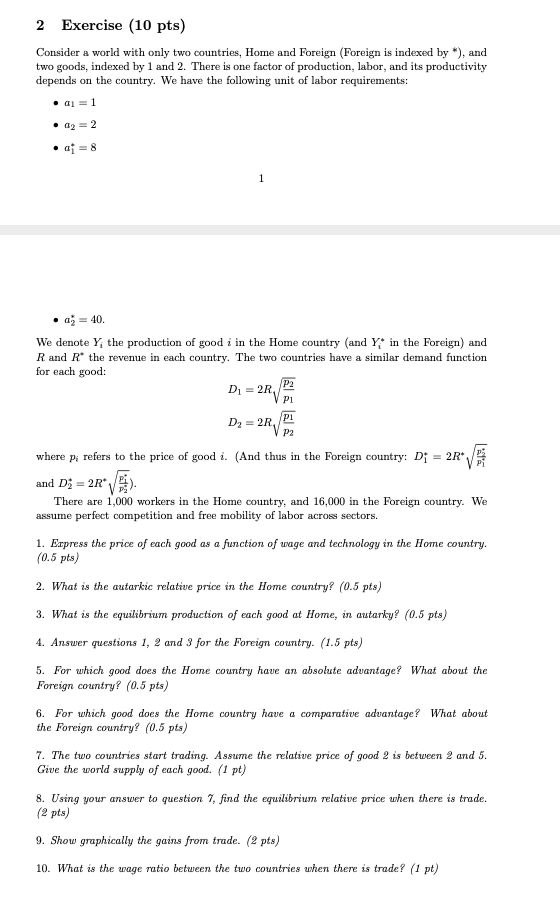
2 Exercise (10 pts) Consider a world with only two countries, Home and Foreign (Foreign is indexed by *), and two goods, indexed by 1 and 2. There is one factor of production, labor, and its productivity depends on the country. We have the following unit of labor requirements: . a1 = 1 . 02 = 2 . of = 8 . 03 = 40. We denote Y, the production of good i in the Home country (and Y* in the Foreign) and R and R" the revenue in each country. The two countries have a similar demand function for each good: D1 = 2R /P2 P1 D1 = 2R, /PI P2 where p; refers to the price of good i. (And thus in the Foreign country: Dj = 2R* and D; = 2R* / B). There are 1,000 workers in the Home country, and 16,000 in the Foreign country. We assume perfect competition and free mobility of labor across sectors. 1. Express the price of each good as a function of wage and technology in the Home country. (0.5 pts) 2. What is the autarkic relative price in the Home country? (0.5 pts) 3. What is the equilibrium production of each good at Home, in autarky? (0.5 pts) 4. Answer questions 1, 2 and 3 for the Foreign country. (1.5 pts) 5. For which good does the Home country have an absolute advantage? What about the Foreign country? (0.5 pts) 6. For which good does the Home country have a comparative advantage? What about the Foreign country? (0.5 pts) 7. The two countries start trading. Assume the relative price of good 2 is between 2 and 5. Give the world supply of each good. (1 pt) 8. Using your answer to question 7, find the equilibrium relative price when there is trade. (2 pts) 9. Show graphically the gains from trade. (2 pts) 10. What is the wage ratio between the two countries when there is trade? (1 pt)
Step by Step Solution
There are 3 Steps involved in it

Get step-by-step solutions from verified subject matter experts
 Study Help