







Question: Provide step-by-step solution 2. There are N (> 2) boxes, indexed k = 1, 2, ..., N. There is a very good book in exactly
Provide step-by-step solution
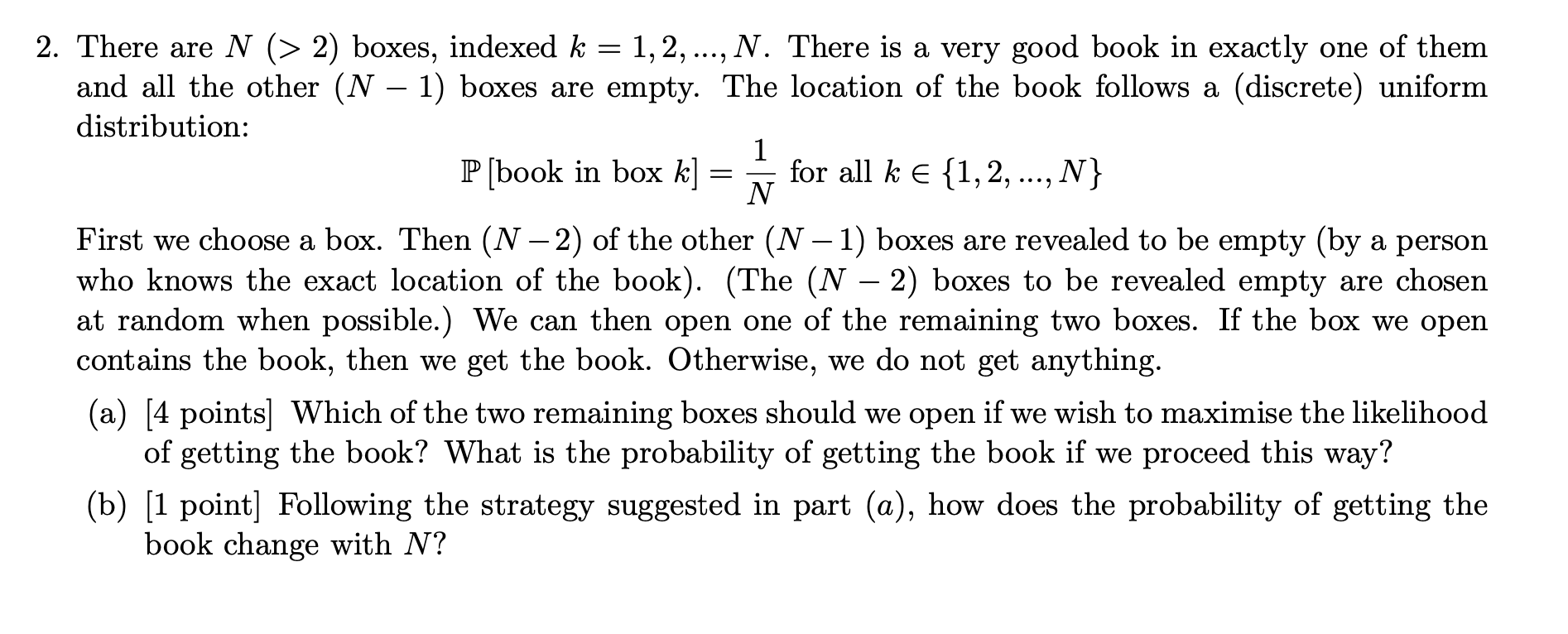
2. There are N (> 2) boxes, indexed k = 1, 2, ..., N. There is a very good book in exactly one of them and all the other (N 1) boxes are empty. The location of the book follows a (discrete) uniform distribution: lP[book in box k] = g for all k E {1,2, ...,N} First we choose a box. Then (N 2) of the other (N 1) boxes are revealed to be empty (by a person who knows the exact location of the book). (The (N 2) boxes to be revealed empty are chosen at random when possible.) We can then open one of the remaining two boxes. If the box we open contains the book, then we get the book. Otherwise, we do not get anything. (a) [4 points] Which of the two remaining boxes should we open if we wish to maximise the likelihood of getting the book? What is the probability of getting the book if we proceed this way? (b) [1 point] Following the strategy suggested in part (a), how does the probability of getting the book change with N
Step by Step Solution
There are 3 Steps involved in it

Get step-by-step solutions from verified subject matter experts
 Study Help