







Question: %******************************************************* % Pseudocode for solving 1-d transient conduction HT problem: % %******************************************************* %Initialize parameters and T Set coefficient as K = 0.01 Total length in
%*******************************************************
% Pseudocode for solving 1-d transient conduction HT problem:
%
%*******************************************************
%Initialize parameters and T
Set coefficient as K = 0.01
Total length in x-dir a=4
Total simulation time b=10;
%boundary conditions
left boundary c1=0;
right boundary c2=100;
%number of grid point over space n, and time m
n=50;
m=100;
%Calculate step size for space and time
delta_x=a/(n-1);
delta_t=b/(m-1);
%Initial temperature set to zero for both new time step and old time step
T=zeros(n,1)
OT=zeros(n,1);
%boundary conditions
T(1,1)=c1;
T(n,1)=c2;
%define new variable coe
coe=delta_t*K/delta_x/delta_x;
%use FTSC explicit scheme solve the problem
iterate in different time step
update the old time step calculation results with new time step value
iterate in different space step
solve new time step temperature based on Finite difference expression
(T(ix,1)=coe*OT(ix+1,1)+(1-2*coe)*OT(ix,1)+coe*OT(ix-1,1); )
end
end
output result
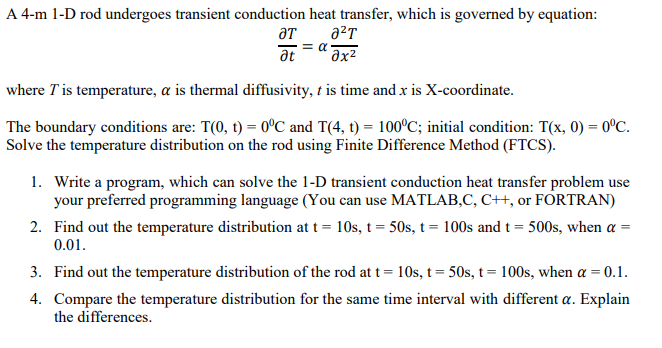
A 4-m 1-D rod undergoes transient conduction heat transfer, which is governed by equation: at x2 where Tis temperature, is thermal diffusivity, t is time and x is X-coordinate. The boundary conditions are: T(0, t) 00C and T(4, t)-100C; initial condition: T(x, 0)-00C Solve the temperature distribution on the rod using Finite Difference Method (FTCS) 1. Write a program, which can solve the 1-D transient conduction heat transfer problem use your preferred programming language (You can use MATLAB,C, C+, or FORTRAN) Find out the temperature distribution at t = 10s, t = 50s, t = 100s and t = 500s, when 0.01 2. . Find out the temperature distribution of the rod at t- 10s, t-50s, t-100s, when a0. Compare the temperature distribution for the same time interval with different a. Explain the differences. 4
Step by Step Solution
There are 3 Steps involved in it

Get step-by-step solutions from verified subject matter experts
 Study Help