







Question: Psychology for Statistics A e B A S T v In a classic study of infant attachment, Harlow (1959) placed infant monkeys in cages with
Psychology for Statistics
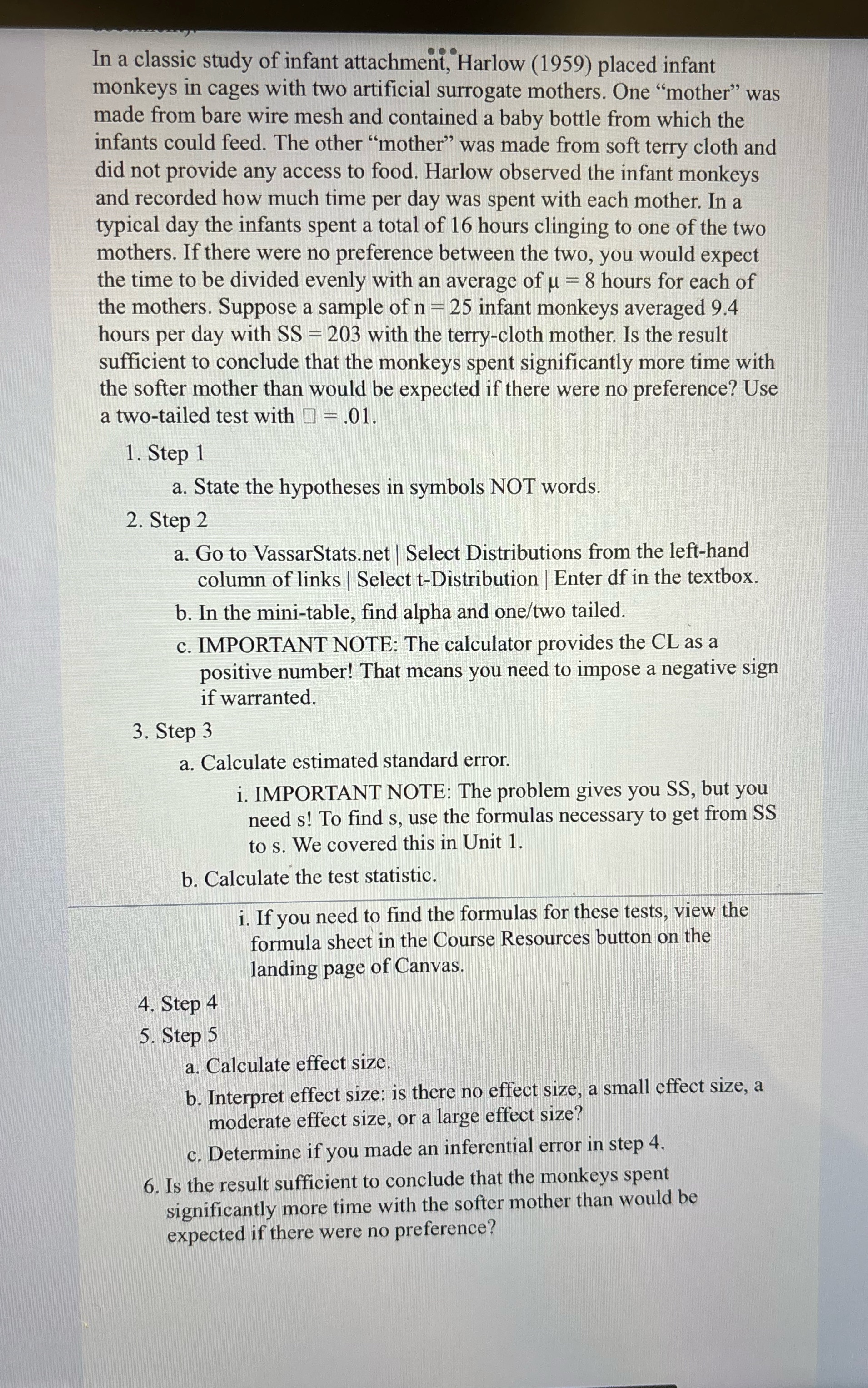
A e B A S T v In a classic study of infant attachment, Harlow (1959) placed infant monkeys in cages with two artificial surrogate mothers. One \"mother\" was made from bare wire mesh and contained a baby bottle from which the infants could feed. The other \"mother\" was made from soft terry cloth and did not provide any access to food. Harlow observed the infant monkeys and recorded how much time per day was spent with each mother. In a typical day the infants spent a total of 16 hours clinging to one of the two mothers. If there were no preference between the two, you would expect the time to be divided evenly with an average of u = 8 hours for each of the mothers. Suppose a sample of n = 25 infant monkeys averaged 9.4 hours per day with SS =203 with the terry-cloth mother. Is the result sufficient to conclude that the monkeys spent significantly more time with the softer mother than would be expected if there were no preference? Use a two-tailed test with [1 = .01. 1. Step 1 a. State the hypotheses in symbols NOT words. 2. Step 2 a. Go to VassarStats.net | Select Distributions from the left-hand column of links | Select t-Distribution | Enter df in the textbox. b. In the mini-table, find alpha and one/two tailed. c. IMPORTANT NOTE: The calculator provides the CL as a positive number! That means you need to impose a negative sign if warranted. 3 Step3 a. Calculate estimated standard error. i. IMPORTANT NOTE: The problem gives you SS, but you need s! To find s, use the formulas necessary to get from SS to s. We covered this in Unit 1. b. Calculate the test statistic. 1 Ifu;eed to ndthfo;guisfor these tests, view the formula sheet in the Course Resources button on the landing page of Canvas. 4. Step 4 5 Step > a. Calculate effect size. b. Interpret effect size: is there no effect size, a small effect size, a moderate effect size, or a large effect size? . Determine if you made an inferential error in step 4. 6. Is the result sufficient to conclude that the monkeys spent significantly more time with the softer mother than would be expected if there were no preference
Step by Step Solution
There are 3 Steps involved in it

Get step-by-step solutions from verified subject matter experts
 Study Help