







Question: public class Location { public static final Location JMU = new Location(38.435427, - 78.872942); public static final Location ISAT = new Location(38.434663, - 78.863732); private
public class Location
{
public static final Location JMU = new Location(38.435427, -
78.872942);
public static final Location ISAT = new Location(38.434663, -
78.863732);
private double latitude;
private double longitude;
/**
* Explicit value constructor for the this Location.
*
* @param latitude The latitude in degrees
* @param longitude The longitude in degrees
*/
public Location(double latitude, double longitude)
{
this.latitude = latitude;
this.longitude = longitude;
}
/**
* Are the two values within .000001 of each other?
*
* @return true if the two values are the same in
* the two objects and false otherwise
*/
public boolean equals(Location other)
{
return (this.latitude - other.latitude
&& this.longitude - other.longitude
}
/**
* Returns the latitude and longitude for this Location.
*
* @return string representation of this Location
*/
public String toString()
{
return String.format("%.6f/%.6f", latitude, longitude);
}
}
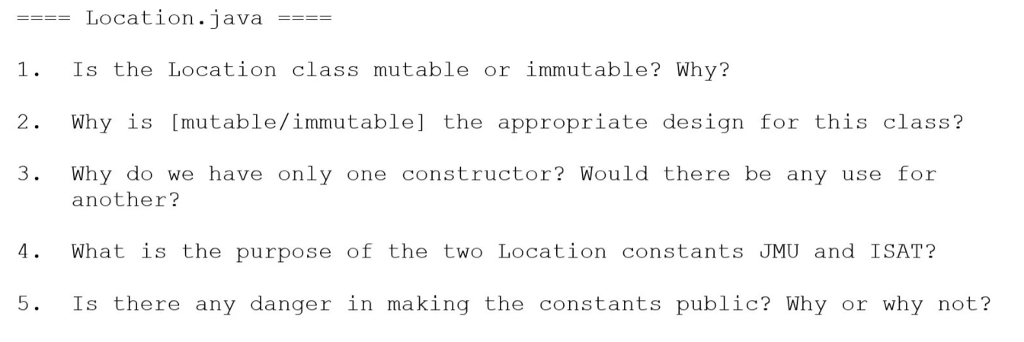
Location.java ==== 1. Is the Location class mutable or immutable? Why? 2. Why is [mutable/immutable] the appropriate design for this class? 3. Why do we have only one constructor? Would there be any use for 4. What is the purpose of the two Location constants JMU and ISAT? 5. Is there any danger in making the constants public? Why or why not? another
Step by Step Solution
There are 3 Steps involved in it

Get step-by-step solutions from verified subject matter experts
 Study Help