





Question: Purpose: An IEP (Individualized Education Program) is a written plan for students with identified disabilities which sets the conditions for the specific accommodations, materials, and
Purpose: An IEP (Individualized Education
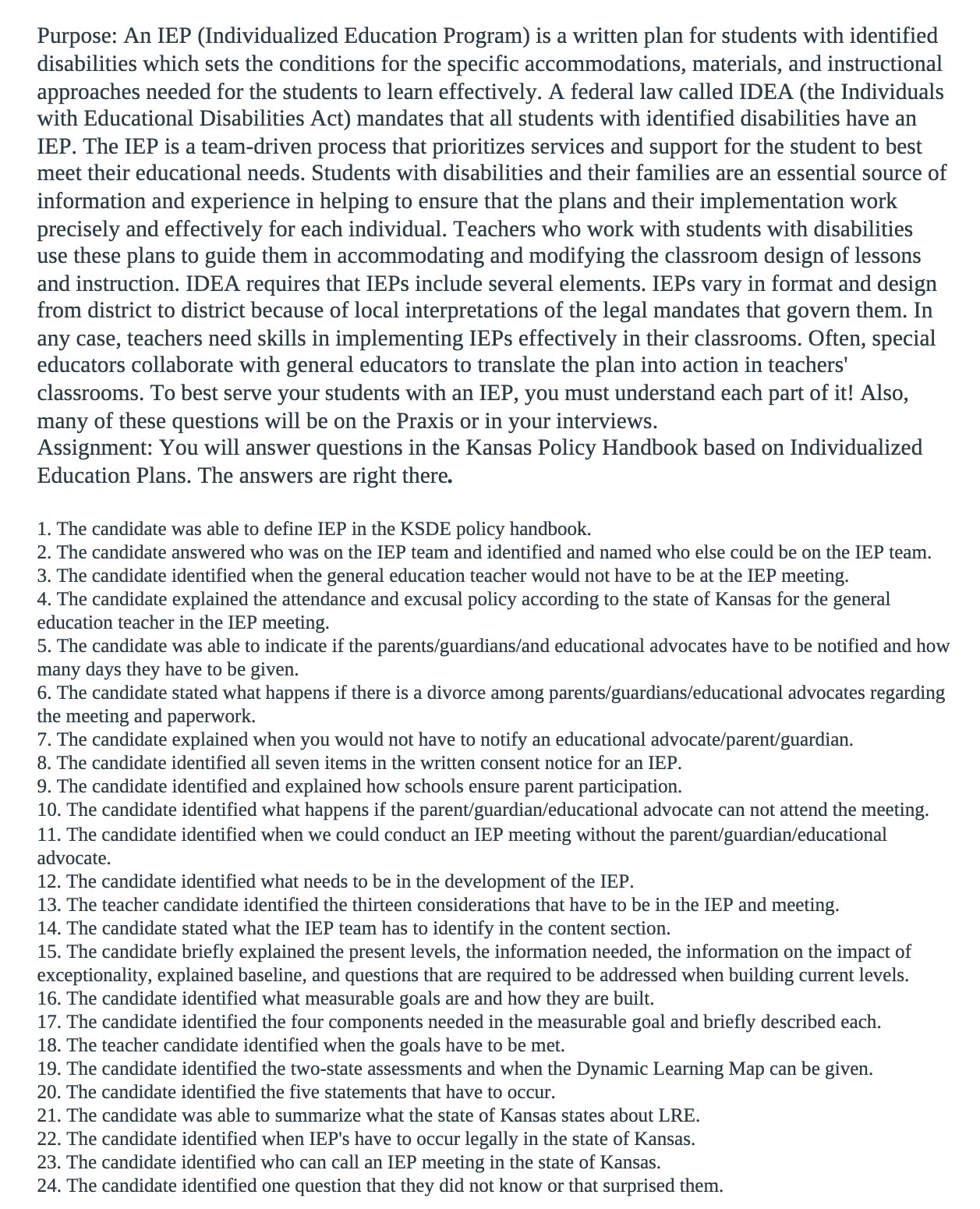
Purpose: An IEP (Individualized Education Program) is a written plan for students with identified disabilities which sets the conditions for the specific accommodations, materials, and instructional approaches needed for the students to learn effectively. A federal law called IDEA (the Individuals with Educational Disabilities Act) mandates that all students with identified disabilities have an IEP. The IEP is a team-driven process that prioritizes services and support for the student to best meet their educational needs. Students with disabilities and their families are an essential source of information and experience in helping to ensure that the plans and their implementation work precisely and effectively for each individual. Teachers who work with students with disabilities use these plans to guide them in accommodating and modifying the classroom design of lessons and instruction. IDEA requires that IEPs include several elements. IEPs vary in format and design from district to district because of local interpretations of the legal mandates that govern them. In any case, teachers need skills in implementing IEPs effectively in their classrooms. Often, special educators collaborate with general educators to translate the plan into action in teachers' classrooms. To best serve your students with an IEP, you must understand each part of it! Also, many of these questions will be on the Praxis or in your interviews. Assignment: You will answer questions in the Kansas Policy Handbook based on Individualized Education Plans. The answers are right there. 1. The candidate was able to define IEP in the KSDE policy handbook. 2. The candidate answered who was on the IEP team and identified and named who else could be on the IEP team. 3. The candidate identified when the general education teacher would not have to be at the IEP meeting. 4. The candidate explained the attendance and excusal policy according to the state of Kansas for the general education teacher in the IEP meeting. 5. The candidate was able to indicate if the parents/guardians/and educational advocates have to be notified and how many days they have to be given. 6. The candidate stated what happens if there is a divorce among parents! guardians/educational advocates regarding the meeting and paperwork. 7. The candidate explained when you would not have to notify an educational advocate/parent/guardian. 8. The candidate identified all seven items in the written consent notice for an IEP. 9. The candidate identified and explained how schools ensure parent participation. 10. The candidate identified what happens if the parent/guardianfeducational advocate can not attend the meeting. 11. The candidate identified when we could conduct an IEP meeting without the parentfguardianfeducational advocate. 12. The candidate identified what needs to be in the development of the IEP. 13. The teacher candidate identified the thirteen considerations that have to be in the IEP and meeting. 14. The candidate stated what the IEP team has to identify in the content section. 15. The candidate briey explained the present levels, the information needed, the information on the impact of exceptionality, explained baseline, and questions that are required to be addressed when building current levels. 16. The candidate identified what measurable goals are and how they are built. 17. The candidate identified the four components needed in the measurable goal and briey described each. 18. The teacher candidate identified when the goals have to be met. 19. The candidate identified the twostate assessments and when the Dynamic Learning Map can be given. 20. The candidate identified the five statements that have to occur. 21. The candidate was able to summarize what the state of Kansas states about LRE. 22. The candidate identified when IEP's have to occur legally in the state of Kansas. 23. The candidate identified who can call an IEP meeting in the state of Kansas. 24. The candidate identified one question that they did not know or that surprised them

Step by Step Solution

There are 3 Steps involved in it

1 Expert Approved Answer
Step: 1 Unlock blur-text-image

Question Has Been Solved by an Expert!

Get step-by-step solutions from verified subject matter experts

Step: 2 Unlock
Step: 3 Unlock

Students Have Also Explored These Related Mathematics Questions!