







Question: Purpose and objective: To enhance readability by reducing the complexity of a program, it is useful to be able to invoke functions that are already
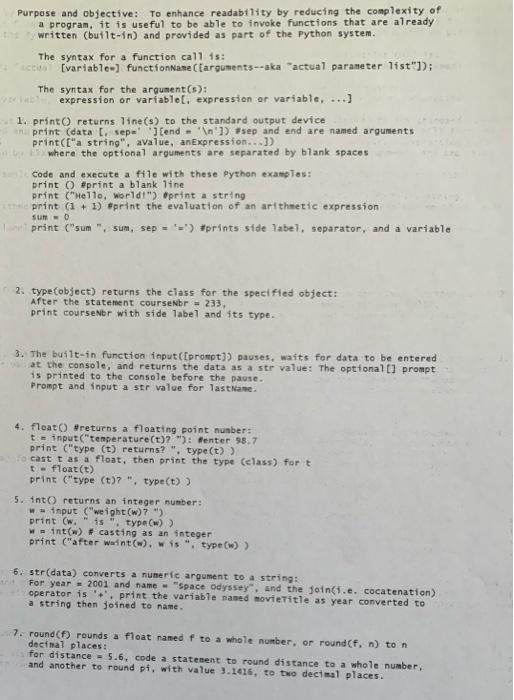
Purpose and objective: To enhance readability by reducing the complexity of a program, it is useful to be able to invoke functions that are already written (built-in) and provided as part of the Python system. The syntax for a function call 15: Sci Evariable) functionName(Larguments--aka actual parameter list")); The syntax for the argument(s): VE expression or variable, expression or variable, ...) 1. print returns line(s) to the standard output device print (data [. sep.' 'J tend - ' ']) sep and and are named arguments print("a string": avalue, an Expression...) or where the optional arguments are separated by blank spaces Code and execute a file with these Python examples: print #print a blank line print ("Hello world!") #print a string print (1 + 1) #print the evaluation of an arithmetic expression print ("sum", sum, sep = '') #prints side label, separator, and a variable sumo 2. type(object) returns the class for the specified object: After the statement courseNbr = 233, print courseNbr with side label and its type. 3. The built-in function input([prompt]) pauses, waits for data to be entered at the console, and returns the data as a str value: The optional) prompt 1s printed to the console before the pause. Prompt and input a str value for lastName. 4. float #returns a floating point number: tinput("temperature(t)?): fenter 98.7 print ("type (t) returns? ". type(t)) cast t as a float, then print the type (class) for t 1 - float(t) print ("type (t)?", type(t)) 5. into returns an integer number: - input ("weight (W)?? print (w." is ". type (w)) W = int() # casting as an integer print ("after waint(). wis ", type (w)) 6. str(data) converts a numeric argument to a string: For year 2001 and name - "space odyssey", and the join(t.e. cocatenation) operator is print the variable named movieTitle as year converted to a string then joined to name. 7. round(f) rounds a float named f to a whole number, or round(f, n) ton decimal places: for distance - 5.6, code a statement to round distance to a whole number, and another to round pi, with value 5.1416, to the decimal places
Step by Step Solution
There are 3 Steps involved in it

Get step-by-step solutions from verified subject matter experts
 Study Help