







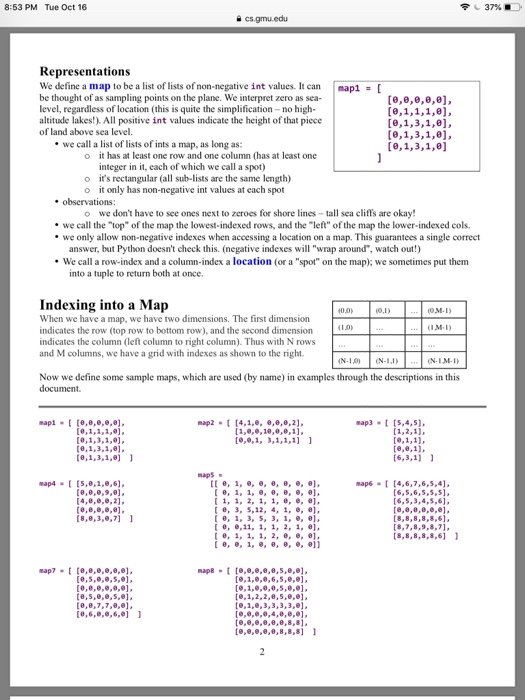
Question: PYHTON CODING FUNCTIONS HELP Part 2. Also need help with these last functions. Requirements/restraints and the map referred to is pictured in the screenshot. Need
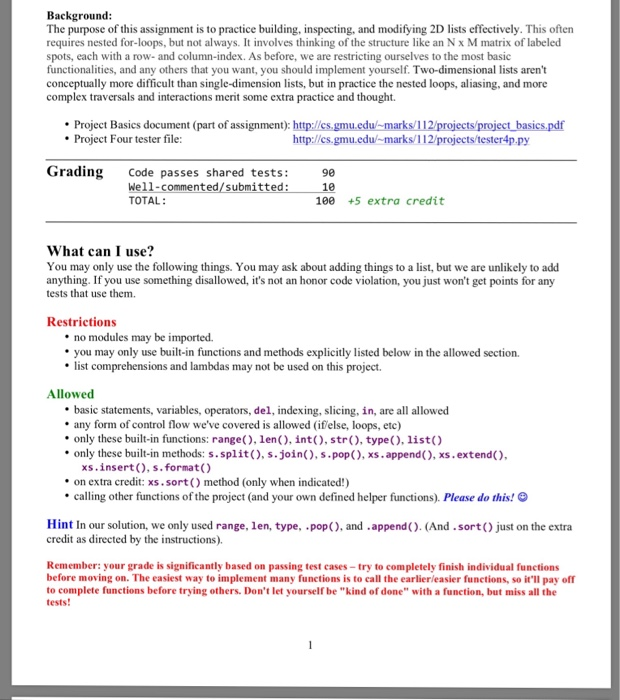
Background The purpose of this assignment is to practice building, inspecting, and modifying 2D lists effectively. This often requires nested for-loops, but not always. It involves thinking of the structure like an N x M matrix of labeled spots, each with a row-and column-index. As before, we are restricting ourselves to the most basic functionalities, and any others that you want, you should implement yourself. Two-dimensional lists aren't conceptually more difficult than single-dimension lists, but in practice the nested loops, aliasing, and more complex traversals and interactions merit some extra practice and thought Project Basics document (part of assignment): http://cs.gmu.edu/-marks/112/projects/project basics,pdf Project Four tester file: http://cs.gmu.edu marks/112/projects/tester4p.py Grading Code passes shared tests: We11-commented/submitted: 1 TOTAL: 90 100 +5 extra credit What can I use? You may only use the following things. You may ask about adding things to a list, but we are unlikely to add anything. If you use something disallowed, it's not an honor code violation, you just won't get points for any tests that use them. Restrictions no modules may be imported. you may only use built-in functions and methods explicitly listed below in the allowed section. list comprehensions and lambdas may not be used on this project Allowed basic statements, variables, operators, del, indexing, slicing, in, are all allowed any form of control flow we've covered is allowed (if else, loops, etc) only these built-in functions: range), len(), int), str, type(), list) only these built-in methods: s.split), s.join(), s.pop), xs.append(), xs.extend() xs.insert(), s.format() on extra credit: xs.sort() method (only when indicated!) calling other functions of the project (and your own defined helper functions). Please do this! e Hint In our solution, we only used range, len, type, pop(), and .append(). (And.sort() just on the extra credit as directed by the instructions). Remember: your grade is significantly based on passing test cases-try to completely finish individual functions before moving on. The easiest way to implement many functions is to call the earlierleasier functions, so it'll pay off to complete functions before trying others. Don't let yourself be "kind of done" with a function, but miss all the tests
Step by Step Solution
There are 3 Steps involved in it

Get step-by-step solutions from verified subject matter experts
 Study Help