







Question: python 16.15 Lab 3 Part C: Leap Years The earth does not orbit the sun in exactly 365 days. This means that the Gregorian calendar
python
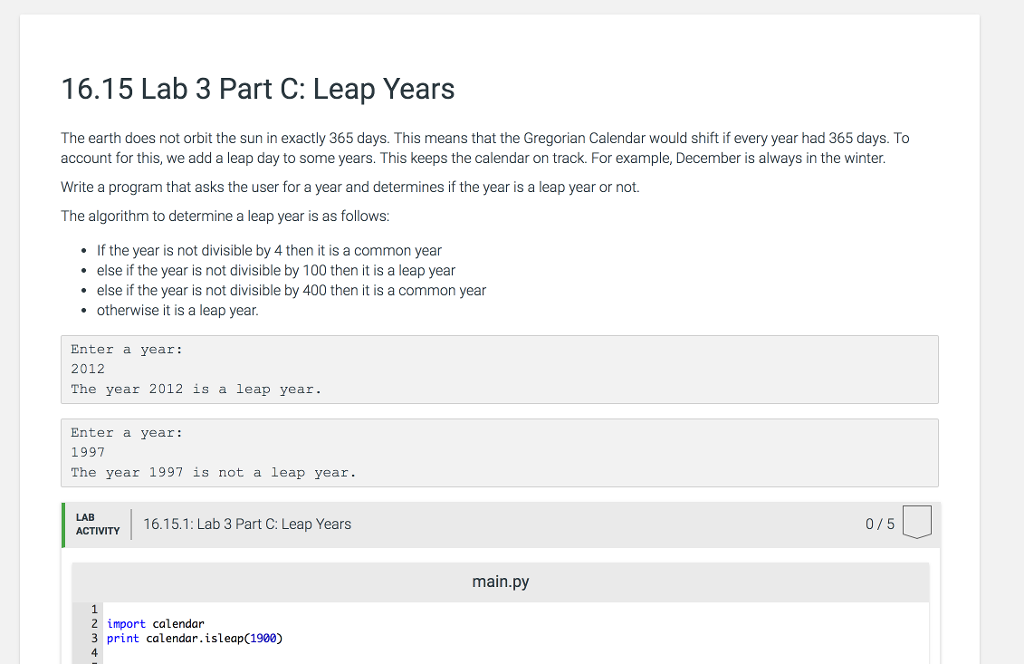
16.15 Lab 3 Part C: Leap Years The earth does not orbit the sun in exactly 365 days. This means that the Gregorian calendar would shift if every year had 365 days. To account for this, we add a leap day to some years. This keeps the calendar on track. For example, December is always in the winter. Write a program that asks the user for a year and determines if the year is a leap year or not. The algorithm to determine a leap year is as follows: If the year is not divisible by 4 then it is a common year else if the year is not divisible by 100 then it is a leap year else if the year is not divisible by 400 then it is a common year otherwise it is a leap year. Enter a year: 2012 The year 2012 is a leap year. Enter a year: 1997 The year 1997 is not a leap year. | Acrivm 1615 LAB ACTIVITY 16.15.1: Lab 3 Part C: Leap Years 0,5) main.py w N P 2 import calendar print calendar.isleap(1900)
Step by Step Solution
There are 3 Steps involved in it

Get step-by-step solutions from verified subject matter experts
 Study Help