







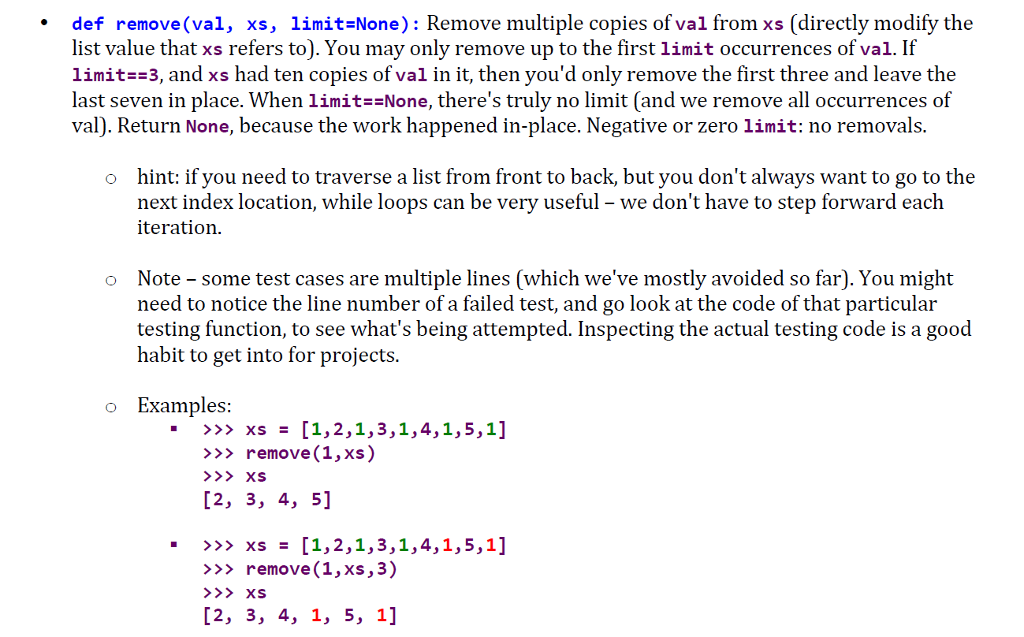
Question: python 3.6 please ! and comment your code .def remove(val, xs, limit-None): Remove multiple copies of val from xs (directly modify the list value that
python 3.6 please ! and comment your code
.def remove(val, xs, limit-None): Remove multiple copies of val from xs (directly modify the list value that xs refers to). You may only remove up to the first limit occurrences of val. If limit -3, and xs had ten copies of val in it, then you'd only remove the first three and leave the last seven in place. When limitNone, there's truly no limit (and we remove all occurrences of val). Return None, because the work happened in-place. Negative or zero limit: no removals. hint: if you need to traverse a list from front to back, but you don't always want to go to the next index location, while loops can be very useful - we don't have to step forward each iteratioin o o Note some test cases are multiple lines (which we've mostly avoided so far). You might need to notice the line number of a failed test, and go look at the code of that particular testing function, to see what's being attempted. Inspecting the actual testing code is a good habit to get into for projects. o Examples >> remove (1,xs) [2, 3, 4, 5] >> remove(1, xs,3)
Step by Step Solution
There are 3 Steps involved in it

Get step-by-step solutions from verified subject matter experts
 Study Help