







Question: python 3Thank you subtraction, and on and use variables whose exponents, called degrees, are non-negative integers. The derivative q(x) to a polynomial function p(x) is
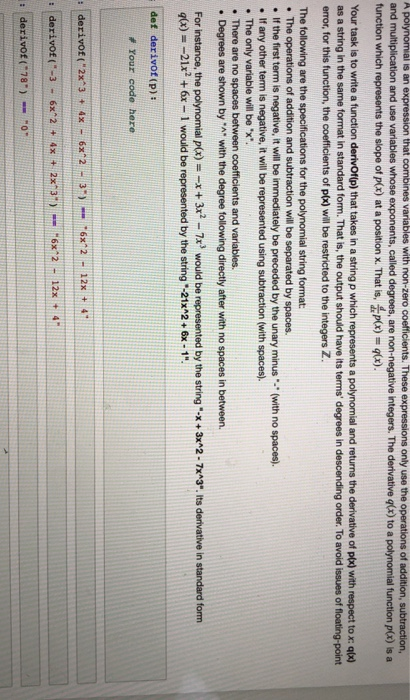
subtraction, and on and use variables whose exponents, called degrees, are non-negative integers. The derivative q(x) to a polynomial function p(x) is a function which represents the slope of p(x) at a position x. That is, px) -) Your task is to write a function derivof(p) that takes in a string p which represents a polynomial and returns the derivative of pb) with respect to x: q) as a string in the same format in standard form. That is, the output should have its terms' degrees in descending order. To avoid issues of floating-point error, for this function, the coefficients of p/x) will be restricted to the integers Z The following are the specifications for the polynomial string format: . The operations of addition and subtraction will be separated by spaces. If the first term is negative, it will be immediately be preceded by the unary minus(with no spaces) . If any other term is negative, it will be represented using subtraction (with spaces). The only variable will be "X. . There are no spaces between coefficients and variables. . Degrees are shown by "A with the degree following directly after with no spaces in between. For instance, the polynomial p(x) -x +3 7x would be represented by the string -x +3x*2-7x*3". its derivative in standard form q(x)--21x2 +6x-1 would be represented by the string -21x 2+6x" def derivot (P): # Your code here : derivot(3 6x"2 + 4x 2x 3 6x 2 -12x +4 : derivof (78)0
Step by Step Solution
There are 3 Steps involved in it

Get step-by-step solutions from verified subject matter experts
 Study Help