







Question: Python 3.x Classes Binary Tree I am having trouble with my coding and after asking this question a few times, I don't think a lot
Python 3.x Classes Binary Tree
I am having trouble with my coding and after asking this question a few times, I don't think a lot of people know what a huffman tree is so I'll describe it below with pictures I do have the code for the Huffman tree, I'll have the question below that:
Huffman Tree:
A Huffman Tree is a binary tree node, with 4 fields:
char: A single character
freq: The number of times the char occurred.
left: A reference to another HuffmanTree.
right: A reference to another HuffmanTree.
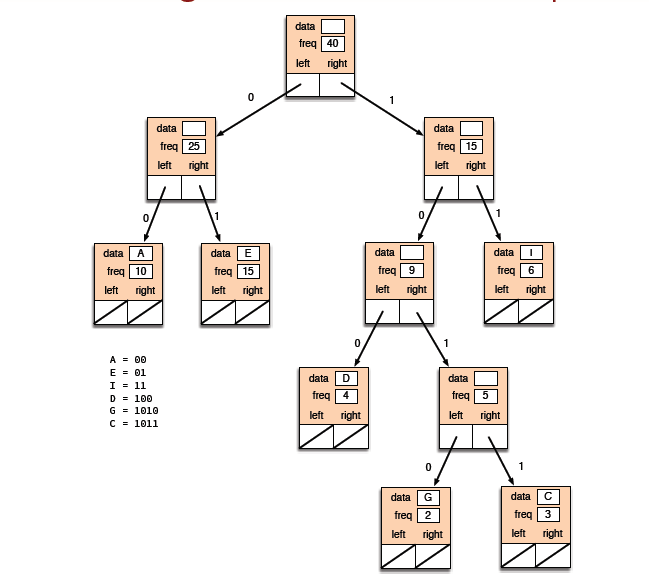
To build a Huffman Tree:
1. Create a leafnode, for every character, with its frequency

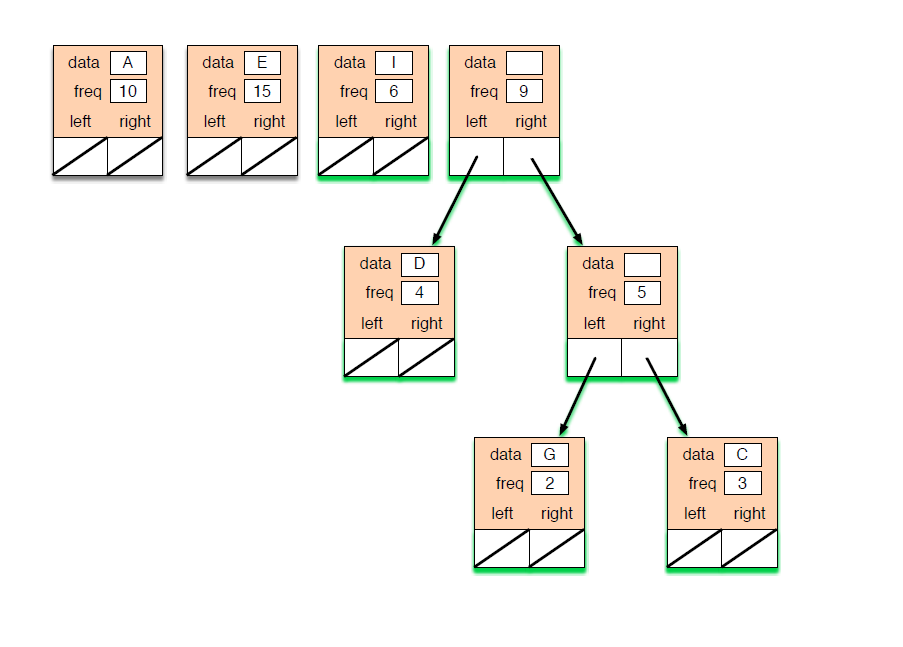
2. Repeat until there is one huffman tree
> Pick the two lowest frequency trees
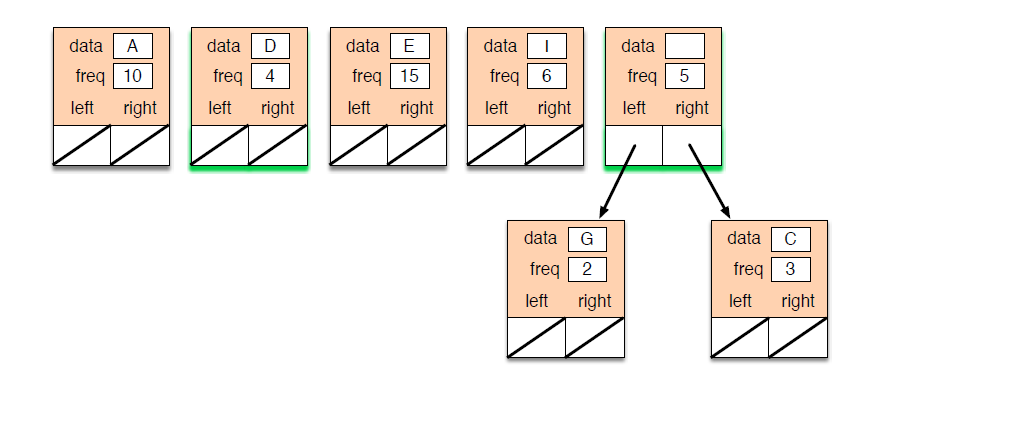
> Combine these as children to new node adding frequencies
Here is a completed Huffman Tree:
Here is the Question:
HuffmanHeap.py Needs to be completed:
# Defines a data structure that allows Huffman codes to # be computed efficiently. # # A Huffman Heap is a queue to store HuffmanTree objects. # The word "heap" implies that the dequeue operation will always # remove and return the HuffmanTree object with the lowest frequency. class HuffmanHeap(object): def __init__(self, leafs): """ Purpose: Creates a new HuffmanHeap object. Pre-conditions: leafs: a list of HuffmanTree leaf nodes. Post-conditions: The heap is created and initialized. Return: None """ pass def enqueue(self, tree): """ Purpose: Adds the tree to the Heap. This is an O(1) operation. Pre-conditions: tree is a HuffmanTree object Post-conditions: the heap increases in size by 1 Return: None """ return None def dequeue(self): """ Purpose: Return the smallest value in the queue. This is an O(1) operation. Pre-conditions: None Post-conditions: The heap decreases in size by 1 Return: A HuffmanTree object, with the lowest frequency """ return None def __len__(self): """ Purpose: Return the number of data values stored in the heap. This method allows Python scripts to call len(hh) if hh is a HuffmanHeap object. Pre-conditions: None Post-conditions: None Return: The number of values stored in the heap """ return 0 def display(self): """ Purpose: Display the data for debugging. Pre-conditions: None Post-conditions: None Return: None """ print('Add code to HuffmanHeap.display() to help you debug.') HuffmanTree.py:# Defines the Huffman Tree data structure # # A Huffman tree-node has a character and a frequency. # some strings to avoid long lines later _INIT_ASSERT_MESSAGE_NONLEAF = 'Invalid Huffman tree construction attempted.' _GETCH_ASSERT_MESSAGE_NONLEAF = 'Method get_char() called on non-leaf node' class HuffmanTree(object): def __init__(self, freq=0, char=None, left=None, right=None): """ Purpose: Initializes the HuffmanTree object. To create a leaf node aleaf = HuffmanTree(freq=10, char='A') bleaf = HuffmanTree(freq=15, char='E') To create an internal node: node = HuffmanTree(left=aleaf,right=bleaf) Pre-conditions: :param freq: a positive integer :param char: a character :param left: another Huffman Tree :param right: another HuffmanTree """ self.__char = char self.left = left self.right = right if left is None and right is None: # leaf node: assign the frequency as given self.__freq = freq else: assert left is not None and right is not None, _INIT_ASSERT_MESSAGE_NONLEAF # non-leaf node: calculate the frequency from the given subtrees self.__freq = left.__freq + right.__freq def is_leaf(self): """ Purpose: Check if the node is a leaf. Simplifies some of the other methods with an abstraction. Return: True if the node is a leaf node """ return self.left is None and self.right is None def get_freq(self): """ Purpose: Return the frequency data stored in the node. Return: :return: the frequency """ return self.__freq def get_char(self): """ Purpose: Return the character stored at a leaf node. Return: :return: the character at a leaf node """ assert self.is_leaf(), _GETCH_ASSERT_MESSAGE_NONLEAF return self.__char def display(self, level=0): """ Purpose: For debugging, display the tree. The structure of the tree is represented by indentation No other real purpose. Preconditions: :param level: indentation amount for subtrees. Return :return: None """ if self.is_leaf(): print(' '*level+'Leaf:', self.__char, self.__freq) else: print(' '*level+'Node:', self.__freq, 'Children:') self.left.display(level+1) self.right.display(level+1) def build_codec(self): """ Purpose: Build a dictionary of char-code pairs from the Huffman tree. Return: :return: a dictionary with character as key, code as value """ codes = {} def encoder(tree, code): if tree.is_leaf(): codes[tree.get_char()] = code else: encoder(tree.left, code+'0') encoder(tree.right, code+'1') if self.is_leaf(): codes[self.__char] = '0' else: encoder(self,'') return codes def __lt__(self, other): return self.__freq data A freq 10 left right data freq|3 left right data D freq|4 left right data E freq |15 left right data G freq | 2 leii rigi ii igi dataI freq 6 left right left right data A freq 10 left right data freq|3 left right data D freq|4 left right data E freq |15 left right data G freq | 2 leii rigi ii igi dataI freq 6 left right left right Step by Step Solution
There are 3 Steps involved in it

Get step-by-step solutions from verified subject matter experts
 Study Help