







Question: Python Code: The edge-detection function described in this chapter returns a black-and-white image. Think of a similar way to transform color values so that the
Python Code:
The edge-detection function described in this chapter returns a black-and-white image. Think of a similar way to transform color values so that the new image is still in its original colors but the outlines within it are merely sharpened. Then, define a function named sharpen that performs this operation. The function should expect an image and two integers as arguments. One integer should represent the degree to which the image should be sharpened. The other integer should represent the threshold used to detect edges. (Hint: A pixel can be darkened by making its RGB values smaller.)
edge-detection function :
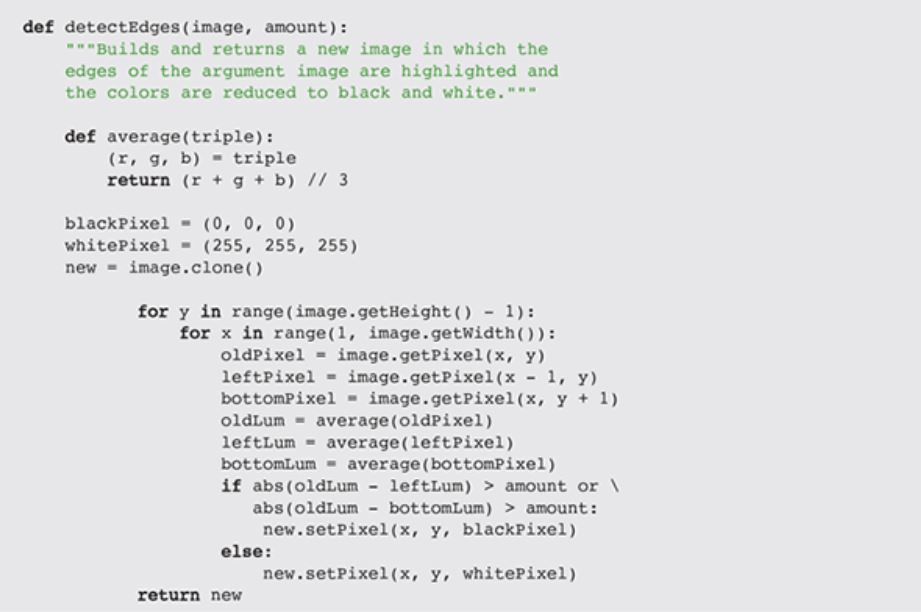
def detectEdges (image, amount): " Builds and returns a new image in which the edges of the argument image are highlighted and the colors are reduced to black and white."* def average (triple): (r, g, b)triple return (rg b) 3 blackPixel-(0, 0, 0) whitePixel (255, 255, 255) new = image.clone() for y in range (image.getHeight) 1): for x in range (1, image.getwidth)) oldPixel image.getPixel(x, y) leftPixel image . getPixel(x - 1, y) bottomPixel-image.getPixel(x, y+ 1) oldLum average (oldPixel) leftLum average(leftPixel) bottomLum average (bottomPixel) if abs (oldLum leftLum) > amount or abs (oldLum bottomLum) amount: new.setPixel(x, y, blackPixel) else: new.setPixel(x, y, whitePixel) return new def detectEdges (image, amount): " Builds and returns a new image in which the edges of the argument image are highlighted and the colors are reduced to black and white."* def average (triple): (r, g, b)triple return (rg b) 3 blackPixel-(0, 0, 0) whitePixel (255, 255, 255) new = image.clone() for y in range (image.getHeight) 1): for x in range (1, image.getwidth)) oldPixel image.getPixel(x, y) leftPixel image . getPixel(x - 1, y) bottomPixel-image.getPixel(x, y+ 1) oldLum average (oldPixel) leftLum average(leftPixel) bottomLum average (bottomPixel) if abs (oldLum leftLum) > amount or abs (oldLum bottomLum) amount: new.setPixel(x, y, blackPixel) else: new.setPixel(x, y, whitePixel) return new
Step by Step Solution
There are 3 Steps involved in it

Get step-by-step solutions from verified subject matter experts
 Study Help