







Question: Python coding project help This is from an intro programming class so we haven't learned any complicated commands yet. I have completed step 1 and
Python coding project help
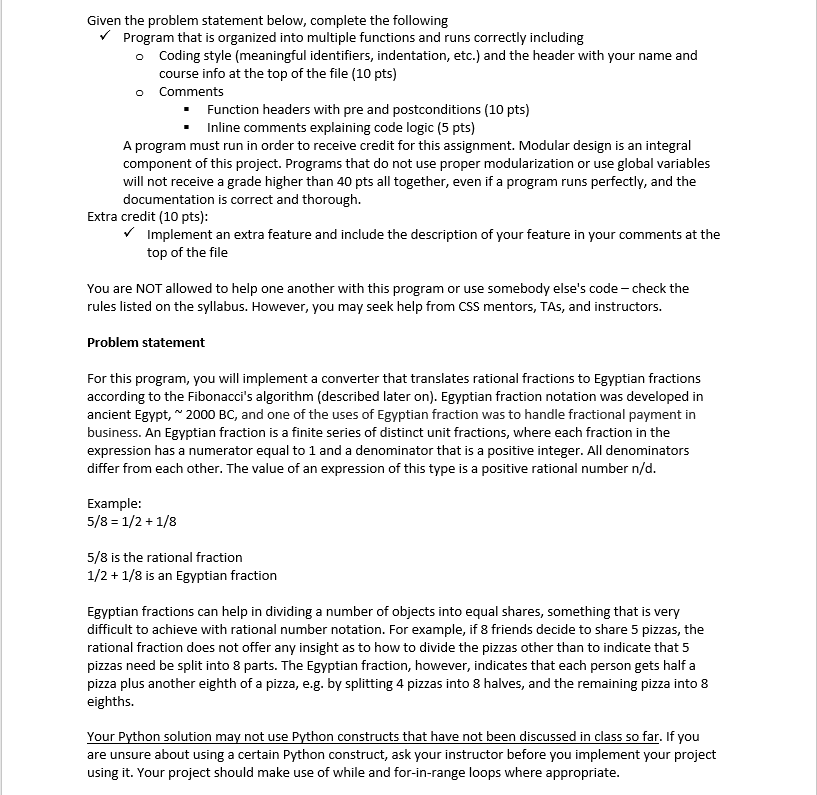
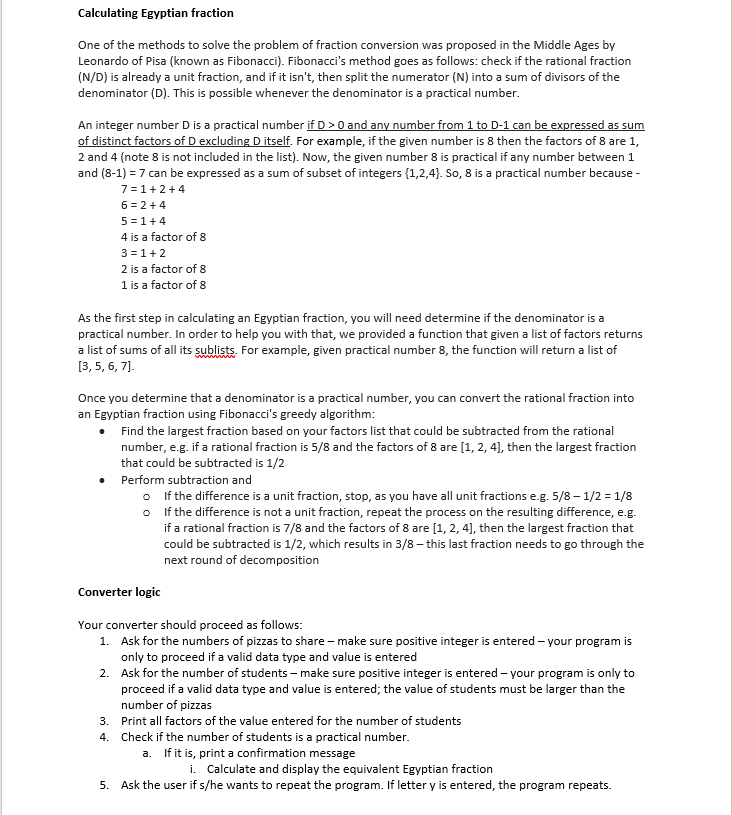
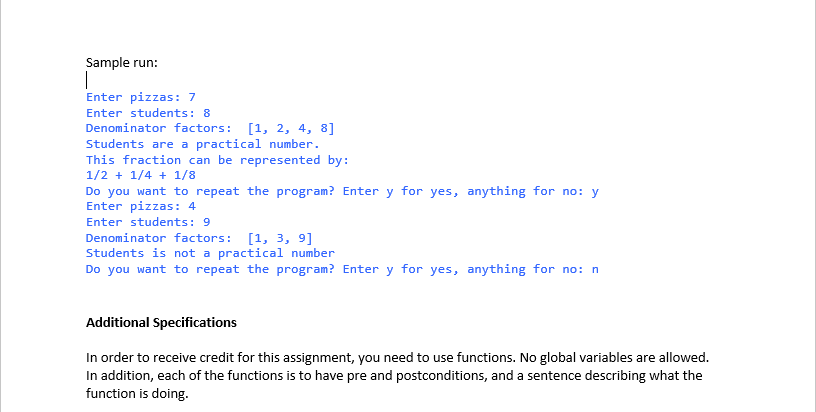
This is from an intro programming class so we haven't learned any complicated commands yet. I have completed step 1 and 2 so far but I'm lost after that.
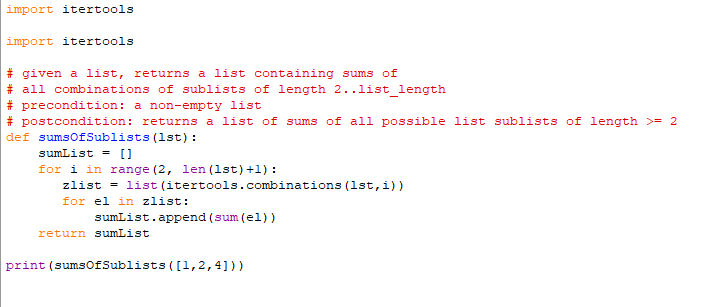
Also, the professor gave us this code mentioned in the instruction: "In order to help you with that, we provided a function that given a list of factors returns a list of sums of all its sublists." I don't think it's required for us to use this code but I thought I'd include it anyway.
Given the problem statement below, complete the following Program that is organized into multiple functions and runs correctly including Coding style (meaningful identifiers, indentation, etc.) and the header with your name and course info at the top of the file (10 pts) o o Comments Function headers with pre and postconditions (10 pts) Inline comments explaining code logic (5 pts) - * A program must run in order to receive credit for this assignment. Modular design is an integral component of this project. Programs that do not use proper modularization or use global variables will not receive a grade higher than 40 pts all together, even if a program runs perfectly, and the documentation is correct and thorough Extra credit (10 pts): V Implement an extra feature and include the description of your feature in your comments at the top of the file You are NOT allowed to help one another with this program or use somebody else's code-check the rules listed on the syllabus. However, you may seek help from CSS mentors, TAs, and instructors. Problem statement For this program, you will implement a converter that translates rational fractions to Egyptian fractions according to the Fibonacci's algorithm (described later on). Egyptian fraction notation was developed in ancient Egypt, N 2000 BC, and one of the uses of Egyptian fraction was to handle fractional payment in business. An Egyptian fraction is a finite series of distinct unit fractions, where each fraction in the expression has a numerator equal to 1 and a denominator that is a positive integer. All denominators differ from each other. The value of an expression of this type is a positive rational number n/d Example: 5/8 1/2+ 1/8 5/8 is the rational fraction 1/2 + 1/8 is an Egyptian fraction Egyptian fractions can help in dividing a number of objects into equal shares, something that is very difficult to achieve with rational number notation. For example, if 8 friends decide to share 5 pizzas, the rational fraction does not offer any insight as to how to divide the pizzas other than to indicate that 5 pizzas need be split into 8 parts. The Egyptian fraction, however, indicates that each person gets half a pizza plus another eighth of a pizza, e.g. by splitting 4 pizzas into 8 halves, and the remaining pizza into 8 eighths. Your Python solution may not use are unsure about using a certain Python construct, ask your instructor before you implement your project using it. Your project should make use of while and for-in-range loops where appropriate hon constructs that have not been discussed in class so far. If you
Step by Step Solution
There are 3 Steps involved in it

Get step-by-step solutions from verified subject matter experts
 Study Help