







Question: python DNA? To match all the characters of a string (go over them one by one), we can use a for loop, for example with
 python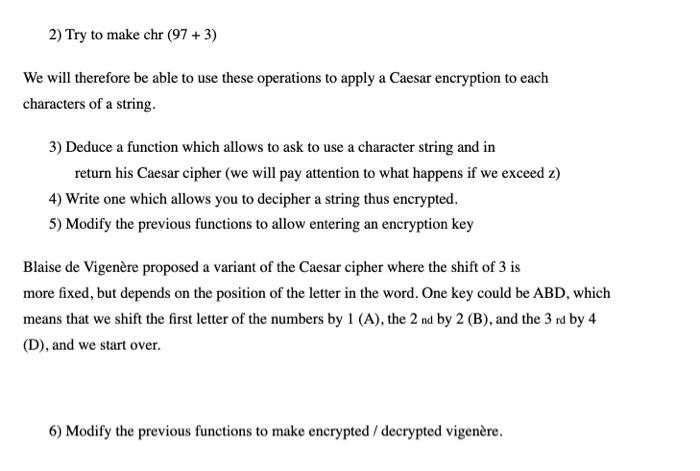
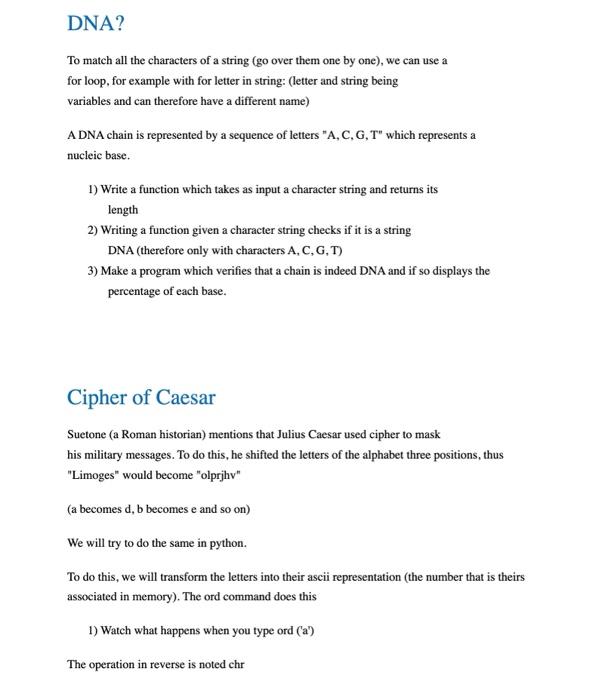
DNA? To match all the characters of a string (go over them one by one), we can use a for loop, for example with for letter in string: (letter and string being variables and can therefore have a different name) A DNA chain is represented by a sequence of letters "A, C, G,T" which represents a nucleic base. 1) Write a function which takes as input a character string and returns its length 2) Writing a function given a character string checks if it is a string DNA (therefore only with characters A, C,G,T) 3) Make a program which verifies that a chain is indeed DNA and if so displays the percentage of each base. Cipher of Caesar Suetone (a Roman historian) mentions that Julius Caesar used cipher to mask his military messages. To do this, he shifted the letters of the alphabet three positions, thus "Limoges" would become "olprjhv" (a becomes db becomes e and so on) We will try to do the same in python. To do this, we will transform the letters into their ascii representation (the number that is theirs associated in memory). The ord command does this 1) Watch what happens when you type ord ('a') The operation in reverse is noted chr 2) Try to make chr (97+3) We will therefore be able to use these operations to apply a Caesar encryption to each characters of a string. 3) Deduce a function which allows to ask to use a character string and in return his Caesar cipher (we will pay attention to what happens if we exceed z) 4) Write one which allows you to decipher a string thus encrypted. 5) Modify the previous functions to allow entering an encryption key Blaise de Vigenre proposed a variant of the Caesar cipher where the shift of 3 is more fixed, but depends on the position of the letter in the word. One key could be ABD, which means that we shift the first letter of the numbers by 1 (A), the 2 nd by 2 (B), and the 3 rd by 4 (D), and we start over. 6) Modify the previous functions to make encrypted / decrypted vigenre. DNA? To match all the characters of a string (go over them one by one), we can use a for loop, for example with for letter in string: (letter and string being variables and can therefore have a different name) A DNA chain is represented by a sequence of letters "A, C, G,T" which represents a nucleic base. 1) Write a function which takes as input a character string and returns its length 2) Writing a function given a character string checks if it is a string DNA (therefore only with characters A, C,G,T) 3) Make a program which verifies that a chain is indeed DNA and if so displays the percentage of each base. Cipher of Caesar Suetone (a Roman historian) mentions that Julius Caesar used cipher to mask his military messages. To do this, he shifted the letters of the alphabet three positions, thus "Limoges" would become "olprjhv" (a becomes db becomes e and so on) We will try to do the same in python. To do this, we will transform the letters into their ascii representation (the number that is theirs associated in memory). The ord command does this 1) Watch what happens when you type ord ('a') The operation in reverse is noted chr 2) Try to make chr (97+3) We will therefore be able to use these operations to apply a Caesar encryption to each characters of a string. 3) Deduce a function which allows to ask to use a character string and in return his Caesar cipher (we will pay attention to what happens if we exceed z) 4) Write one which allows you to decipher a string thus encrypted. 5) Modify the previous functions to allow entering an encryption key Blaise de Vigenre proposed a variant of the Caesar cipher where the shift of 3 is more fixed, but depends on the position of the letter in the word. One key could be ABD, which means that we shift the first letter of the numbers by 1 (A), the 2 nd by 2 (B), and the 3 rd by 4 (D), and we start over. 6) Modify the previous functions to make encrypted / decrypted vigenre
Step by Step Solution
There are 3 Steps involved in it

Get step-by-step solutions from verified subject matter experts
 Study Help