







Question: Python function. IMPLEMENTATION MUST BE IN PLACE Implement the function: def remove_all_evens(lst) This function gets a list of positive integers, lst. When called, it should
Python function. IMPLEMENTATION MUST BE IN PLACE
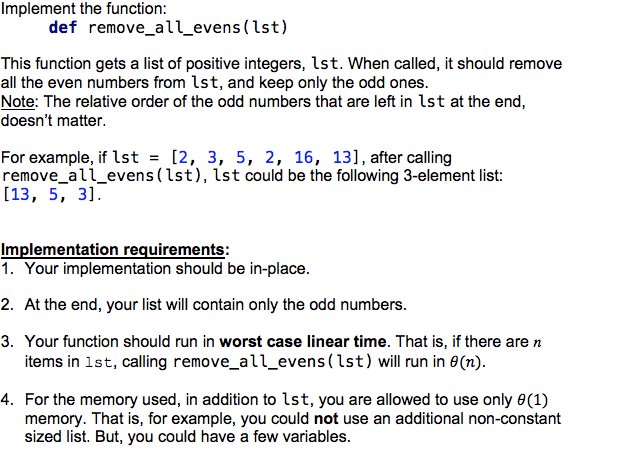
Implement the function: def remove_all_evens(lst) This function gets a list of positive integers, lst. When called, it should remove all the even numbers from lst, and keep only the odd ones. Note: The relative order of the odd numbers that are left in lst at the end, doesn't matter. For example, if lst [2, 3, 5, 2, 16, 13], after calling remove-a-evens ( st ) , st could be the following 3-element list: [13, 5, 31 Implementation requirements: 1. Your implementation should be in-place 2. At the end, your list will contain only the odd numbers. 3. Your function should run in worst case linear time. That is, if there are n tems in 1st, calling remove all_evens(st) will run in (n). 4. For the memory used, in addition to lst, you are allowed to use only (1) memory. That is, for example, you could not use an additional non-constant sized list. But, you could have a few variables
Step by Step Solution
There are 3 Steps involved in it

Get step-by-step solutions from verified subject matter experts
 Study Help