







Question: Python functions are first-class elements of the language. That means that they can be treated like any other values. One common use of first-class functions
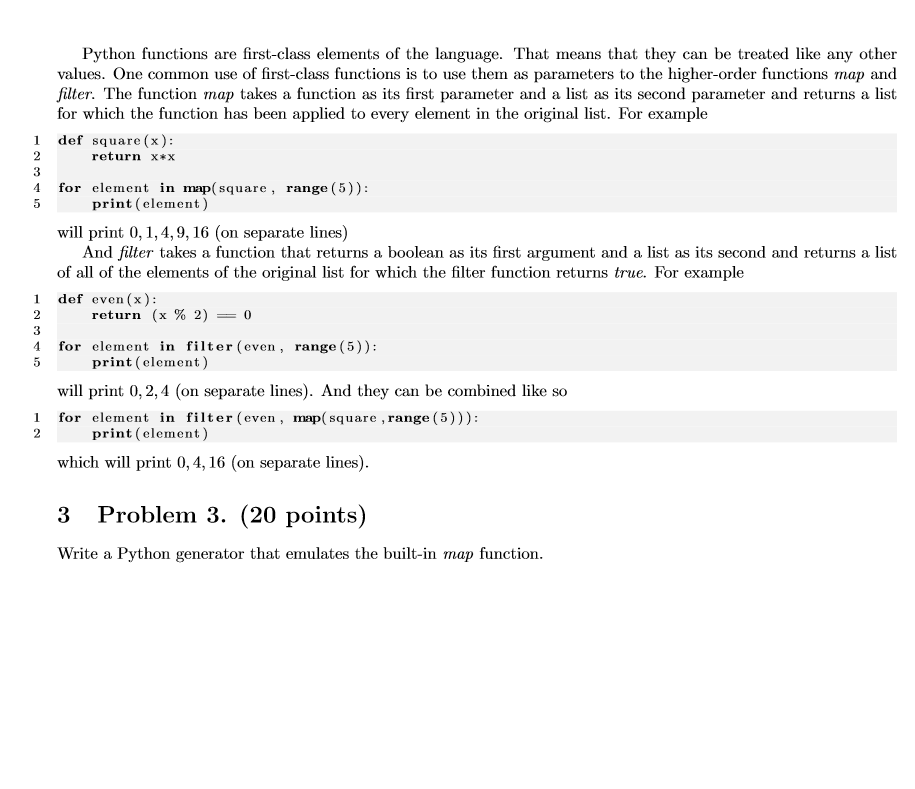
Python functions are first-class elements of the language. That means that they can be treated like any other values. One common use of first-class functions is to use them as parameters to the higher-order functions map and filter. The function map takes a function as its first parameter and a list as its second parameter and returns a list for which the function has been applied to every element in the original list. For example def square(x): return x*x for clement in map(square, range (5)): print (element) will print 0, 1, 4, 9, 16 (on separate lines) And filter takes a function that returns a boolean as its first argument arid a list as its second and returns a list of all of the elements of the original list for which the filter function returns true. For example def even(x): return (x % 2) = 0 for clement in filter (even, range(5)): print (element) will print 0, 2, 4 (on separate lines). And they can be combined like so for element in filter (even, map(square, range (5))): print (element) which will print 0, 4, 16 (on separate lines). Write a Python generator that emulates the built-in map function. Python functions are first-class elements of the language. That means that they can be treated like any other values. One common use of first-class functions is to use them as parameters to the higher-order functions map and filter. The function map takes a function as its first parameter and a list as its second parameter and returns a list for which the function has been applied to every element in the original list. For example def square(x): return x*x for clement in map(square, range (5)): print (element) will print 0, 1, 4, 9, 16 (on separate lines) And filter takes a function that returns a boolean as its first argument arid a list as its second and returns a list of all of the elements of the original list for which the filter function returns true. For example def even(x): return (x % 2) = 0 for clement in filter (even, range(5)): print (element) will print 0, 2, 4 (on separate lines). And they can be combined like so for element in filter (even, map(square, range (5))): print (element) which will print 0, 4, 16 (on separate lines). Write a Python generator that emulates the built-in map function
Step by Step Solution
There are 3 Steps involved in it

Get step-by-step solutions from verified subject matter experts
 Study Help