







Question: Python generator def min_key_order(adict): # Test min_key_order c-->d = {1:'a', 2:'x', 4:'m', 8:'d', 16:'f'} c-->i = min_key_order(d) ==-->[next(i), next(i), d.pop(8), next(i), d.setdefault(32,'z'), next(i), next(i)]-->[(1, 'a'),
Python generator
def min_key_order(adict):
# Test min_key_order c-->d = {1:'a', 2:'x', 4:'m', 8:'d', 16:'f'} c-->i = min_key_order(d) ==-->[next(i), next(i), d.pop(8), next(i), d.setdefault(32,'z'), next(i), next(i)]-->[(1, 'a'), (2, 'x'), 'd', (4, 'm'), 'z', (16, 'f'), (32, 'z')] ==-->d-->{1:'a', 2:'x', 4:'m', 16:'f', 32:'z'} c-->d = {1:'a', 2:'x', 4:'m', 8:'d', 16:'f'} c-->i = min_key_order(d) ==-->[next(i), next(i), next(i), d.setdefault(3,'n'), d.setdefault(10,'o'), d.setdefault(32,'z'), next(i), next(i), next(i), next(i)]-->[(1, 'a'), (2, 'x'), (4, 'm'), 'n', 'o', 'z', (8, 'd'), (10, 'o'), (16, 'f'), (32, 'z')] ==-->d-->{1:'a', 2:'x', 3:'n', 4:'m', 8:'d', 10:'o', 16:'f', 32:'z'} c-->d = {1:'a', 2:'x', 4:'m', 8:'d', 16:'f'} c-->i = min_key_order(d) ==-->[next(i), d.pop(2), d.pop(4), d.pop(8), next(i)]-->[(1, 'a'), 'x', 'm', 'd', (16, 'f')] ==-->d-->{1:'a', 16:'f'} c-->d = {1:'a', 2:'x', 4:'m', 8:'d', 16:'f'} c-->i = min_key_order(d) ==-->[next(i), d.pop(2), next(i), d.pop(4), d.pop(8), next(i)]-->[(1, 'a'), 'x', (4, 'm'), 'm', 'd', (16, 'f')] ==-->d-->{1:'a', 16:'f'} c-->d = {} c-->i = min_key_order(d) ^-->next(i)-->StopIteration
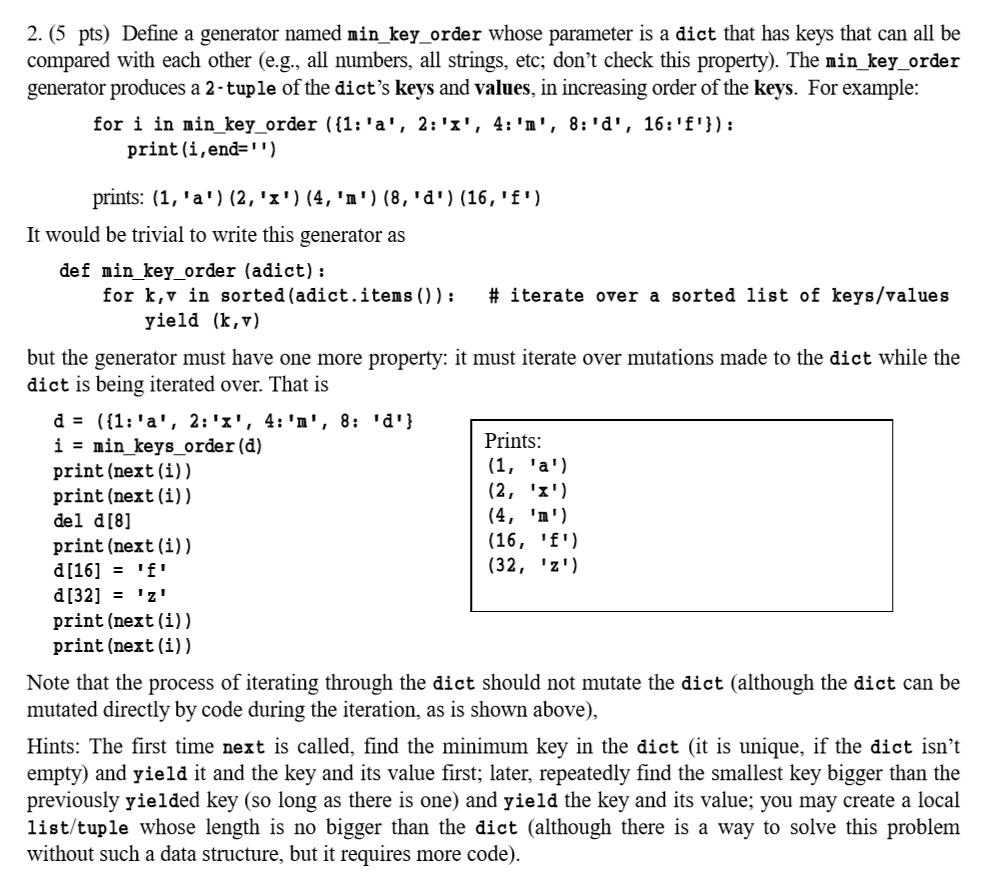
2. (5 pts) Define a generator named nin key_order whose parameter is a dict that has keys that can all be compared with each other (e.g., all numbers, all strings, etc; don't check this property). The min key order generator produces a 2-tuple of the dict's keys and values, in increasing order of the keys. For example: for i in nin key order ([1: 'a', 2:'x', 4:'n', 8:'d', 16:'f'): print (i,end-') prints: (1, 'a') (2,'x') (4, 'n') (8, 'd') (16, 'f') It would be trivial to write this generator as def nin_key_order (adict): for k,v in sorted (adict.itens()) : # iterate over a sorted list of keys/values yield (k,v) but the generator must have one more property: it must iterate over mutations made to the dict while the dict is being iterated over. That is Prints: i-min keys-order (d) print (next(i)) print (next(i)) del d[8] print (next(i)) d[16] = 'f' print (nezt(i)) print(next (i)) Note that the process of iterating through the dict should not mutate the dict (although the dict can be mutated directly by code during the iteration, as is shown above), Hints: The first time next is called, find the minimum key in the dict it is unique, if the dict isn't empty) and yield it and the key and its value first; later, repeatedly find the smallest key bigger than the previously yielded key (so long as there is one) and yield the key and its value; you may create a local list/tuple whose length is no bigger than the dict (although there is a way to solve this problem without such a data structure, but it requires more code)
Step by Step Solution
There are 3 Steps involved in it

Get step-by-step solutions from verified subject matter experts
 Study Help