







Question: Python: Horne s rule provides an efficient method for evaluating a polynomial p(t) o ati of degree n at any t to. In this exercise,
Python: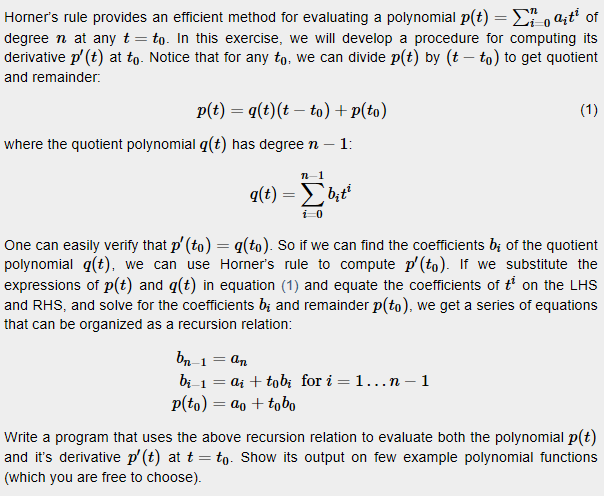
Horne s rule provides an efficient method for evaluating a polynomial p(t) o ati of degree n at any t to. In this exercise, we will develop a procedure for computing its derivative p' (t) at to. Notice that for any to, we can divide p(t) by (t - to) to get quotient and remainder: p(t) (t) (t to) +p(to) where the quotient polynomial q(t) has degree n - 1 TL One can easily verify that p'(to) g(to). So if we can find the coefficients bi of the quotient polynomial q(t), we can use Horner's rule to compute p' (to). If we substitute the expressions of p(t) and q(t) in equation (1) and equate the coefficients of t on the LHS and RHS, and solve for the coefficients bi and remainder p(to), we get a series of equations that can be organized as a recursion relation: n-1 1=an bi i = ai + tobi for i=1 n-1 p(to) +tobo Write a program that uses the above recursion relation to evaluate both the polynomial p(t) and it's derivative p'(t) at t-to. Show its output on few example polynomial functions which you are free to choose). Horne s rule provides an efficient method for evaluating a polynomial p(t) o ati of degree n at any t to. In this exercise, we will develop a procedure for computing its derivative p' (t) at to. Notice that for any to, we can divide p(t) by (t - to) to get quotient and remainder: p(t) (t) (t to) +p(to) where the quotient polynomial q(t) has degree n - 1 TL One can easily verify that p'(to) g(to). So if we can find the coefficients bi of the quotient polynomial q(t), we can use Horner's rule to compute p' (to). If we substitute the expressions of p(t) and q(t) in equation (1) and equate the coefficients of t on the LHS and RHS, and solve for the coefficients bi and remainder p(to), we get a series of equations that can be organized as a recursion relation: n-1 1=an bi i = ai + tobi for i=1 n-1 p(to) +tobo Write a program that uses the above recursion relation to evaluate both the polynomial p(t) and it's derivative p'(t) at t-to. Show its output on few example polynomial functions which you are free to choose)
Step by Step Solution
There are 3 Steps involved in it

Get step-by-step solutions from verified subject matter experts
 Study Help