







Question: %%% Python Jupyter notebook %%% words.txt - file Writing programs or programming is a very creative and rewarding activity You can write programs for many
%%% Python Jupyter notebook %%%
words.txt - file
Writing programs or programming is a very creative and rewarding activity You can write programs for many reasons ranging from making your living to solving a difficult data analysis problem to having fun to helping someone else solve a problem This book assumes that {\em everyone} needs to know how to program and that once you know how to program, you will figure out what you want to do with your newfound skills
We are surrounded in our daily lives with computers ranging from laptops to cell phones We can think of these computers as our personal assistants who can take care of many things on our behalf The hardware in our current-day computers is essentially built to continuously ask us the question What would you like me to do next
Our computers are fast and have vasts amounts of memory and could be very helpful to us if we only knew the language to speak to explain to the computer what we would like it to do next If we knew this language we could tell the computer to do tasks on our behalf that were reptitive Interestingly, the kinds of things computers can do best are often the kinds of things that we humans find boring and mind-numbing
# Code here
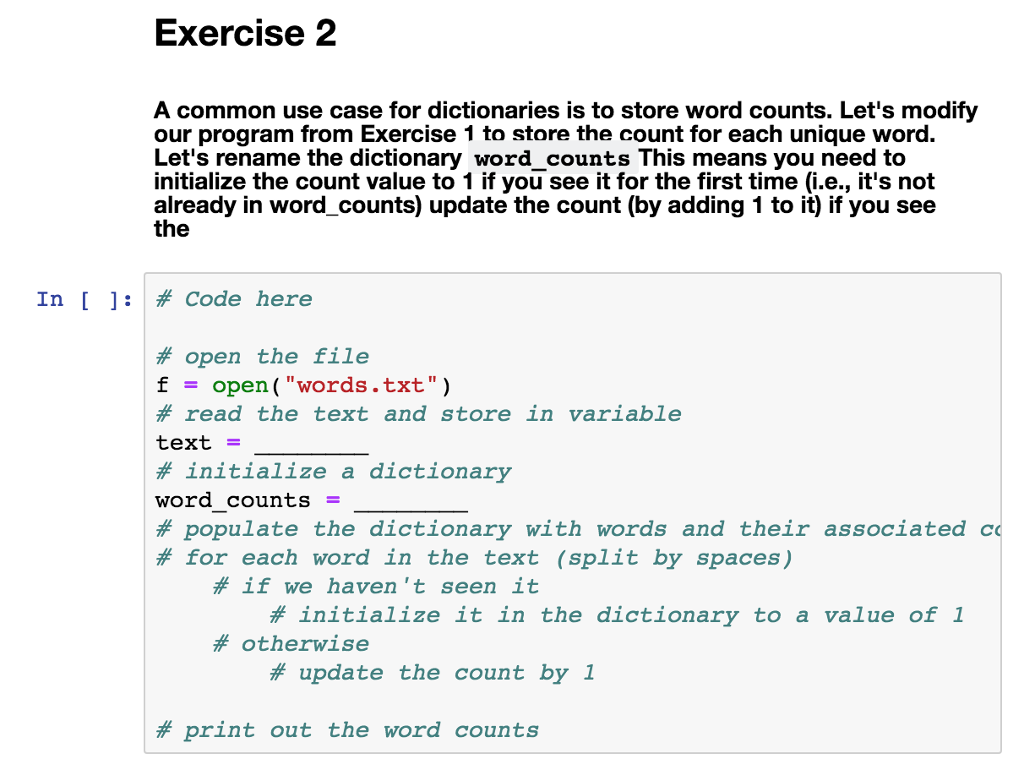
# open the file f = open("words.txt") # read the text and store in variable text = ________ # initialize a dictionary word_counts = ________ # populate the dictionary with words and their associated counts in the text # for each word in the text (split by spaces) # if we haven't seen it # initialize it in the dictionary to a value of 1 # otherwise # update the count by 1 # print out the word counts
Exercise 2 A common use case for dictionaries is to store word counts. Let's modify our program from Exercise 1 to store the count for each unique word. Let's rename the dictionary word counts This means you need to initialize the count value to 1 if you see it for the first time (i.e., it's not already in word counts) update the count (by adding 1 to it) if you see the In [ ]: | # Code here # open the file f -open("words.txt") # read the text and store in variable text - # initialize a dictionary word counts - # populate the dictionary with words and their associated c # for each word in the text (split by spaces) # if we haven't seen it # initialize it in the dictionary to a value of 1 # otherwise # update the count by 1 # print out the word counts
Step by Step Solution
There are 3 Steps involved in it

Get step-by-step solutions from verified subject matter experts
 Study Help