







Question: python Lists can hold integers, strings, and even other lists, for example [ [test], [ ], [1. [me] ] ) is a list with three
 python
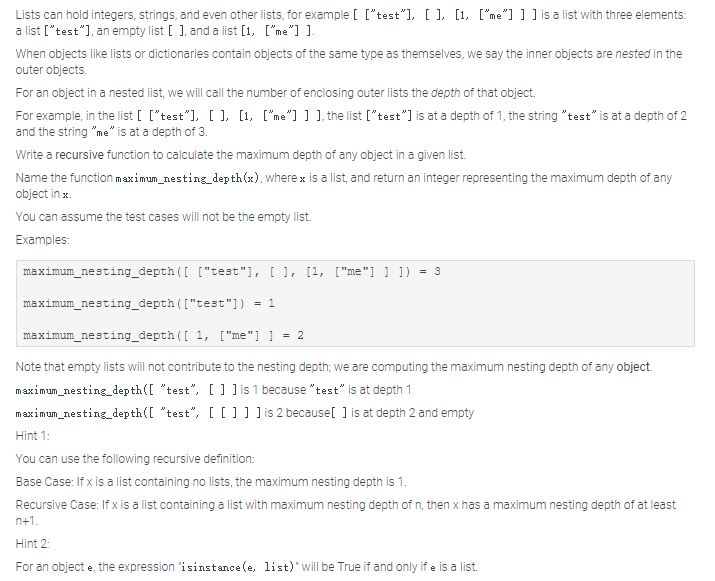
Lists can hold integers, strings, and even other lists, for example [ ["test"], [ ], [1. ["me"] ] ) is a list with three elements: a list ["test"), an empty list [ ], and a list [1. ["me"] ]. When objects like lists or dictionaries contain objects of the same type as themselves, we say the inner objects are nested in the outer objects For an object in a nested list, we will call the number of enclosing outer lists the depth of that object. For example, in the list [ ["test"], [ ], [1, ["me"] } ], the list ["test") is at a depth of 1, the string "test" is at a depth of 2 and the string "me" is at a depth of 3. Write a recursive function to calculate the maximum depth of any object in a given list. Name the function maximum_nesting_depth(x), where x is a list, and return an integer representing the maximum depth of any object inx. You can assume the test cases will not be the empty list. Examples: maximum_nesting_depth([ ("test"], [], [1, ["me"] ] ]) = 3 maximum_nesting_depth(["test"]) = 1 maximum_nesting_depth([ 1, ["me"] ] = 2 Note that empty lists will not contribute to the nesting depth; we are computing the maximum nesting depth of any object maximum_nesting_depth [ "test", [ ] ] is 1 because "test" is at depth 1 maximum_nesting_depth([ "test", [[ ]]]is 2 because[ ] is at depth 2 and empty Hint 1: You can use the following recursive definition: Base Case: If x is a list containing no lists, the maximum nesting depth is 1. Recursive Case: If x is a list containing a list with maximum nesting depth of n, then x has a maximum nesting depth of at least n+1. Hint 2: For an object e, the expression "isinstancee, list)" will be True if and only if e is a list
Step by Step Solution
There are 3 Steps involved in it

Get step-by-step solutions from verified subject matter experts
 Study Help