







Question: Python Problem Problem 3: Iterating Over Subsets Recall from the first lecture that Python has a built-in set data structure that provides yvarious useful operations.
Python Problem
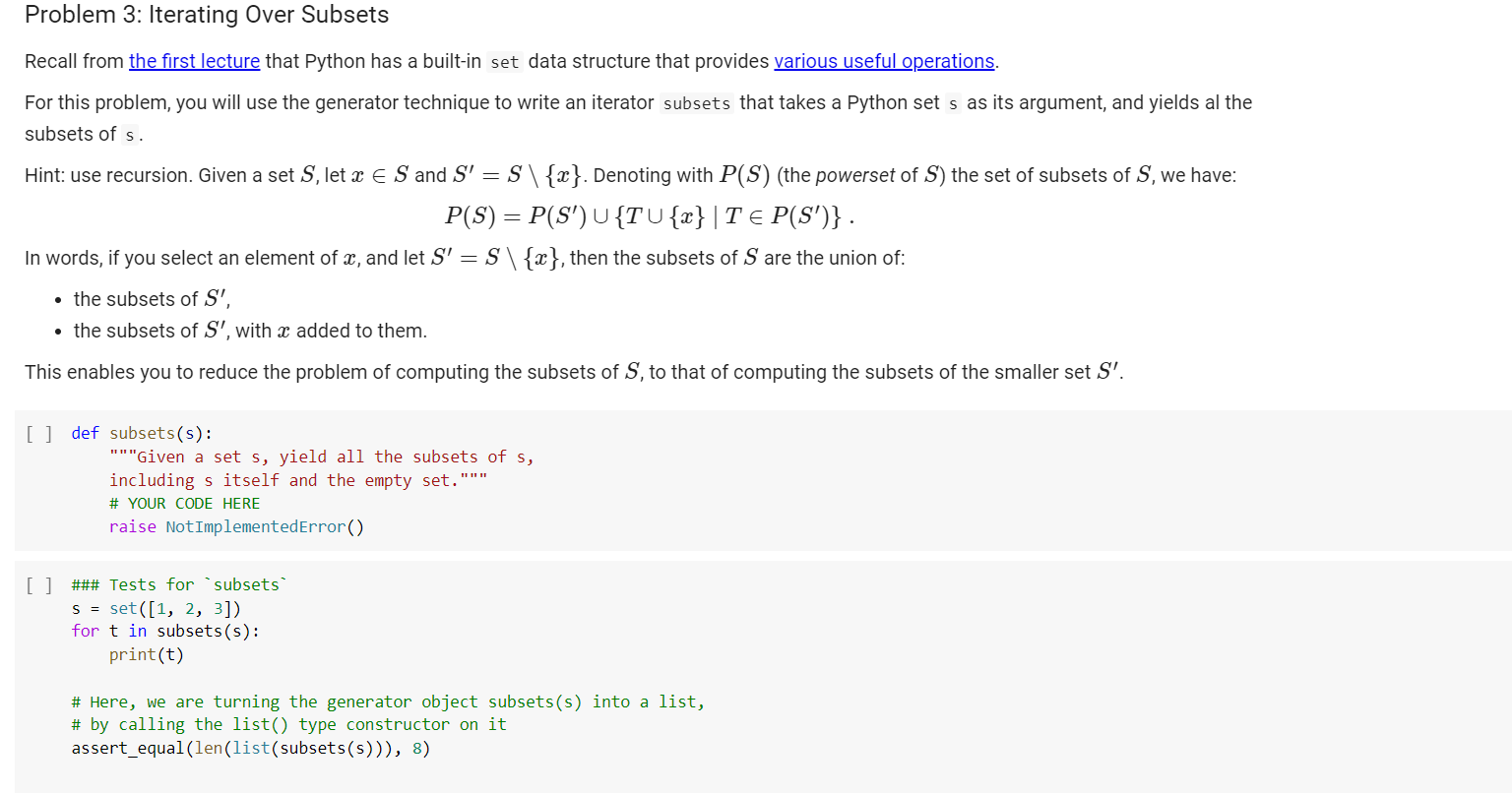
Problem 3: Iterating Over Subsets Recall from the first lecture that Python has a built-in set data structure that provides yvarious useful operations. For this problem, you will use the generator technique to write an iterator subsets that takes a Python set s as its argument, and yields al the subsets of s . S\ {x}. Denoting with P(S) (the powerset of S) the set of subsets of S, we have: Hint: use recursion. Given a set S, let x E S and S' = P(S) = P(S') U {TU{x} |T P(S')} . In words, if you select an element of x, and let S' = S \ {x}, then the subsets of S are the union of: the subsets of S'. the subsets of S', with x added to them. This enables you to reduce the problem of computing the subsets of S, to that of computing the subsets of the smaller set S'. [] def subsets(s): ubsets of s, """Given a set s, yield all the including s itself and the empty set.' # YOUR CODE HERE raise NotImplementedError() [1 ### Tests for `subsets` s = set([1, 2, 3]) for t in subsets(s): print(t) # Here, we are turning the generator object subsets(s) into a list, # by calling the list() type constructor on it assert_equal(len(list(subsets(s))), 8)
Step by Step Solution
There are 3 Steps involved in it

Get step-by-step solutions from verified subject matter experts
 Study Help