







Question: Python program. Thank you For simplicity, we can treat the wine barrel as a horizontal cylinder with a given radius (r) and length (L), and
Python program. Thank you
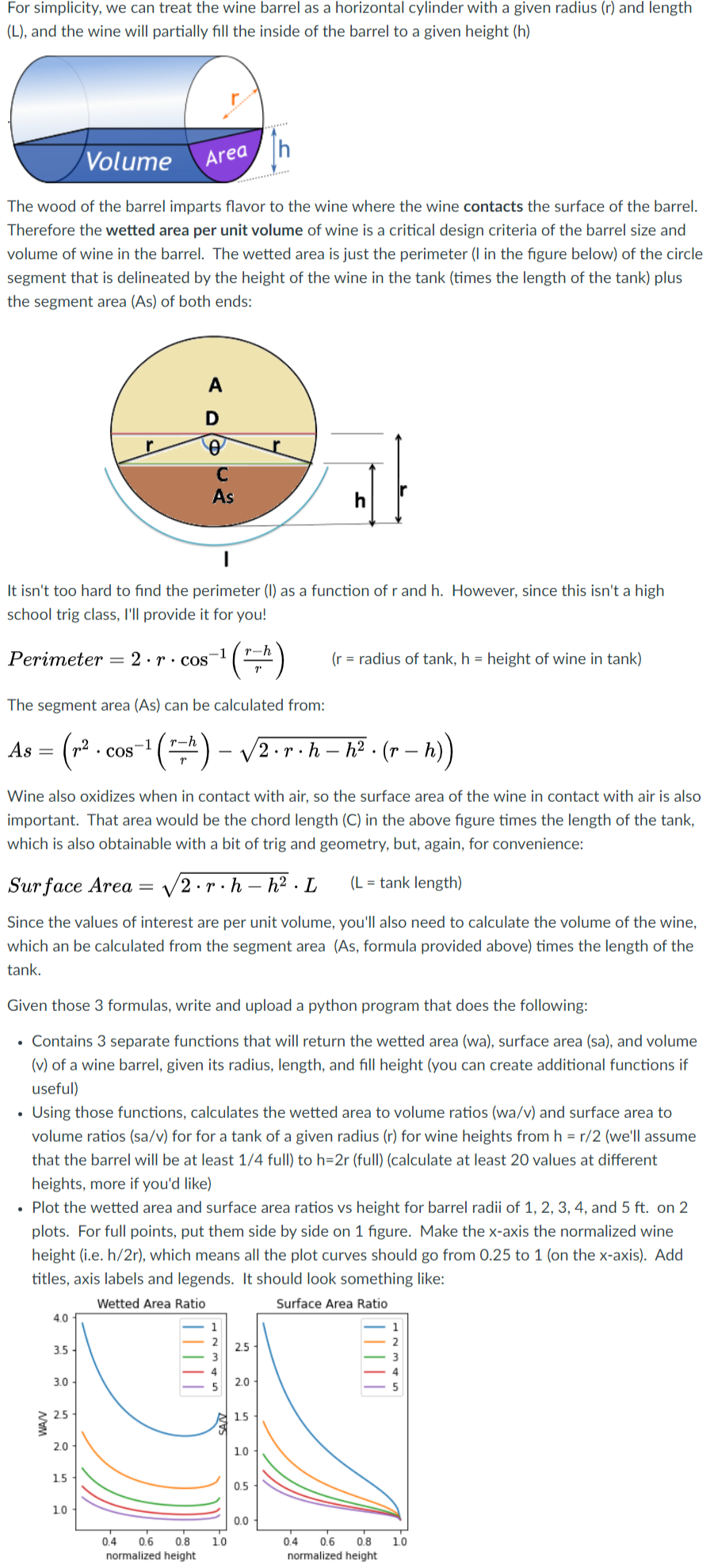
For simplicity, we can treat the wine barrel as a horizontal cylinder with a given radius (r) and length (L), and the wine will partially fill the inside of the barrel to a given height (h) h Volume Area The wood of the barrel imparts flavor to the wine where the wine contacts the surface of the barrel. Therefore the wetted area per unit volume of wine is a critical design criteria of the barrel size and volume of wine in the barrel. The wetted area is just the perimeter (I in the figure below) of the circle segment that is delineated by the height of the wine in the tank (times the length of the tank) plus the segment area (As) of both ends: D As h I It isn't too hard to find the perimeter (I) as a function of r and h. However, since this isn't a high school trig class, I'll provide it for you! Perimeter = 2.r . cos -1 1(*) (r = radius of tank, h = height of wine in tank) The segment area (As) can be calculated from: As - (-2 -1 COS (*=) V2.7. h h2. (r- h)) Wine also oxidizes when in contact with air, so the surface area of the wine in contact with air is also important. That area would be the chord length (C) in the above figure times the length of the tank, which is also obtainable with a bit of trig and geometry, but, again, for convenience: Surface Area = V2...h h2 . L (L = tank length) Since the values of interest are per unit volume, you'll also need to calculate the volume of the wine, which an be calculated from the segment area (As, formula provided above) times the length of the tank. Given those 3 formulas, write and upload a python program that does the following: . Contains 3 separate functions that will return the wetted area (wa), surface area (sa), and volume (v) of a wine barrel, given its radius, length, and fill height (you can create additional functions if useful) Using those functions, calculates the wetted area to volume ratios (wa/v) and surface area to volume ratios (sa/v) for for a tank of a given radius (r) for wine heights from h = r/2 (we'll assume that the barrel will be at least 1/4 full) to h=2r (full) (calculate at least 20 values at different heights, more if you'd like) Plot the wetted area and surface area ratios vs height for barrel radii of 1, 2, 3, 4, and 5 ft. on 2 plots. For full points, put them side by side on 1 figure. Make the x-axis the normalized wine height (i.e. h/2r), which means all the plot curves should go from 0.25 to 1 (on the x-axis). Add titles, axis labels and legends. It should look something like: Wetted Area Ratio Surface Area Ratio 4.0 1 3.5 2.5 4 3.0 4 5 20 5 25 A 15 WA/V 2.0 10 15 0.5 10 0.0 10 10 0.4 0.6 0.8 normalized height 0.4 0.6 0.8 normalized height For simplicity, we can treat the wine barrel as a horizontal cylinder with a given radius (r) and length (L), and the wine will partially fill the inside of the barrel to a given height (h) h Volume Area The wood of the barrel imparts flavor to the wine where the wine contacts the surface of the barrel. Therefore the wetted area per unit volume of wine is a critical design criteria of the barrel size and volume of wine in the barrel. The wetted area is just the perimeter (I in the figure below) of the circle segment that is delineated by the height of the wine in the tank (times the length of the tank) plus the segment area (As) of both ends: D As h I It isn't too hard to find the perimeter (I) as a function of r and h. However, since this isn't a high school trig class, I'll provide it for you! Perimeter = 2.r . cos -1 1(*) (r = radius of tank, h = height of wine in tank) The segment area (As) can be calculated from: As - (-2 -1 COS (*=) V2.7. h h2. (r- h)) Wine also oxidizes when in contact with air, so the surface area of the wine in contact with air is also important. That area would be the chord length (C) in the above figure times the length of the tank, which is also obtainable with a bit of trig and geometry, but, again, for convenience: Surface Area = V2...h h2 . L (L = tank length) Since the values of interest are per unit volume, you'll also need to calculate the volume of the wine, which an be calculated from the segment area (As, formula provided above) times the length of the tank. Given those 3 formulas, write and upload a python program that does the following: . Contains 3 separate functions that will return the wetted area (wa), surface area (sa), and volume (v) of a wine barrel, given its radius, length, and fill height (you can create additional functions if useful) Using those functions, calculates the wetted area to volume ratios (wa/v) and surface area to volume ratios (sa/v) for for a tank of a given radius (r) for wine heights from h = r/2 (we'll assume that the barrel will be at least 1/4 full) to h=2r (full) (calculate at least 20 values at different heights, more if you'd like) Plot the wetted area and surface area ratios vs height for barrel radii of 1, 2, 3, 4, and 5 ft. on 2 plots. For full points, put them side by side on 1 figure. Make the x-axis the normalized wine height (i.e. h/2r), which means all the plot curves should go from 0.25 to 1 (on the x-axis). Add titles, axis labels and legends. It should look something like: Wetted Area Ratio Surface Area Ratio 4.0 1 3.5 2.5 4 3.0 4 5 20 5 25 A 15 WA/V 2.0 10 15 0.5 10 0.0 10 10 0.4 0.6 0.8 normalized height 0.4 0.6 0.8 normalized height
Step by Step Solution
There are 3 Steps involved in it

Get step-by-step solutions from verified subject matter experts
 Study Help