







Question: **PYTHON** programming project pkease help!! #!/usr/bin/env python3 from objects import Card, Hand, Deck def main(): print(Cards - Tester) print() #test sorting of the cards testcardsList
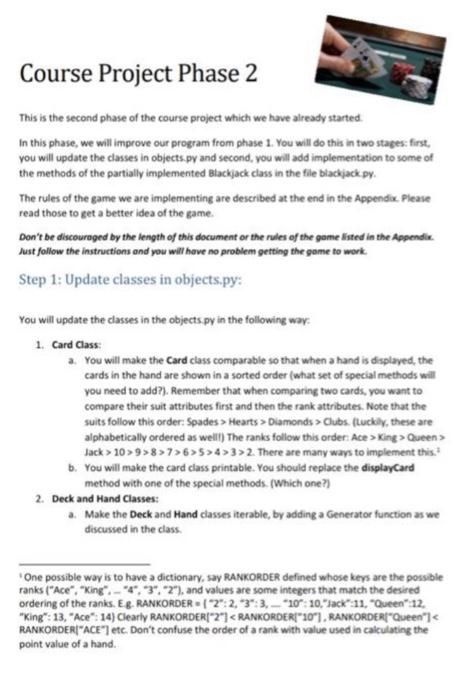
![cards testcardsList = [Card("Ace","Spades"), Card("Queen","Hearts"), Card("10","Clubs"), Card("3","Diamonds"), Card("Jack","Hearts"), Card("7","Spades")] testcardsList.sort() print("TEST CARDS](https://dsd5zvtm8ll6.cloudfront.net/si.experts.images/questions/2024/09/66f94b51b349c_77766f94b514edf8.jpg)
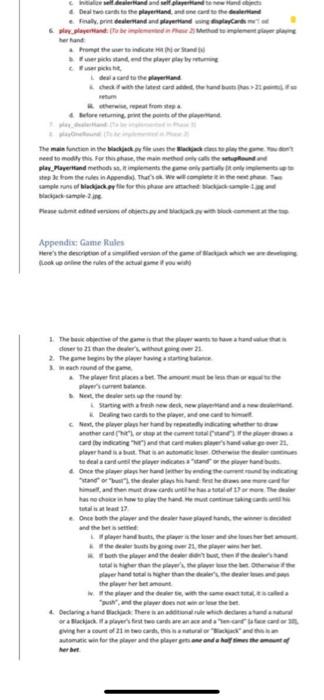
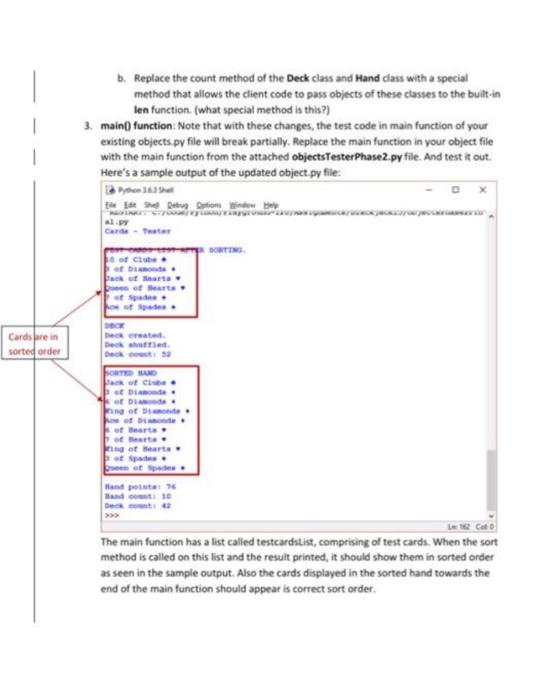
#!/usr/bin/env python3 from objects import Card, Hand, Deck def main(): print("Cards - Tester") print() #test sorting of the cards testcardsList = [Card("Ace","Spades"), Card("Queen","Hearts"), Card("10","Clubs"), Card("3","Diamonds"), Card("Jack","Hearts"), Card("7","Spades")] testcardsList.sort() print("TEST CARDS LIST AFTER SORTING.") for c in testcardsList: print(c) print() # test deck print("DECK") deck = Deck() print("Deck created.") deck.shuffle() print("Deck shuffled.") print("Deck count:", len(deck)) print() # test hand hand = Hand() for i in range(10): hand.addCard(deck.dealCard()) print("SORTED HAND") for c in sorted(hand): print(c) print() print("Hand points:", hand.points) print("Hand count:", len(hand)) print("Deck count:", len(deck)) if __name__ == "__main__": main()#!/usr/bin/env python3 from objects import Card, Deck, Hand class Blackjack: def __init__(self, startingBalance): self.money = startingBalance self.deck = Deck() self.playerHand = Hand() self.dealerHand = Hand() self.bet = 0 def displayCards(self,hand, title): ''' Print the title and display the cards in the given hand in a sorted order''' print(title.upper()) for c in sorted(hand): print(c) print() def handle_winner(self, winner, message): ''' print the player's hand's points print the message Update self.money according to the winner ''' pass #To be implemented in Phase 2 def getBet(self): ''' Method to update self.bet by prompting the user for the bet amount, making sure bet is less than self.money. ''' pass #To be implemented in Phase 2 def setupRound(self): ''' Setup the round by doing these steps: Call getBet to initialize self.bet, initialize self.deck to a new Deck object and shuffle it initialize self.dealerHand and self.playerHand to new Hand objects deal two cards to the playerHand, and one card to the dealerHand finally, print dealerHand and playerHand using displayCards method ''' pass # To be implemented in Phase 2 def play_playerHand(self): ''' Method to implement player playing his hand by 1. Prompting the user to indicate Hit (h) or Stand (s) 2. If user picks stand, end the player play by returning 3. If user picks hit, deal a card to the playerHand. check if with the latest addition, the hand busts (has > 21 points), if so return otherwise, prompt the player again whether to hit or stand. 4. Print playerHand points ''' pass # To be implemented in Phase 2 def play_dealerHand(self): ''' Method to play the dealer's hand. Continue to deal cards till the points of the dealerHand are less than 17. Print the dealer's hand before returning''' pass # To be implemented in Phase 3 def playOneRound(self): ''' Method implements playing one round of the game 1. Checks if playerHand is a Blackjack, if so handles that case 2. Lets player play his hand if it busts, declares player loser 3. Else lets dealer play his hand. 4. If dealer busts, declares the player to be the winner 5. Otherwise declares the winner based on who has higher points: if Player > dealer, player is the winner else if player
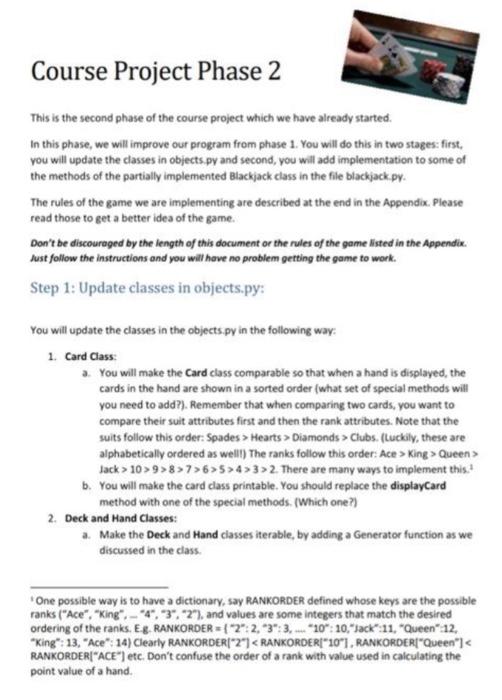
Course Project Phase 2 This is the second phase of the course project which we have already started In this phase, we will improve our program from phase 1. You will do this in two stages: first, you will update the classes in objects.py and second, you will add implementation to some of the methods of the partially implemented Blackjack class in the file blackjack py The rules of the game we are implementing are described at the end in the Appendix. Please read those to get a better idea of the game. Don't be discouraged by the length of this document or the rules of the game listed in the Appendix Just follow the instructions and you will have no problem getting the game to work Step 1: Update classes in objects.py: You will update the classes in the objects.py in the following way 1. Card Class: a. You will make the Card class comparable so that when a hand is displayed, the cards in the hand are shown in a sorted order (what set of special methods will you need to add?). Remember that when comparing two cards, you want to compare their suit attributes first and then the rank attributes. Note that the suits follow this order: Spades > Hearts > Diamonds > Clubs. (Luckily, these are alphabetically ordered as well) The ranks follow this order: Ace > King > Queen> Jack > 10 >9>8>7>6>5>4>3>2. There are many ways to implement this? b. You will make the card class printable. You should replace the display Card method with one of the special methods. (Which one?) 2. Deck and Hand Classes: a. Make the Deck and Hand classes iterable, by adding a Generator function as we discussed in the class. One possible way is to have a dictionary, say RANKORDER defined whose keys are the possible ranks ("Ace", "King". -"4","3","2"), and values are some integers that match the desired ordering of the tanks. Eg RANKORDER= ["2":2,"3":3, -20 10,"fack11. "Queen":12. "King": 13, "Ace":14) Clearly RANKORDERI"2"] Hearts > Diamonds > Clubs. (Luckily, these are alphabetically ordered as welll) The ranks follow this order: Ace> King > Queen> Jack > 10>9>8>7>6>5>4>3>2. There are many ways to implement this.. b. You will make the card class printable. You should replace the displayCard method with one of the special methods. (Which one?) 2. Deck and Hand Classes: 2. Make the Deck and Hand classes iterable, by adding a Generator function as we discussed in the class. One possible way is to have a dictionary, say RANKORDER defined whose keys are the possible ranks ("Ace", "King". -"4",3","2"), and values are some integers that match the desired ordering of the ranks. Eg. RANKORDER = 1*2*:2,"3":3, ... 20":10,"Jack" 11. "Queen" 12. "King":13,"Ace" 14) Clearly RANKORDER["2") Hearts > Diamonds > Clubs. (Luckily, these are alphabetically ordered as well) The ranks follow this order: Ace > King > Queen> Jack > 10 >9>8>7>6>5>4>3>2. There are many ways to implement this? b. You will make the card class printable. You should replace the display Card method with one of the special methods. (Which one?) 2. Deck and Hand Classes: a. Make the Deck and Hand classes iterable, by adding a Generator function as we discussed in the class. One possible way is to have a dictionary, say RANKORDER defined whose keys are the possible ranks ("Ace", "King". -"4","3","2"), and values are some integers that match the desired ordering of the tanks. Eg RANKORDER= ["2":2,"3":3, -20 10,"fack11. "Queen":12. "King": 13, "Ace":14) Clearly RANKORDERI"2"] Hearts > Diamonds > Clubs. (Luckily, these are alphabetically ordered as welll) The ranks follow this order: Ace> King > Queen> Jack > 10>9>8>7>6>5>4>3>2. There are many ways to implement this.. b. You will make the card class printable. You should replace the displayCard method with one of the special methods. (Which one?) 2. Deck and Hand Classes: 2. Make the Deck and Hand classes iterable, by adding a Generator function as we discussed in the class. One possible way is to have a dictionary, say RANKORDER defined whose keys are the possible ranks ("Ace", "King". -"4",3","2"), and values are some integers that match the desired ordering of the ranks. Eg. RANKORDER = 1*2*:2,"3":3, ... 20":10,"Jack" 11. "Queen" 12. "King":13,"Ace" 14) Clearly RANKORDER["2")
Step by Step Solution
There are 3 Steps involved in it

Get step-by-step solutions from verified subject matter experts
 Study Help