







Question: Python: Question 3b Define an iterative function named no_adj_dup, it is passed a linked list (11) as an argument. It returns a reference to the
Python: Question 3b
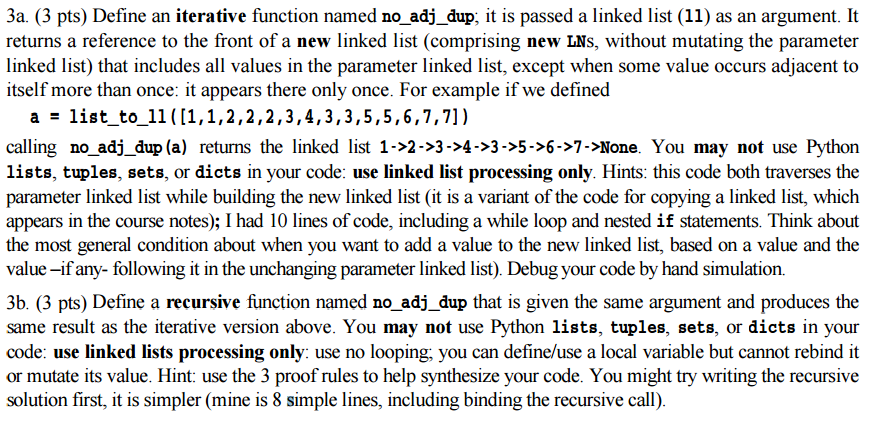
Define an iterative function named no_adj_dup, it is passed a linked list (11) as an argument. It returns a reference to the front of a new linked list (comprising new LNs, without mutating the parameter s, linked list that includes all values in the parameter linked list, except when some value occurs adjacent to itself more than once: it appears there only once. For example if we defined a = list_to_11 ([1, 1, 2, 2, 2, 3, 4, 3, 3, 5, 5, 6, 7, 7]) calling no_adj_dup (a) returns the linked list 1 rightarrow 2 rightarrow 3 rightarrow 4 rightarrow 3 rightarrow 5 rightarrow 6 rightarrow 7 rightarrow None. You may not use Python lists, tuples, sets or dicts in your code: use linked list processing only. Define a recursive function named no_adj_dup that is given the same argument and produces the same result as the iterative version above. You may not use Python lists, tuples, sets, or dicts in your code: use linked lists processing only: use no looping, you can define/use a local variable but cannot rebind it or mutate its value
Step by Step Solution
There are 3 Steps involved in it

Get step-by-step solutions from verified subject matter experts
 Study Help