







Question: Python recursion problem def printTriangleTop(m, i): 2. Once you understand the snippet in part 1, you will take the concept and apply it in a
Python recursion problem
def printTriangleTop(m, i):
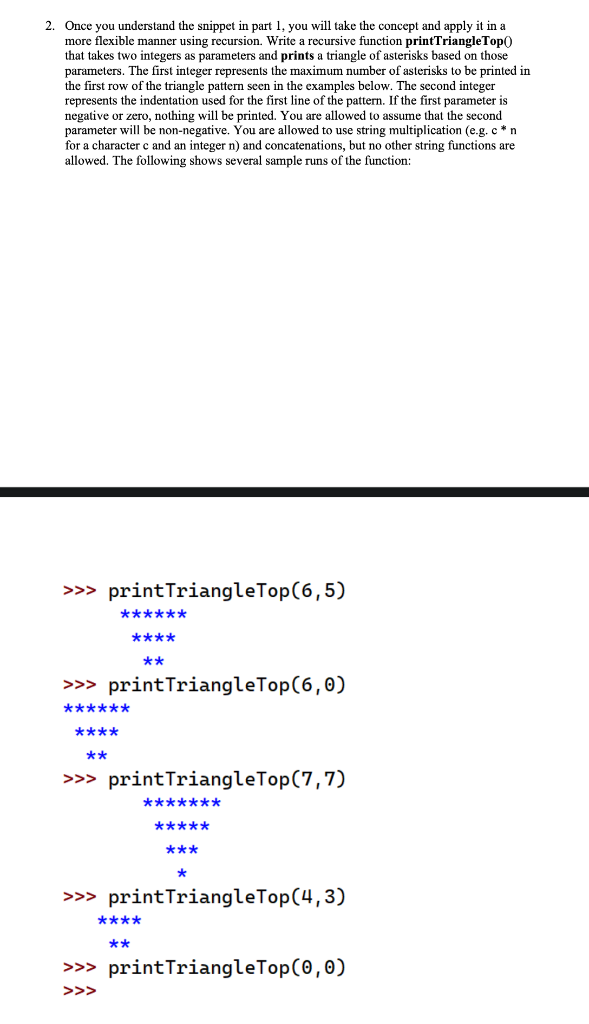
2. Once you understand the snippet in part 1, you will take the concept and apply it in a more flexible manner using recursion. Write a recursive function print TriangleTopo that takes two integers as parameters and prints a triangle of asterisks based on those parameters. The first integer represents the maximum number of asterisks to be printed in the first row of the triangle pattern seen in the examples below. The second integer represents the indentation used for the first line of the pattern. If the first parameter is negative or zero, nothing will be printed. You are allowed to assume that the second parameter will be non-negative. You are allowed to use string multiplication (e.g. c*n for a character c and an integer n) and concatenations, but no other string functions are allowed. The following shows several sample runs of the function: >>> printTriangleTop(6,5) ****** **** ** >>> print TriangleTop(6,0) ****** **** ** >>> printTriangle Top(7,7) ******* ***** *** >>> printTriangleTop(4,3) **** ** >>> printTriangleTop(0,0)
Step by Step Solution
There are 3 Steps involved in it

Get step-by-step solutions from verified subject matter experts
 Study Help