







Question: python There are many ways to reach f(xr) = 0, to find xr. We can use iteration on f(xn) to decide on the next approximation:
 python
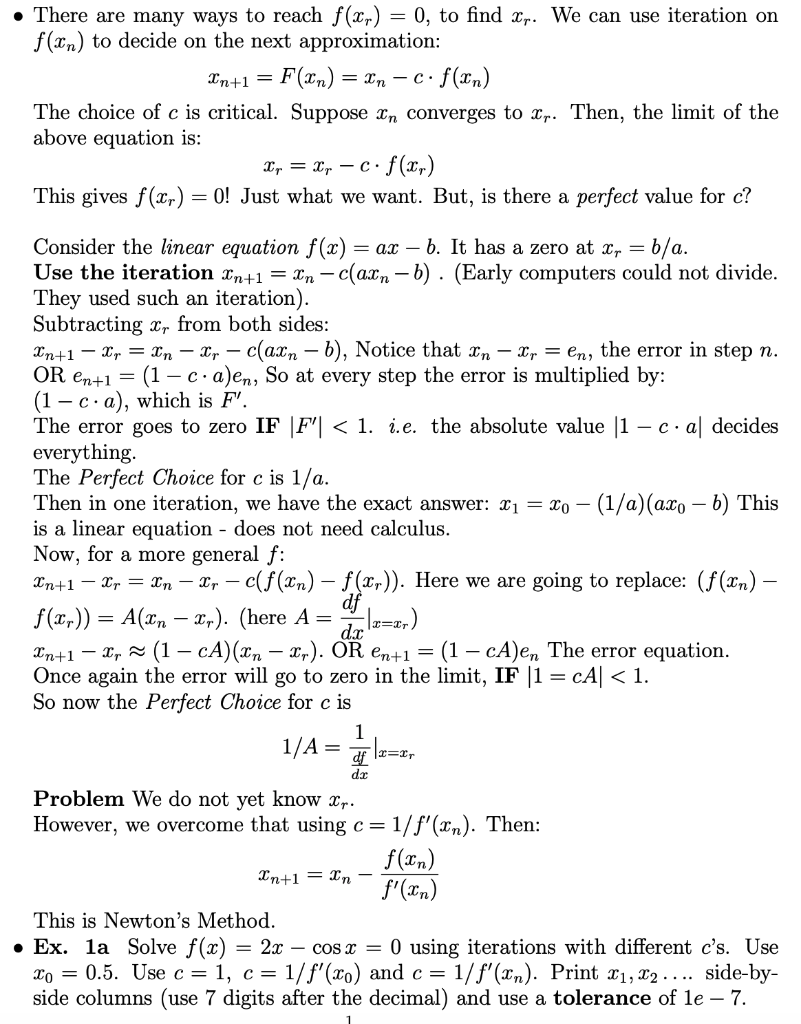
There are many ways to reach f(xr) = 0, to find xr. We can use iteration on f(xn) to decide on the next approximation: In+1 = F(xn) = In - c.f(In) The choice of c is critical. Suppose In converges to Ir. Then, the limit of the above equation is: Xr = X, - c. f(xv) This gives f (xr) = 0! Just what we want. But, is there a perfect value for c? Consider the linear equation f(x) = ax b. It has a zero at &r = b/a. Use the iteration In+1 = In - c(amn b) (Early computers could not divide. They used such an iteration). Subtracting x, from both sides: In+1 X, = In Ir caxn b), Notice that In Xr = en, the error in step n. OR en+1 = (1 - c.a)en, So at every step the error is multiplied by: (1 - c.a), which is F'. The error goes to zero IF |F|
Step by Step Solution
There are 3 Steps involved in it

Get step-by-step solutions from verified subject matter experts
 Study Help