







Question: Q 1 ( a ) ( b ) ( c ) ( d ) ( e ) Fluids can be classified as compressible or incompressible
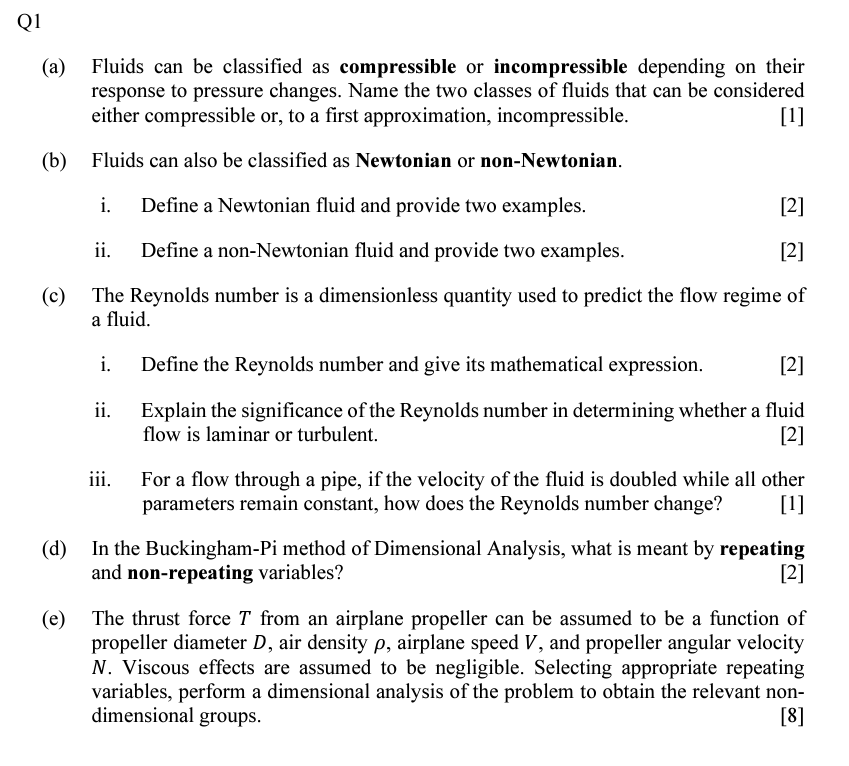
Qabcde Fluids can be classified as compressible or incompressible depending on their response to pressure changes. Name the two classes of fluids that can be considered either compressible or to a first approximation, incompressible. Fluids can also be classified as Newtonian or nonNewtonian. i ii Define a Newtonian fluid and provide two examples. Define a nonNewtonian fluid and provide two examples. The Reynolds number is a dimensionless quantity used to predict the flow regime of a fluid. i ii iii. Define the Reynolds number and give its mathematical expression. Explain the significance of the Reynolds number in determining whether a fluid flow is laminar or turbulent. For a flow through a pipe, if the velocity of the fluid is doubled while all other parameters remain constant, how does the Reynolds number change? In the BuckinghamPi method of Dimensional Analysis, what is meant by repeating and nonrepeating variables? The thrust force from an airplane propeller can be assumed to be a function of propeller diameter air density airplane speed and propeller angular velocity Viscous effects are assumed to be negligible. Selecting appropriate repeating variables, perform a dimensional analysis of the problem to obtain the relevant nondimensional groups. Q
a Fluids can be classified as compressible or incompressible depending on their response to pressure changes. Name the two classes of fluids that can be considered either compressible or to a first approximation, incompressible.
b Fluids can also be classified as Newtonian or nonNewtonian.
i Define a Newtonian fluid and provide two examples.
ii Define a nonNewtonian fluid and provide two examples.
c The Reynolds number is a dimensionless quantity used to predict the flow regime of a fluid.
i Define the Reynolds number and give its mathematical expression.
ii Explain the significance of the Reynolds number in determining whether a fluid flow is laminar or turbulent.
iii. For a flow through a pipe, if the velocity of the fluid is doubled while all other parameters remain constant, how does the Reynolds number change?
d In the BuckinghamPi method of Dimensional Analysis, what is meant by repeating and nonrepeating variables?
e The thrust force T from an airplane propeller can be assumed to be a function of propeller diameter D air density rho airplane speed V and propeller angular velocity N Viscous effects are assumed to be negligible. Selecting appropriate repeating variables, perform a dimensional analysis of the problem to obtain the relevant nondimensional groups.
Step by Step Solution
There are 3 Steps involved in it
1 Expert Approved Answer
Step: 1 Unlock

Question Has Been Solved by an Expert!
Get step-by-step solutions from verified subject matter experts
Step: 2 Unlock
Step: 3 Unlock
 Study Help