







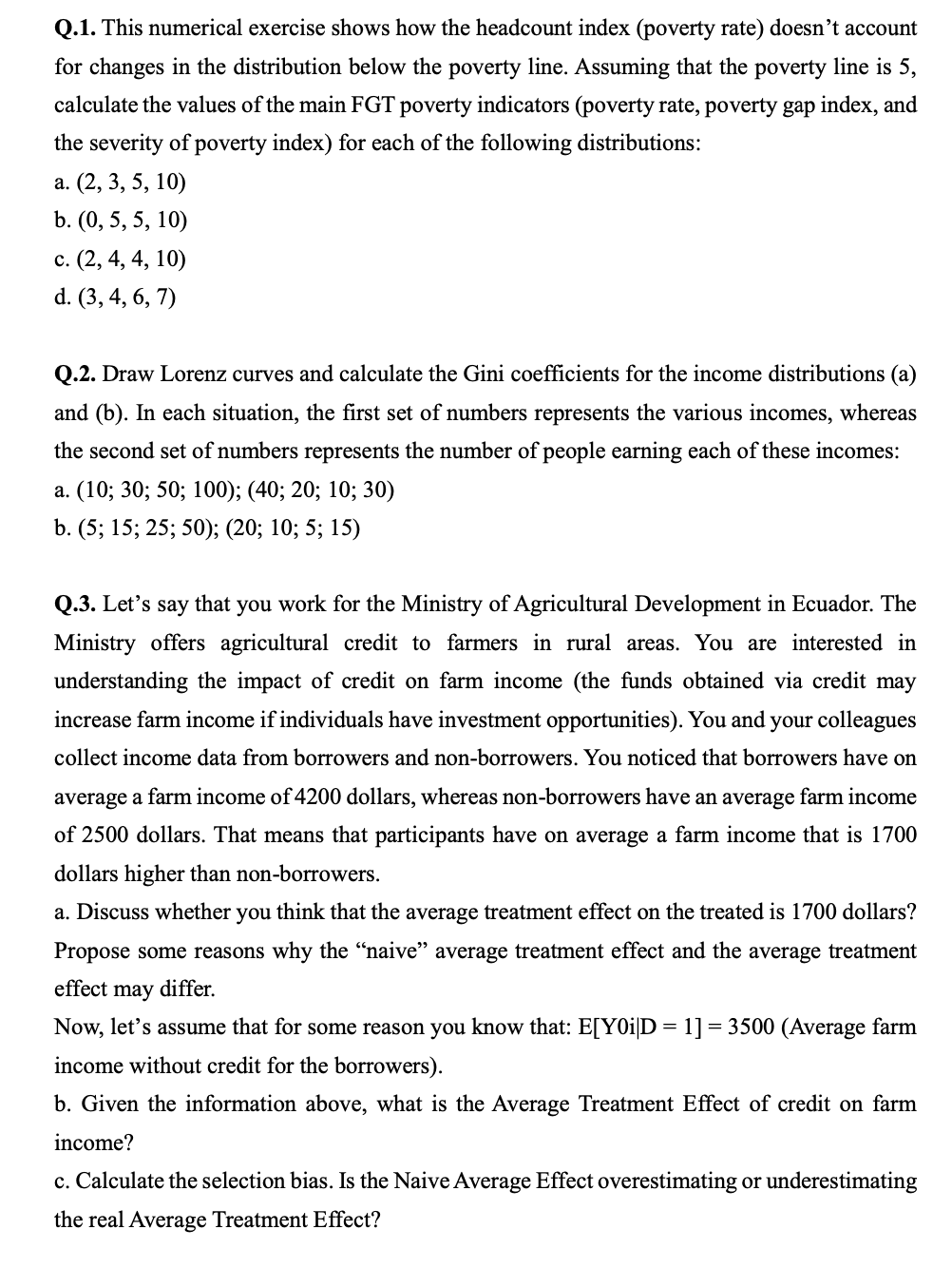
Question: Q . 1 . This numerical exercise shows how the headcount index ( poverty rate ) doesn't account for changes in the distribution below the
Q This numerical exercise shows how the headcount index poverty rate doesn't account for changes in the distribution below the poverty line. Assuming that the poverty line is calculate the values of the main FGT poverty indicators poverty rate, poverty gap index, and the severity of poverty index for each of the following distributions:
a
b
c
d
Q Draw Lorenz curves and calculate the Gini coefficients for the income distributions a and b In each situation, the first set of numbers represents the various incomes, whereas the second set of numbers represents the number of people earning each of these incomes:
a ; ; ; ; ; ; ;
b ; ; ; ; ; ; ;
Q Let's say that you work for the Ministry of Agricultural Development in Ecuador. The Ministry offers agricultural credit to farmers in rural areas. You are interested in understanding the impact of credit on farm income the funds obtained via credit may increase farm income if individuals have investment opportunities You and your colleagues collect income data from borrowers and nonborrowers. You noticed that borrowers have on average a farm income of dollars, whereas nonborrowers have an average farm income of dollars. That means that participants have on average a farm income that is dollars higher than nonborrowers.
a Discuss whether you think that the average treatment effect on the treated is dollars? Propose some reasons why the "naive" average treatment effect and the average treatment effect may differ.
Now, let's assume that for some reason you know that: mathrmEmathrmYmathrmimid mathrmDAverage farm income without credit for the borrowers
b Given the information above, what is the Average Treatment Effect of credit on farm income?
c Calculate the selection bias. Is the Naive Average Effect overestimating or underestimating the real Average Treatment Effect?
Step by Step Solution
There are 3 Steps involved in it
1 Expert Approved Answer
Step: 1 Unlock

Question Has Been Solved by an Expert!
Get step-by-step solutions from verified subject matter experts
Step: 2 Unlock
Step: 3 Unlock
 Study Help