







Question: Q 2 . A culvert is to be designed and constructed with a return period of 5 0 years at a point on a stream.
Q A culvert is to be designed and constructed with a return period of years at a point on a stream.
Given below are the maximum flow records at a point where a drainage structure is to be designed.
a Using Weibul's formula given below, determine the year flood
marks
rank of the event; total number of event
b The average difference in elevation between the river bed and finished level of the road at the culvert
location is The length of the embankment is slope is and the pool elevation at the outlet
at year return period is above the invert. Use a free board of for concrete,
and
Design an adequately sized concrete pipe culvert of square edge with head wall for the road for the
year return period flood and indicate the condition of operation of the culvert for the design flood. Q A concrete culvert is to be provided at a point on a river course over which a road is to be constructed.
The catchment area of the river above the culvert location is hectares and its stream length is
The fall in level of the catchment from the farthest point to the culvert site was found to be The
vegetation cover of the catchment is found to be varied and shown in Table below
Table : Vegetation cover and runoff coefficient for the catchment
The Rainfall Intensity characteristics for the catchment for the various return periods are represented by the
constants in Table from which the design intensity can be calculated using the equation
Where
rainfall intensity for a given return period,
time concentration
constants given Table
Table Rainfall Intensity Return Period Constants for Catchment
The area reduction factors ARF for the catchment are given by the Table
Table ARF for the catchment
a Calculate the time of concentration using
i Kirpich formula:
Where;
time concentration
stream length
mean slope stream
ii Bransby Williams formula:
Where;
time concentration
stream length
Elevation change
catchment area
b Given a design period of years, calculate the peak design runoff using the two times of
concentration you have calculated. Comment on the different discharge values ff any
marks
From the discharge estimated by the Bransby Williams formula, Design an adequately sized concrete
pipe culvert to pass the years flood. The height of the road above the invert level of the river at
the culvert location is the length of the culvert is natural streambed slope and
the downstream level of the years flood is above the downstream invert. Use a groove end
with headwall with ; for concrete ; You may consider multiple culverts if the
diameter of pipe becomes too big to be closer to headwater.
Determine the conditions of flow in the culvert by determining: i the critical depth and ii the normal
depth using the charts attached.
c Because of the easily erodible nature of the soil at the culvert outlet, it is necessary to protect the
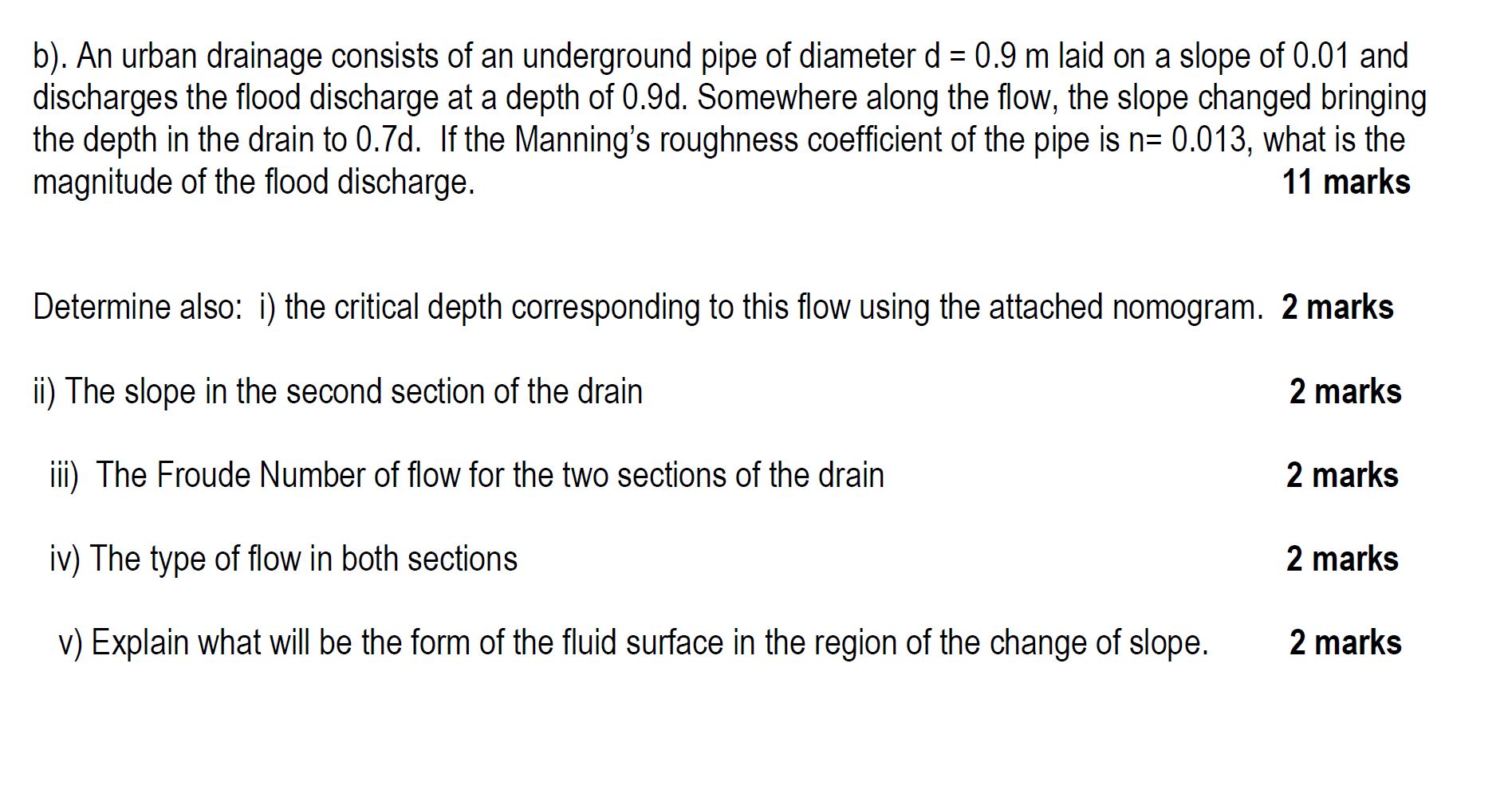
downstream side from excessive erosiob An urban drainage consists of an underground pipe of diameter laid on a slope of and
discharges the flood discharge at a depth of Somewhere along the flow, the slope changed bringing
the depth in the drain to If the Manning's roughness coefficient of the pipe is what is the
magnitude of the flood discharge.
marks
Determine also: i the critical depth corresponding to this flow using the attached nomogram. marks
ii The slope in the second section of the drain
iii The Froude Number of flow for the two sections of the drain
iv The type of flow in both sections
v Explain what will be the form of the fluid surface in the region of the change of slope.
Step by Step Solution
There are 3 Steps involved in it
1 Expert Approved Answer
Step: 1 Unlock

Question Has Been Solved by an Expert!
Get step-by-step solutions from verified subject matter experts
Step: 2 Unlock
Step: 3 Unlock
 Study Help