







Question: Q 2 : ODE eigenvalue problem An axially loaded wood column ( simply supported on both ends ) has the following characteristics: - (
Q: ODE eigenvalue problem
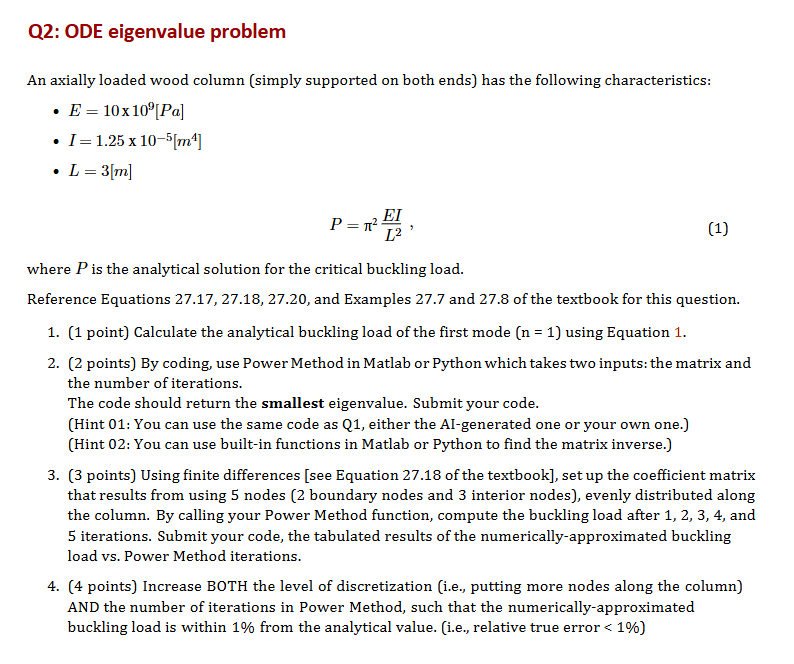
An axially loaded wood column simply supported on both ends has the following characteristics:
Etimes mathrm~Pa
Itimes leftmright
Lm
PpifracE IL
where P is the analytical solution for the critical buckling load.
Reference Equations and Examples and of the textbook for this question.
point Calculate the analytical buckling load of the first mode mathrmn using Equation
points By coding, use Power Method in Matlab or Python which takes two inputs: the matrix and the number of iterations.
The code should return the smallest eigenvalue. Submit your code.
Hint : You can use the same code as Q either the AIgenerated one or your own one.
Hint : You can use builtin functions in Matlab or Python to find the matrix inverse.
points Using finite differences see Equation of the textbook set up the coefficient matrix that results from using nodes boundary nodes and interior nodes evenly distributed along the column. By calling your Power Method function, compute the buckling load after and iterations. Submit your code, the tabulated results of the numericallyapproximated buckling load vs Power Method iterations.
points Increase BOTH the level of discretization ie putting more nodes along the column AND the number of iterations in Power Method, such that the numericallyapproximated buckling load is within from the analytical value. ie relative true error
Please for the coding parts do it in MATLAB.
Step by Step Solution
There are 3 Steps involved in it
1 Expert Approved Answer
Step: 1 Unlock

Question Has Been Solved by an Expert!
Get step-by-step solutions from verified subject matter experts
Step: 2 Unlock
Step: 3 Unlock
 Study Help