







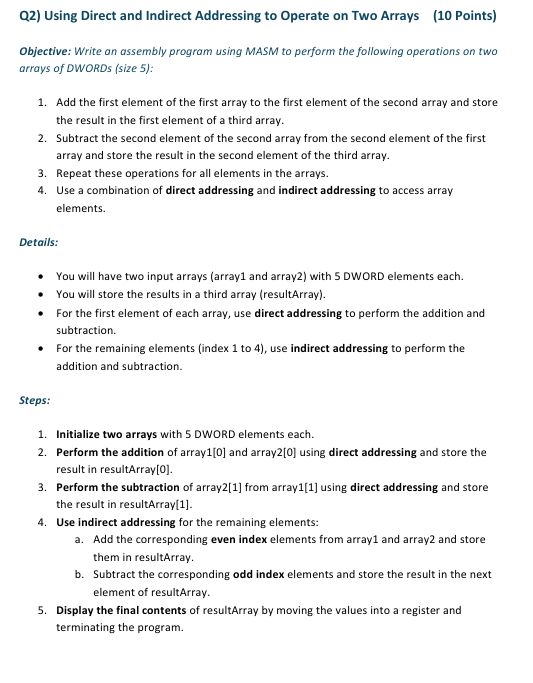
Question: Q 2 ) Using Direct and Indirect Addressing to Operate on Two Arrays ( 1 0 Points ) Objective: Write an assembly program using MASM
Q Using Direct and Indirect Addressing to Operate on Two Arrays
Points
Objective: Write an assembly program using MASM to perform the following operations on two arrays of DWORDs size :
Add the first element of the first array to the first element of the second array and store the result in the first element of a third array.
Subtract the second element of the second array from the second element of the first array and store the result in the second element of the third array.
Repeat these operations for all elements in the arrays.
Use a combination of direct addressing and indirect addressing to access array elements.
Details:
You will have two input arrays array and array with DWORD elements each.
You will store the results in a third array resultArray
For the first element of each array, use direct addressing to perform the addition and subtraction.
For the remaining elements index to use indirect addressing to perform the addition and subtraction.
Steps:
Initialize two arrays with DWORD elements each.
Perform the addition of array and array using direct addressing and store the result in resultArray
Perform the subtraction of array from array using direct addressing and store the result in resultArray
Use indirect addressing for the remaining elements:
a Add the corresponding even index elements from array and array and store them in resultArray.
b Subtract the corresponding odd index elements and store the result in the next element of resultArray.
Display the final contents of resultArray by moving the values into a register and terminating the program. Expected Output:
After running the program, resultArray should contain the results of:
resultArray array array
resultArray array array
Continuing the same for all elements using both direct and indirect addressing.
Print the result Array Using Irvine Library Procedure.
Elements of array
Elements of array
Use bit variables and registers.
Step by Step Solution
There are 3 Steps involved in it
1 Expert Approved Answer
Step: 1 Unlock

Question Has Been Solved by an Expert!
Get step-by-step solutions from verified subject matter experts
Step: 2 Unlock
Step: 3 Unlock
 Study Help