







Question: Q 3 ( 2 5 % ) ( a: 5 % , b : 8 % , c : 8 % , d : 4
Qa: :::
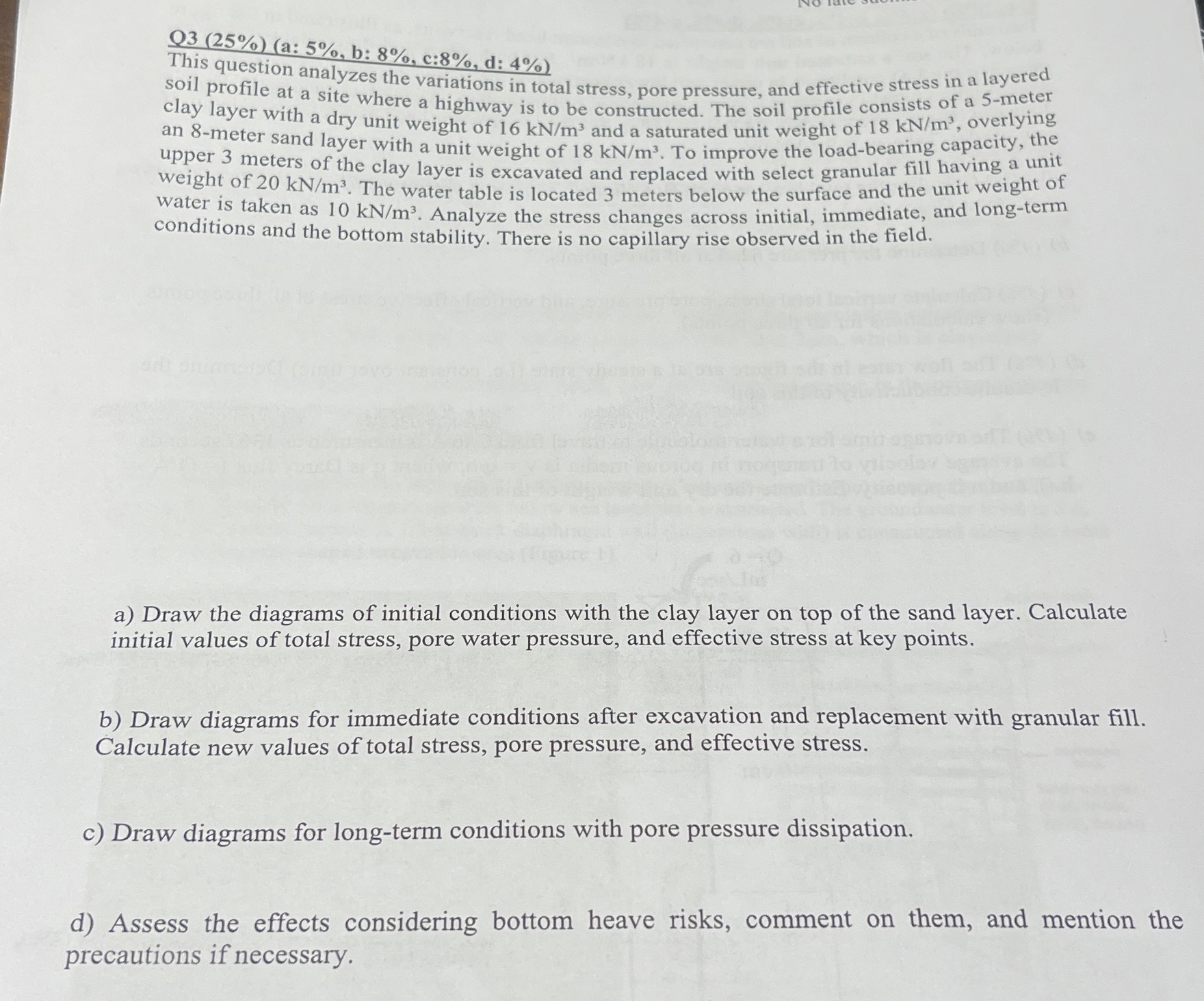
This question analyzes the variations in total stress, pore pressure, and effective stress in a layered soil profile at a site where a highway is to be constructed. The soil profile consists of a meter clay layer with a dry unit weight of and a saturated unit weight of overlying an meter sand layer with a unit weight of To improve the loadbearing capacity, the upper meters of the clay layer is excavated and replaced with select granular fill having a unit weight of The water table is located meters below the surface and the unit weight of water is taken as Analyze the stress changes across initial, immediate, and longterm conditions and the bottom stability. There is no capillary rise observed in the field.
a Draw the diagrams of initial conditions with the clay layer on top of the sand layer. Calculate initial values of total stress, pore water pressure, and effective stress at key points.
b Draw diagrams for immediate conditions after excavation and replacement with granular fill. Calculate new values of total stress, pore pressure, and effective stress.
c Draw diagrams for longterm conditions with pore pressure dissipation.
d Assess the effects considering bottom heave risks, comment on them, and mention the precautions if necessary.
Step by Step Solution
There are 3 Steps involved in it
1 Expert Approved Answer
Step: 1 Unlock

Question Has Been Solved by an Expert!
Get step-by-step solutions from verified subject matter experts
Step: 2 Unlock
Step: 3 Unlock
 Study Help