







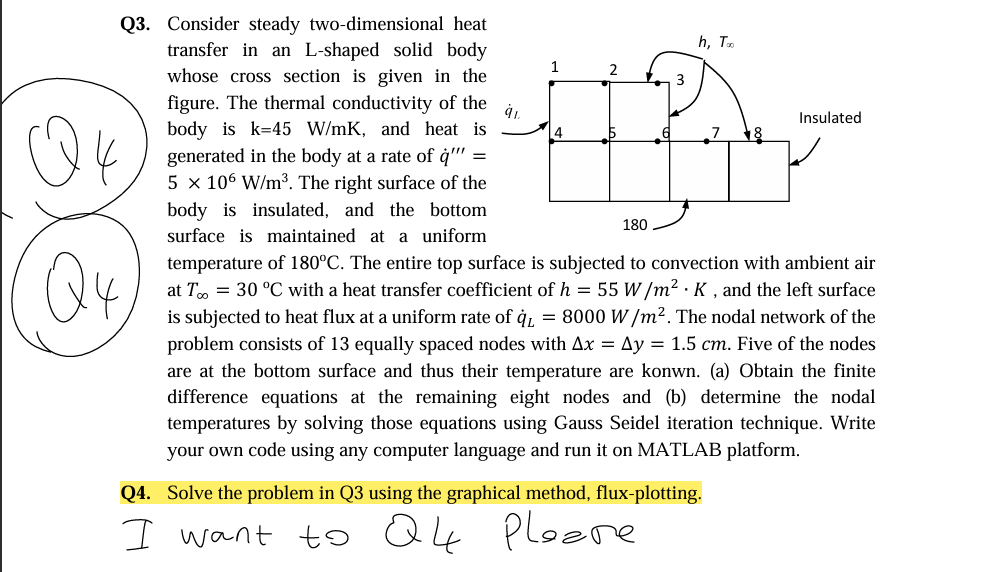
Question: Q 3 . Consider steady two - dimensional heat transfer in an L - shaped solid body whose cross section is given in the figure.
Q Consider steady twodimensional heat
transfer in an Lshaped solid body
whose cross section is given in the
figure. The thermal conductivity of the
body is kWmK and heat is
generated in the body at a rate of q
times Wm The right surface of the
body is insulated, and the bottom
surface is maintained at a uniform
temperature of deg C The entire top surface is subjected to convection with ambient air
at Tinfty deg C with a heat transfer coefficient of hWmK and the left surface
is subjected to heat flux at a uniform rate of qLWm The nodal network of the
problem consists of equally spaced nodes with Delta xDelta ycm Five of the nodes
are at the bottom surface and thus their temperature are konwn. a Obtain the finite
difference equations at the remaining eight nodes and b determine the nodal
temperatures by solving those equations using Gauss Seidel iteration technique. Write
your own code using any computer language and run it on MATLAB platform.
Q Solve the problem in Q using the graphical method, fluxplotting.
Q Solve the problem in Q using the graphical method, fluxplotting.
want to Q SOLUTONS PLEASEEEE JUSTQ
Consider steady twodimensional heat
transfer in an Lshaped solid body
whose cross section is given in the
figure. The thermal conductivity of the
body is kWmK and heat is
generated in the body at a rate of q
times Wm The right surface of the
body is insulated, and the bottom
surface is maintained at a uniform
temperature of deg C The entire top surface is subjected to convection with ambient air
at Tinfty deg C with a heat transfer coefficient of hWmK and the left surface
is subjected to heat flux at a uniform rate of qLWm The nodal network of the
problem consists of equally spaced nodes with Delta xDelta ycm Five of the nodes
are at the bottom surface and thus their temperature are konwn. a Obtain the finite
difference equations at the remaining eight nodes and b determine the nodal
temperatures by solving those equations using Gauss Seidel iteration technique. Write
your own code using any computer language and run it on MATLAB platform.
Solve the problem in Q using the graphical method, fluxplotting.
want to Qle Ploare
Step by Step Solution
There are 3 Steps involved in it
1 Expert Approved Answer
Step: 1 Unlock

Question Has Been Solved by an Expert!
Get step-by-step solutions from verified subject matter experts
Step: 2 Unlock
Step: 3 Unlock
 Study Help