







Question: Q 3 ) Gradient Descent. Please use the file assign 2 q 3 . py provided along with this assignment. ( 3 marks ) The
Q Gradient Descent. Please use the file assign qpy provided along with this assignment. marks
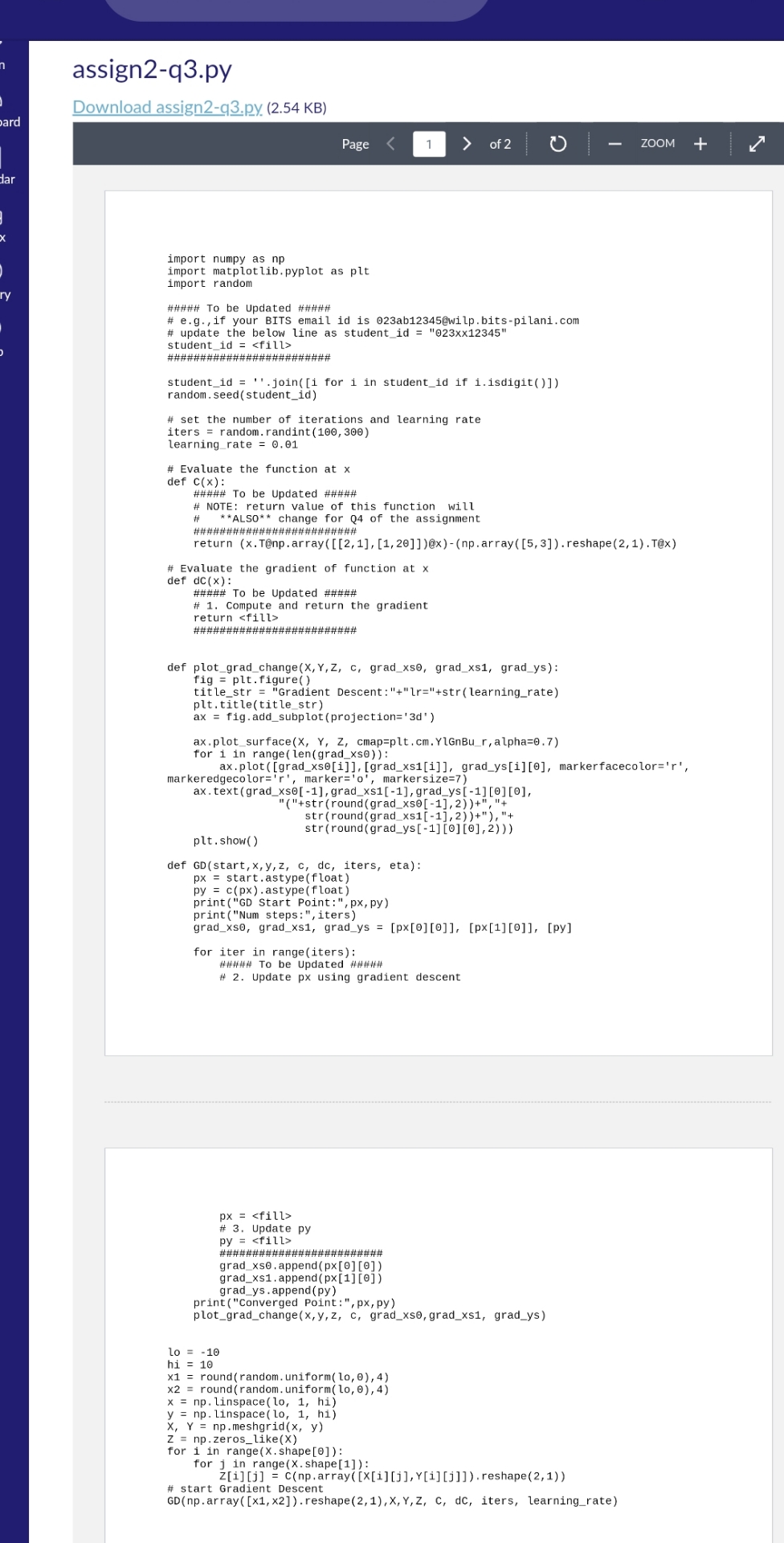
The python source file implements the gradient descent algorithm. You are
expected to fill in the missing lines of code to get the algorithm to work as
expected. The script takes no additional parameters.
There are four places where you need to add your lines of code. Your lines
of code should go inbetween the lines with the comment:
##### To be Updated #####
and
#########################
NOTE: You should NOT modify any other lines of the script.
Deliverables: A A screenshot of the D plot obtained when you execute the
python script after adding your lines of code. B A screenshot of the console
output obtained obtained when you execute the python script after adding
your lines of code. C The equations of the Loss function and gradient of
loss function on which the gradient descent was performed. D A snapshot
of the lines of code that was added by you in the designated places. Do not
write the entire code. marks
For your benefit, we have given below the sample output plot and console
output for a fictitious student id xx
import numpy as np
import matplotlib.pyplot as plt
import random
##### To be Updated #####
# egif your BITS email id is ab@wilp.bitspilani.com
# update the below line as studentid xx
studentid da
#########################
studentid joini for i in studentid if iisdigit
random.seedstudentid
# set the number of iterations and learning rate
iters random.randint
learningrate
# Evaluate the function at x
def Cx:
##### To be Updated #####
# NOTE: return value of this function will
# ALSO change for Q of the assignment
#########################
return xT@nparray@xnparrayreshapeT@x
# Evaluate the gradient of function at x
def dCx:
##### To be Updated #####
# Compute and return the gradient
return
#########################
def plotgradchangeXYZ c gradxs gradxs gradys:
fig pltfigure
titlestr "Gradient Descent:"lrstrlearningrate
plttitletitlestr
ax fig.addsubplotprojectiond
axplotsurfaceX Y Z cmappltcmYlGnBuralpha
for i in rangelengradxs:
axplotgradxsigradxsi gradysi markerfacecolorr markeredgecolorr markero markersize
axtextgradxsgradxsgradys
strroundgradxs
strroundgradxs
strroundgradys
pltshow
def GDstartxyz c dc iters, eta:
px start.astypefloat
py cpxastypefloat
printGD Start Point:",pxpy
printNum steps:",iters
gradxs gradxs gradys pxpxpy
for iter in rangeiters:
##### To be Updated #####
# Update px using gradient descent
px
# Update py
py
#########################
gradxsappendpx
gradxsappendpx
gradysappendpy
printConverged Point:",pxpy
plotgradchangexyz c gradxsgradxs gradys
lo
hi
x roundrandomuniformlo
x roundrandomuniformlo
x nplinspacelo hi
y nplinspacelo hi
X Y npmeshgridx y
Z npzeroslikeX
for i in rangeXshape:
for j in rangeXshape:
Zij CnparrayXijYijreshape
# start Gradient Descent
GDnparrayxxreshapeXYZ C dC iters, learningrate
narddarryassignqpyDownload assignqpy KBimport numpy as npAmport matplotlib. pyplot as pltimport random##### To be Updated ##### eg if your BITS email id is abwilp. bits pilani. comstudent id
Step by Step Solution
There are 3 Steps involved in it
1 Expert Approved Answer
Step: 1 Unlock

Question Has Been Solved by an Expert!
Get step-by-step solutions from verified subject matter experts
Step: 2 Unlock
Step: 3 Unlock
 Study Help