



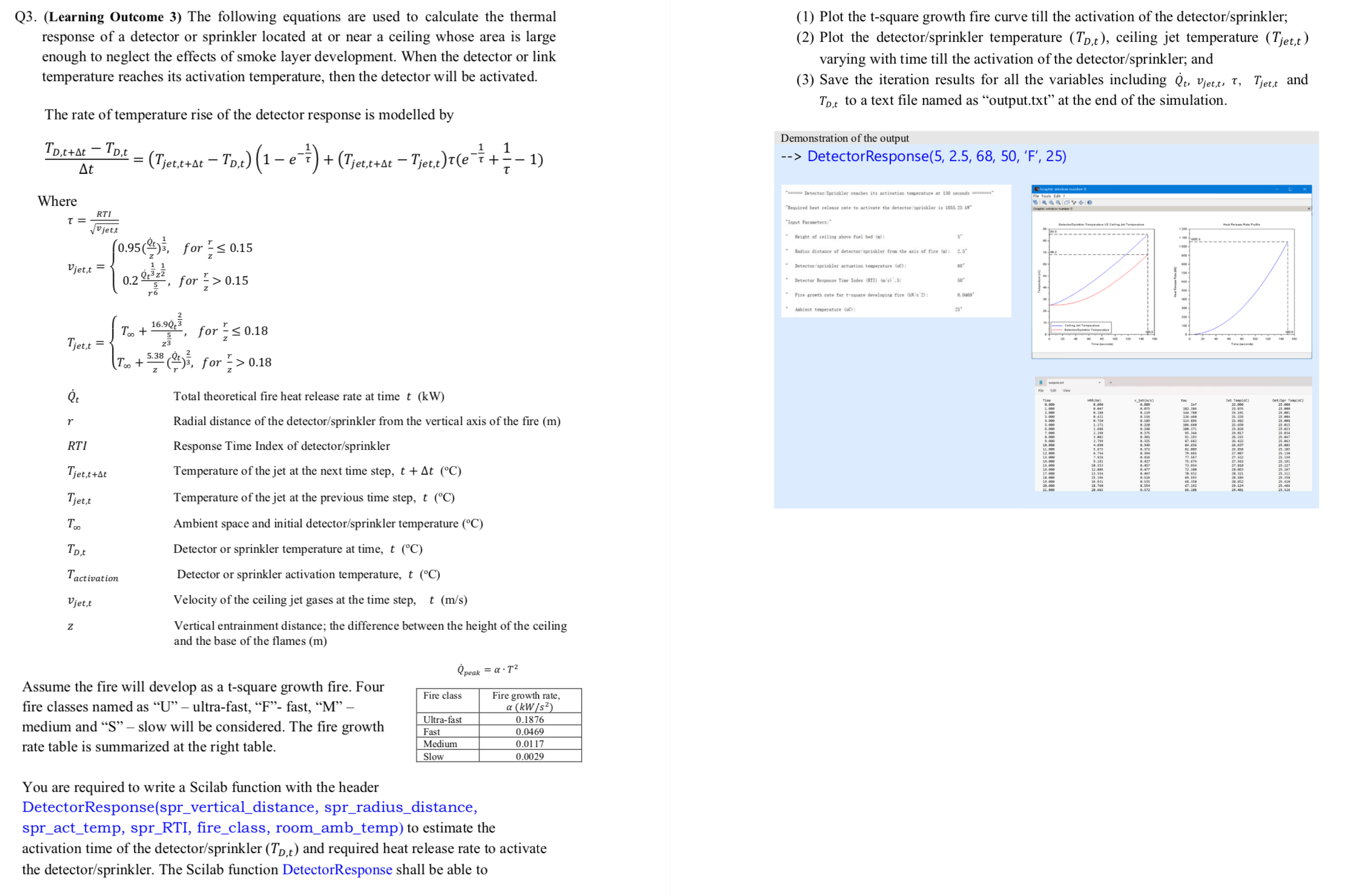
Question: Q 3 . You are required to write a Scilab function with the header DetectorResponse ( spr _ vertical _ distance, spr _ radius _
Q You are required to write a Scilab function with the header
DetectorResponsesprverticaldistance, sprradiusdistance,
spracttemp, sprRTI, fireclass, roomambtemp to estimate the
activation time of the detectorsprinkler TDt and required heat release rate to activate the detectorsprinkler The Scilab function DetectorResponse shall be able to
Plot the tsquare growth fire curve till the activation of the detectorsprinkler;
Plot the detectorsprinkler temperature TDt ceiling jet temperature Tjett varying with time till the activation of the detectorsprinkler; and
Save the iteration results for all the variables including Qtvjetttau Tjett and TDt to a text file named as "output.txt at the end of the simulation.
The following equations are used to calculate the thermal response of a detector or sprinkler located at or near a ceiling whose area is large enough to neglect the effects of smoke layer development. When the detector or link temperature reaches its activation temperature, then the detector will be activated.
The rate of temperature rise of the detector response is modelled by
Where
for
for
Total theoretical fire heat release rate at time
Radial distance of the detectorsprinkler from the vertical axis of the fire m
RTI Response Time Index of detectorsprinkler
Temperature of the jet at the next time step,
Temperature of the jet at the previous time step,
Ambient space and initial detectorsprinkler temperature
Detector or sprinkler temperature at time,
Detector or sprinkler activation temperature,
Velocity of the ceiling jet gases at the time step,
Z
Vertical entrainment distance; the difference between the height of the ceiling
and the base of the flames m
Assume the fire will develop as a tsquare growth fire.
Four fire classes named as U ultrafast, F fast, M
medium and S slow will be considered. The fire growth
rate table is summarized at the right table.
Ultrafast
Fast
Medium
Slow
Step by Step Solution
There are 3 Steps involved in it
1 Expert Approved Answer
Step: 1 Unlock

Question Has Been Solved by an Expert!
Get step-by-step solutions from verified subject matter experts
Step: 2 Unlock
Step: 3 Unlock