







Question: Q 4 . ( a ) Consider a set of randomly generated integer data whose cardinality is high ( 2 2 0 ) . Justify
Qa Consider a set of randomly generated integer data whose cardinality is high
Justify which algorithm will be appropriate to arrange this data in order with a proper time
complexity analysis. Provide a pseudocode of i data generation and ii your algorithm.
b Suppose you want to find out whether an integer is present in the above data. Justify which
algorithm will be appropriate to achieve this goal with a proper timecomplexity analysis.
Provide a pseudocode of your algorithm.
c Examine whether a nonlinear data structure can be used to perform the task in a Q Construct two strings and The string should contain the first three characters of your
firstname followed by "ETCE". The string Y should contain "ETCE" followed by the last three
characters of your lastname. Clearly show and Find i a longest common subsequence of
and and ii a longest common substring of and In both the cases, you should show the
recursive solution and appropriate table. Analyze the timecomplexity of your solutions.
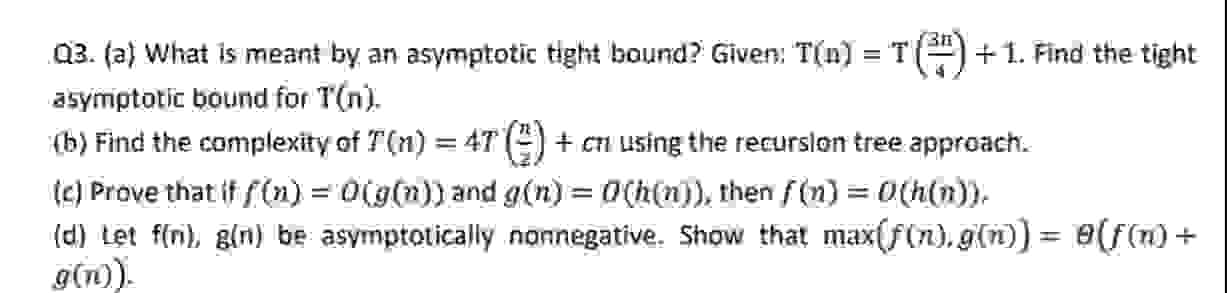
Showing pseudocode is not compulsory but can be of help for the construction of the tables.Qa What is meant by an asymptotic tight bound? Given: Find the tight
asymptotic bound for
b Find the complexity of using the recurslon tree approach.
c Prove that if and then
d Let be asymptotically nomegative. Show that max
Step by Step Solution
There are 3 Steps involved in it
1 Expert Approved Answer
Step: 1 Unlock

Question Has Been Solved by an Expert!
Get step-by-step solutions from verified subject matter experts
Step: 2 Unlock
Step: 3 Unlock
 Study Help