







Question: Q . 4 Case study Pepsi Next was launched by PepsiCo into the US market in February 2 0 1 2 , and has since
Q Case study
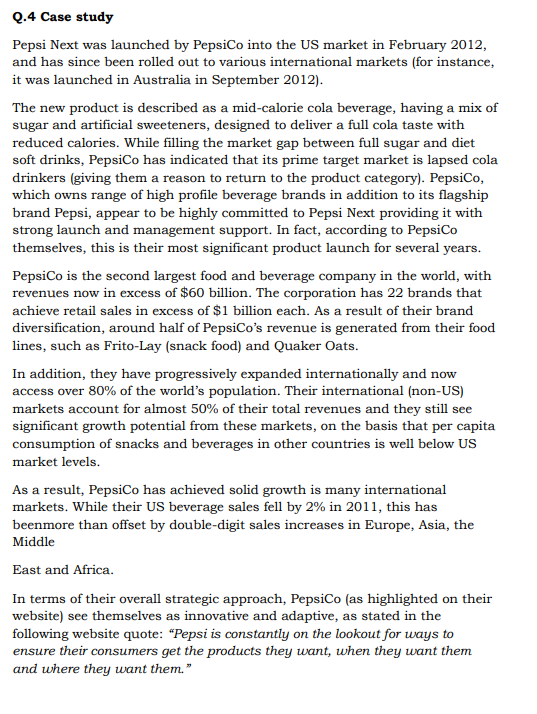
Pepsi Next was launched by PepsiCo into the US market in February
and has since been rolled out to various international markets for instance,
it was launched in Australia in September
The new product is described as a midcalorie cola beverage, having a mix of
sugar and artificial sweeteners, designed to deliver a full cola taste with
reduced calories. While filling the market gap between full sugar and diet
soft drinks, PepsiCo has indicated that its prime target market is lapsed cola
drinkers giving them a reason to return to the product category PepsiCo,
which owns range of high profile beverage brands in addition to its flagship
brand Pepsi, appear to be highly committed to Pepsi Next providing it with
strong launch and management support. In fact, according to PepsiCo
themselves, this is their most significant product launch for several years.
PepsiCo is the second largest food and beverage company in the world, with
revenues now in excess of $ billion. The corporation has brands that
achieve retail sales in excess of $ billion each. As a result of their brand
diversification, around half of PepsiCo's revenue is generated from their food
lines, such as FritoLay snack food and Quaker Oats.
In addition, they have progressively expanded internationally and now
access over of the world's population. Their international nonUS
markets account for almost of their total revenues and they still see
significant growth potential from these markets, on the basis that per capita
consumption of snacks and beverages in other countries is well b Q Case atudy
A new report releaaed by AIM Respirch and Haraal Cequity studies how and
to what extent crgoniaations in India leverage behavioural scierser and data
science to analyse consumes behaviour acrusa differemt induatries abs
functions.
The report titled "Impact of Behavioural Science and Data Seience on
Consumer Behuwiour" also dives into the coninection between behavioural
asd data science in comperhending conaumer behaviour send makes a case
for their use in enllsboration.
Dath scitscr has apen increasing popularity in the laat couple of years ass
ia uaed extensivel by moat organiaationa to identify gruwth drivera. While
data is a critical input to improve cuatomer satisfaction and ibcrease
revenues, Behavioural Seirser pling a crucial role in aturying and andlyxing
customer experiencex, brand boyalty, and overall coetaumer journey.
According to the atudy, there is limited use of Rehavioural Science
techrizques by Isdian organisations to study buying behasiour. Around one
in five respondenta said they had none or nare utiliantion, indicating a
significamt seope for improvements acreas certain ibduxtrica asd functions,
e report peuvides detailed inaighta through a compreberaive analyais of
the survey. The atudy highlights clata where the utilisation of Rehavioural
Seience could see impreved outeomes if two fursetions within the aume
compinny warked sogether. Along with this, the study identifies areas in
which Behavioural Scirscr and Data Seitrsee can be used in conjunction.
The study can be used by leatiera or decisionmabers to get insight into
where their comphatita stand in utilising Behavioural Seserscta compared to
others and rewliae areas where they are falling behisd. The study also helpe
its rebeders identify future roudmaps in terms of using. Behavioural Science
along with Data Sciesce to their atvientage.
Overall, almost every Behavioural Science techrique aurveyed had more
thans two in five respondenta agrecing to ita highvery high utiliantion.
Although, almost every technique also hid more than who said they
had none or rare utilisation. Rezapondenta in the marketing fusetion had
higber utilisation of moot Behavioural Science techriaques surveyed than all
the other functions. Amsoat every technique had move thanaround two in
three Marketing respondenta, saying, that they have a highvery high
utilisiation.
In terms of industry, different sectors had the higheat share of respondents
claiming they have a highvery high utiliaation of different Bethavioural
Seience techniques. However, Telecom a Merlia consistently performet
wellalmoat every technique had more than of of Telerom & Media
reapondents anying yta to utiliaing it to a highvery high extent.
Queation:
Write the factors that influersee the behavior of an individual.
Diacusa about the situation how behaviour acience deals with consumer
behavior.
Step by Step Solution
There are 3 Steps involved in it
1 Expert Approved Answer
Step: 1 Unlock

Question Has Been Solved by an Expert!
Get step-by-step solutions from verified subject matter experts
Step: 2 Unlock
Step: 3 Unlock
 Study Help