







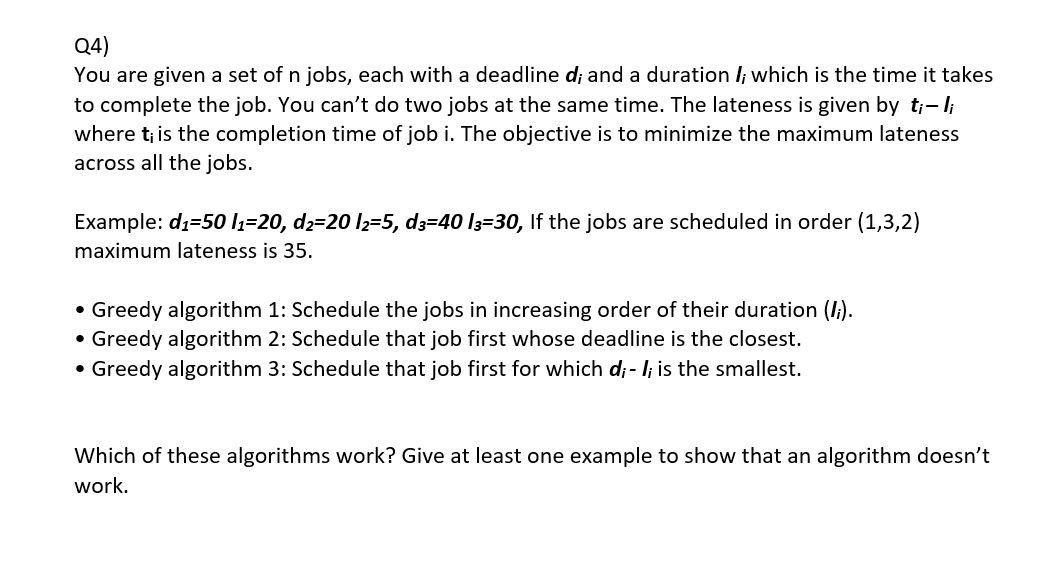
Question: Q 4 d _ ( i ) and a duration I _ ( i ) which is the time it takes to complete the job.
Qdi and a duration Ii which is the time it takes
to complete the job. You can't do two jobs at the same time. The lateness is given by tili
where ti is the completion time of job i The objective is to minimize the maximum lateness
across all the jobs.
Example: dIdIdI If the jobs are scheduled in order
maximum lateness is
Greedy algorithm : Schedule the jobs in increasing order of their duration li
Greedy algorithm : Schedule that job first whose deadline is the closest.
Greedy algorithm : Schedule that job first for which di Ii is the smallest.
Which of these algorithms work? Give at least one example to show that an algorithm doesn't
work.
Step by Step Solution
There are 3 Steps involved in it
1 Expert Approved Answer
Step: 1 Unlock

Question Has Been Solved by an Expert!
Get step-by-step solutions from verified subject matter experts
Step: 2 Unlock
Step: 3 Unlock
 Study Help