







Question: Q 5 - 7 : Determining fluid flow through pipes and tubes has great relevance in many areas of engineering and science. In engineering, typical
Q : Determining fluid flow through pipes and tubes has great relevance in many areas of engineering and science. In engineering, typical applications include the flow of liquids and gases through cooling systems.
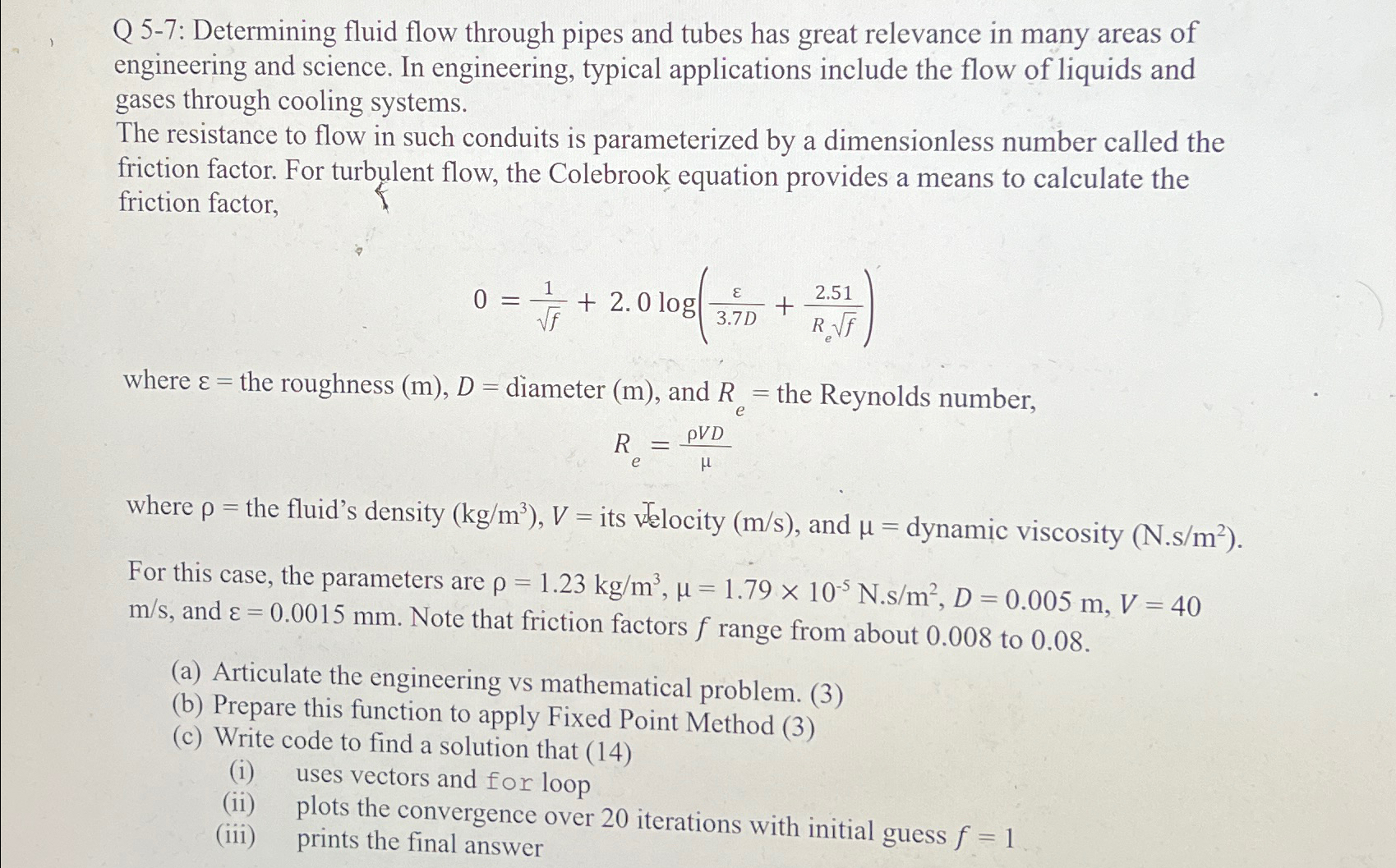
The resistance to flow in such conduits is parameterized by a dimensionless number called the friction factor. For turbulent flow, the Colebrook equation provides a means to calculate the friction factor,
where the roughness diameter and the Reynolds number,
where the fluid's density its velocity and dynamic viscosity
For this case, the parameters are and Note that friction factors range from about to
a Articulate the engineering vs mathematical problem.
b Prepare this function to apply Fixed Point Method
c Write code to find a solution that
i uses vectors and for loop
ii plots the convergence over iterations with initial guess
iii prints the final answer
Step by Step Solution
There are 3 Steps involved in it
1 Expert Approved Answer
Step: 1 Unlock

Question Has Been Solved by an Expert!
Get step-by-step solutions from verified subject matter experts
Step: 2 Unlock
Step: 3 Unlock
 Study Help