



Question: Q 5 In clothing, moreover, M&S faces problems that cannot be solved simply by improving its fashion judgments. Research indicates that overall demand for clothing
Q
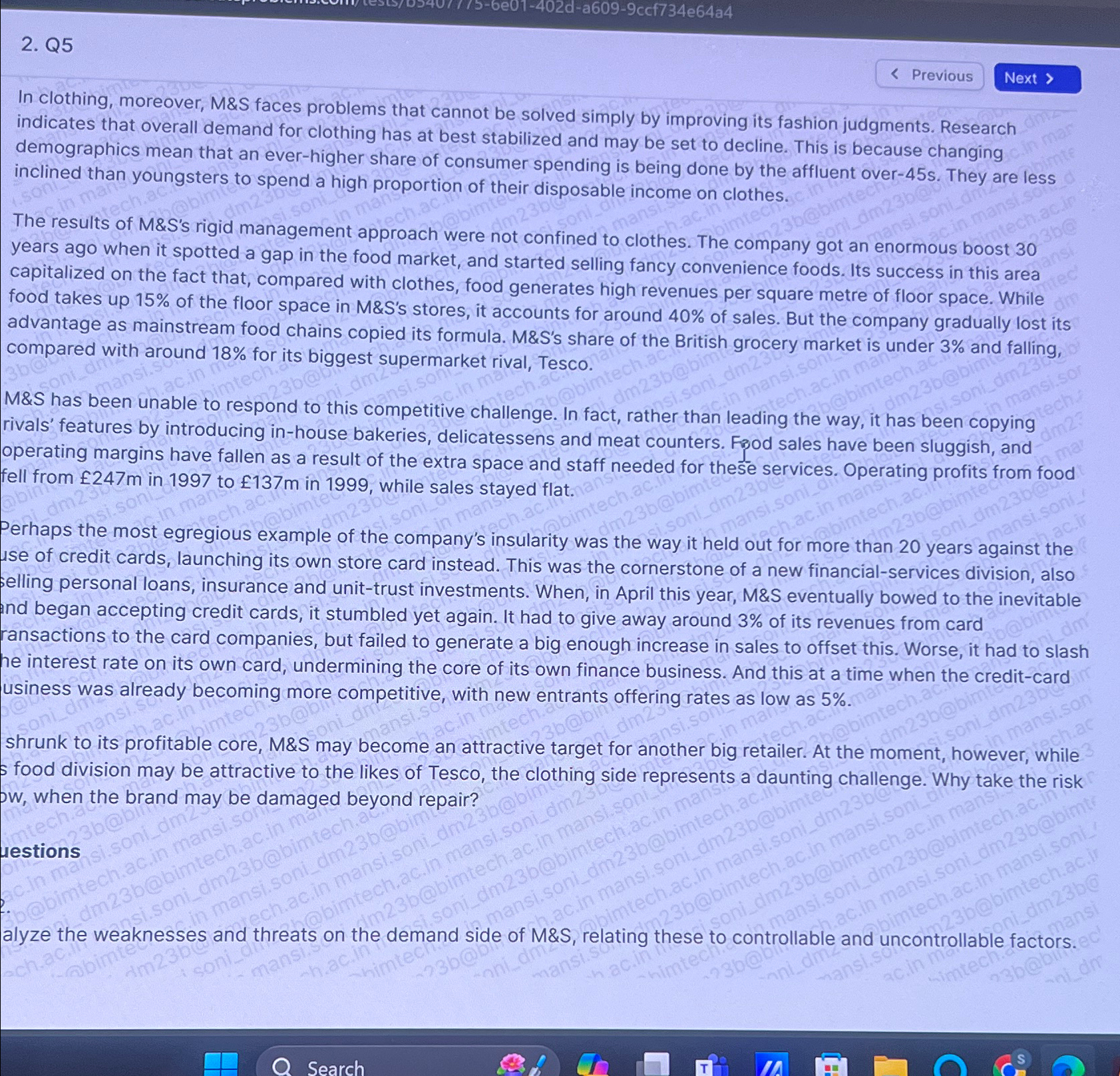
In clothing, moreover, M&S faces problems that cannot be solved simply by improving its fashion judgments. Research indicates that overall demand for clothing has at best stabilized and may be set to decline. This is because changing demographics mean that an everhigher share of consumer spending is being done by the affluent over They are less inclined than youngsters to spend a high proportion of their disposable income on clothes.
The results of M&Ss rigid management approach were not confined to clothes. The company got an enormous boost years ago when it spotted a gap in the food market, and started selling fancy convenience foods. Its success in this area capitalized on the fact that, compared with clothes, food generates high revenues per square metre of floor space. While food takes up of the floor space in M&Ss stores, it accounts for around of sales. But the company gradually lost its advantage as mainstream food chains copied its formula. M&Ss share of the British grocery market is under and falling, compared with around for its biggest supermarket rival, Tesco.
M&S has been unable to respond to this competitive challenge. In fact, rather than leading the way, it has been copying rivals' features by introducing inhouse bakeries, delicatessens and meat counters. Food sales have been sluggish, and operating margins have fallen as a result of the extra space and staff needed for these services. Operating profits from food fell from in to in while sales stayed flat.
Perhaps the most egregious example of the company's insularity was the way it held out for more than years against the use of credit cards, launching its own store card instead. This was the cornerstone of a new financialservices division, also selling personal loans, insurance and unittrust investments. When, in April this year, M&S eventually bowed to the inevitable and began accepting credit cards, it stumbled yet again. It had to give away around of its revenues from card ransactions to the card companies, but failed to generate a big enough increase in sales to offset this. Worse, it had to slash he interest rate on its own card, undermining the core of its own finance business. And this at a time when the creditcard usiness was already becoming more competitive, with new entrants offering rates as low as
shrunk to its profitable core, M&S may become an attractive target for another big retailer. At the moment, however, while s food division may be attractive to the likes of Tesco, the clothing side represents a daunting challenge. Why take the risk pw when the brand may be damaged beyond repair?
uestions
alyze the weaknesses and threats on the demand side of M&S relating these to controllable and uncontrollable factors.
Step by Step Solution
There are 3 Steps involved in it
1 Expert Approved Answer
Step: 1 Unlock

Question Has Been Solved by an Expert!
Get step-by-step solutions from verified subject matter experts
Step: 2 Unlock
Step: 3 Unlock