







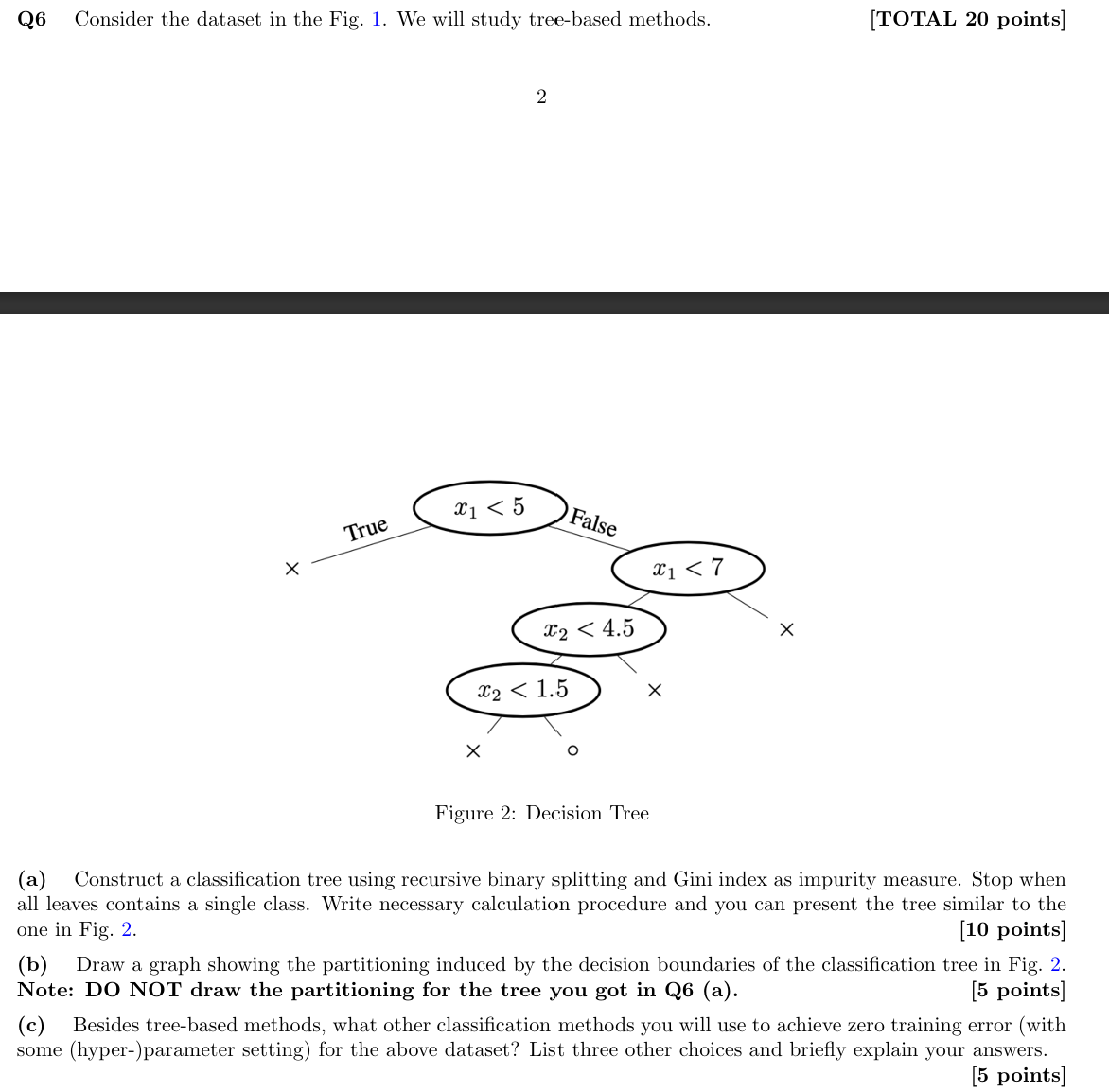
Question: Q 6 Consider the dataset in the Fig. 1 . We will study tree - based methods. Figure 2 : Decision Tree Is x 1
Q Consider the dataset in the Fig. We will study treebased methods.
Figure : Decision Tree
Is xxx
Yes xxx:
Outcome: timescross mark
No xxgeq x:
Is xxx
Yes xxx:
Is xxx
Yes xxx:
Is xxx
Yes xxx: Outcome: circcircle mark No xxgeq x: Outcome: timescross mark
No xxgeq x: Outcome: timescross mark
No xxgeq x: Outcome: timescross mark
a Construct a classification tree using recursive binary splitting and Gini index as impurity measure. Stop when all leaves contains a single class. Write necessary calculation procedure and you can present the tree similar to the one in Fig.
b Draw a graph showing the partitioning induced by the decision boundaries of the classification tree in Fig. Note: DO NOT draw the partitioning for the tree you got in Qa
c Besides treebased methods, what other classification methods you will use to achieve zero training error with some hyperparameter setting for the above dataset? List three other choices and briefly explain your answers.
Step by Step Solution
There are 3 Steps involved in it
1 Expert Approved Answer
Step: 1 Unlock

Question Has Been Solved by an Expert!
Get step-by-step solutions from verified subject matter experts
Step: 2 Unlock
Step: 3 Unlock
 Study Help